The Bright Blue Origin: Blue Origin Gears Up for West Coast Launches and Lunar Permanence
Blue In The News
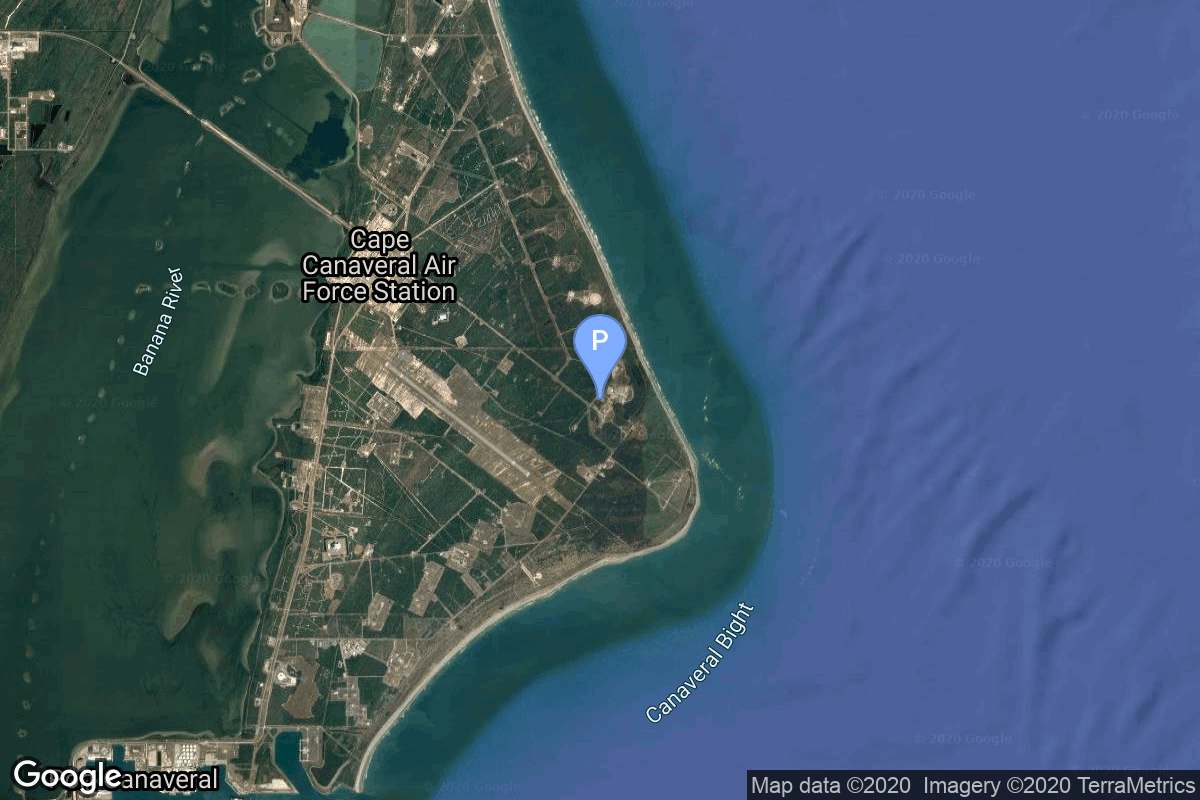
Blue Origin has taken a significant step toward expanding its launch footprint beyond Florida, with the U.S. Space Force selecting the company to enter final negotiations for a lease at Space Launch Complex (SLC)-14 at Vandenberg Space Force Base in California. Announced on April 14, 2026, this move aims to establish heavy and super-heavy launch capabilities on the West Coast, enhancing national security through greater launch resilience and flexibility.
According to Col. James Horn III, commander of Space Launch Delta, the decision was driven by Blue Origin’s technical maturity and the readiness of its New Glenn launch vehicle. “New Glenn brings critical capability,” he said, noting that the Space Force’s primary consideration remains national security. While no firm launch date has been set, Horn estimated that establishing a new launch site typically takes about two years. Before construction begins, Blue Origin must complete an environmental impact assessment—a standard but essential step in responsible development.
This West Coast expansion complements Blue Origin’s ongoing work on lunar infrastructure. The company is actively developing in-situ resource utilization (ISRU) technology under its “Air Pioneer” system, designed to extract oxygen from lunar regolith for breathable air, fuel cells, and propellant. Recent tweets from Blue Origin’s official account (April 13 and April 7) showcased successful testing of reactor and purification systems at its Space Resources Center of Excellence, highlighting progress toward “Lunar Permanence”—a vision of sustained human presence on the Moon.
Meanwhile, a second Blue Moon MK1 lunar lander is moving through production at Lunar Plant 1 in Florida, with its aft module and cryogenic tanks in assembly. The BE-7 engine—key to powering these landers—recently completed acceptance testing and was shipped to the same facility, underscoring Blue Origin’s methodical build-up for its Artemis III and beyond commitments.

Bright Blue Updates
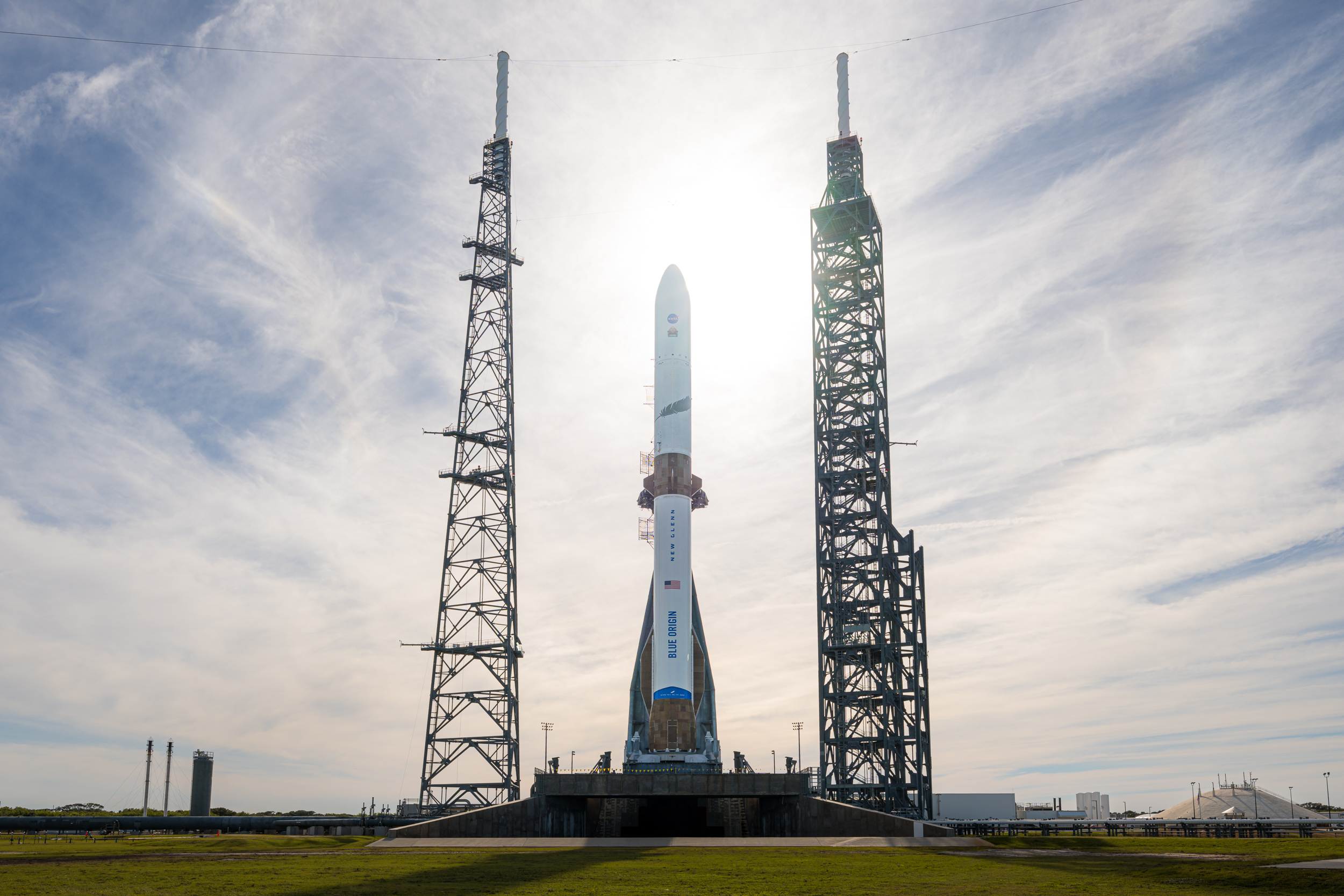
Blue Origin’s New Glenn rocket is preparing for its third flight (NG-3), which has not yet launched as of April 15, 2026. The company conducted a successful launch rehearsal on April 14 and is targeting a hotfire test for the fully integrated vehicle on Wednesday, April 15—the same day as this report. If successful, this paves the way for an upcoming launch carrying AST SpaceMobile’s BlueBird 7 satellite.
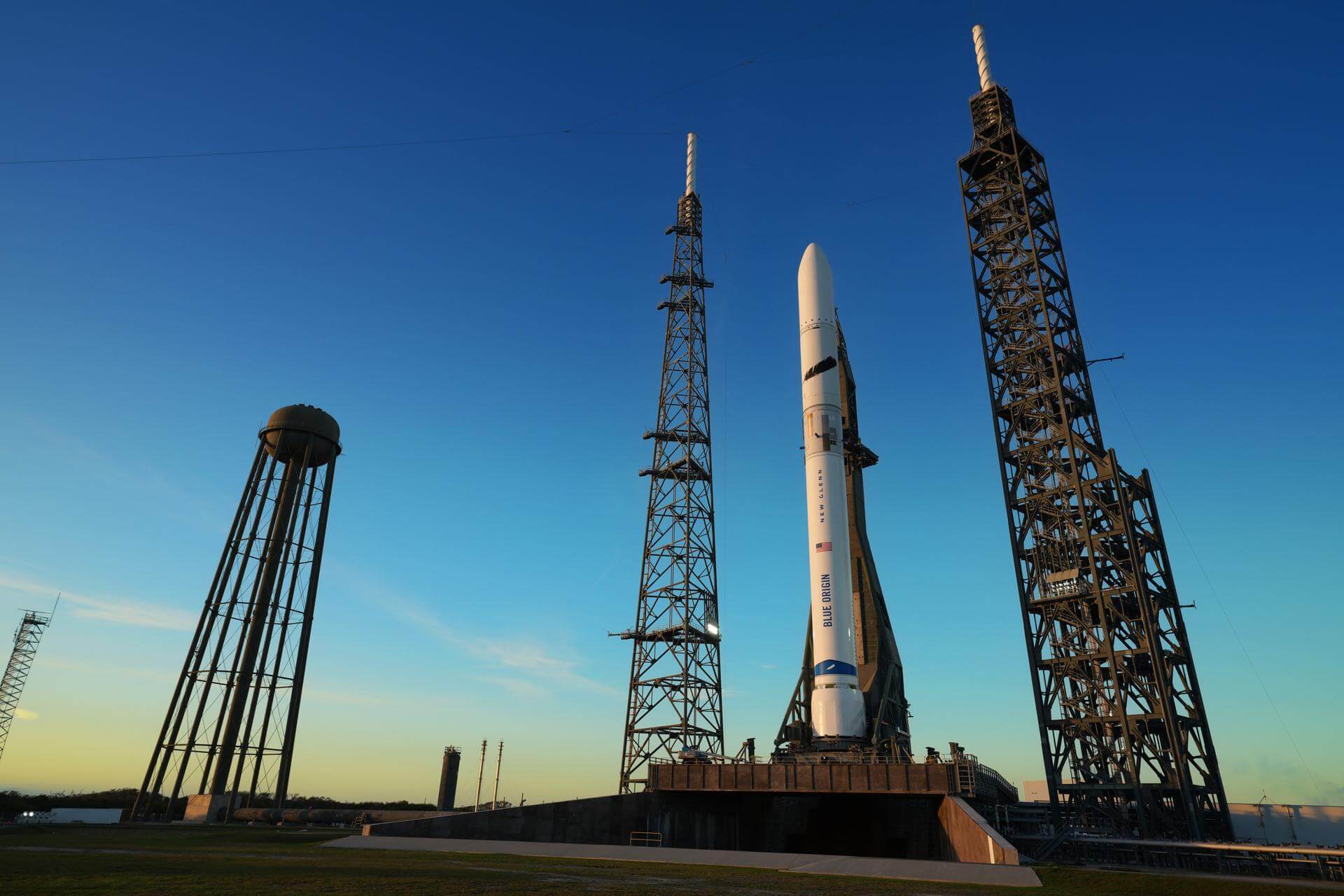
The NG-3 mission will mark a milestone: it will be the first New Glenn flight to reuse a booster. Dubbed “Never Tell Me The Odds,” this first-stage booster previously flew on NG-2 and has since undergone refurbishment. According to CEO Dave Limp’s April 13 tweet, the team replaced all seven BE-4 engines and tested upgrades, including a new thermal protection system on one engine nozzle. The booster has now been integrated with the upper stage and payload at Launch Complex 36 in Cape Canaveral.
While the exact launch date for NG-3 remains unconfirmed, Blue Origin had previously indicated a target of “no earlier than April 10.” Given the hotfire is scheduled for April 15, the launch will occur sometime after that—pending successful testing and regulatory approvals. This mission is particularly important as it’s Blue Origin’s first dedicated commercial flight and a critical demonstration of booster reusability.
Looking further ahead, Blue Origin’s role in Amazon’s Leo constellation looms large. Though New Glenn has not yet launched any Amazon satellites, the rocket is expected to carry 48 or more per mission once operational. Amazon confirmed on April 14 that inaugural Leo missions on both New Glenn and ULA’s Vulcan are “stacked and ready,” though neither vehicle has flown a Leo payload as of mid-April 2026.

The Internet Of Amazon
While Blue Origin prepares to enter the launch services arena in earnest, its corporate sibling Amazon is accelerating deployment of its Leo satellite broadband constellation. As of April 4, 2026, Amazon has successfully launched 241 satellites—most recently 29 aboard a ULA Atlas V rocket, the heaviest payload ever carried by that vehicle. However, the company remains far short of the 1,616 satellites required by its FCC deadline of July 30, 2026, and has formally requested a two-year extension.
Future Leo missions are scheduled with increasing frequency: an Atlas V launch is planned for April 27, followed by an Ariane 64 mission on April 28 carrying 32 satellites. Blue Origin’s New Glenn is expected to join this cadence later this year, though no specific launch date has been announced. Amazon emphasized in a March 23 blog post that New Glenn will be key to achieving its goal of more than 20 launches annually in the constellation’s second year.

Blue Side Projects
In a bold move that signals long-term ambition beyond launch services, Blue Origin has entered the burgeoning orbital data centre market. On March 19, 2026, the company filed an application with the U.S. Federal Communications Commission (FCC) for “Project Sunrise”—a proposed constellation of up to 51,600 satellites operating in sun-synchronous orbits between 500 and 1,800 kilometres altitude.
According to Blue Origin, Project Sunrise would provide in-space computing for artificial intelligence workloads, leveraging the continuous solar power available in orbit and eliminating terrestrial constraints like land use and grid infrastructure. The satellites would primarily link via optical intersatellite connections to Blue Origin’s previously announced TeraWave broadband constellation. While the company did not disclose a deployment timeline, it requested a waiver from standard FCC milestone rules, arguing that since it’s seeking non-interference access to Ka-band spectrum, there’s no risk of “warehousing” valuable frequencies.
This filing places Blue Origin in direct competition with SpaceX (which proposed up to one million orbital data centre satellites) and startup Starcloud (88,000 satellites). Blue Origin welcomed this competition, stating in its FCC filing that “the demand for space-based compute power is growing” and that market diversity will “catalyze advancements in technology and resource efficiency.”
Citations
- “Blue Origin moves toward launch at Vandenberg” – https://spacenews.com/blue-origin-moves-toward-launch-at-vandenberg/
- “Blue Origin joins the orbital data center race” – https://spacenews.com/blue-origin-joins-the-orbital-data-center-race/
- “Atlas 5 launches Amazon Leo satellites” – https://spacenews.com/atlas-5-launches-amazon-leo-satellites/
- “Amazon Leo targets faster deployment cadence as deadline pressure mounts” – https://spacenews.com/amazon-leo-targets-faster-deployment-cadence-as-deadline-pressure-mounts/
BlueBird Block 2 #2
Provider: Blue Origin
Date: April 18, 2026
Time: 10:45 AM UTC
Vehicle: New Glenn
AST SpaceMobile’s Block 2 BlueBird satellites are designed to deliver up to 10 times the bandwidth capacity of the BlueBird Block 1 satellites, required to achieve 24/7 continuous cellular broadband service coverage in the United States, with beams designed to support a capacity of up to 40 MHz, enabling peak data transmission speeds up to 120 Mbps, supporting voice, full data and video applications. The Block 2 BlueBirds, featuring as large as 2400 square foot communications arrays, will be the largest satellites ever commercially deployed in Low Earth orbit once launched.
This launch will feature 1 satellite, BlueBird 7/BlueBird Block 2 FM2.
Amazon Leo (New Glenn #1)
Provider: Blue Origin
Date: December 31, 2026
Time: 12:00 AM UTC
Vehicle: New Glenn
Amazon Leo, formerly known as Project Kuiper, is a mega constellation of satellites in Low Earth Orbit that will offer broadband internet access, this constellation will be managed by Kuiper Systems LLC, a subsidiary of Amazon. This constellation is planned to be composed of 3,276 satellites. The satellites are projected to be placed in 98 orbital planes in three orbital layers, one at 590 km, 610 km and 630 km altitude.
61 satellites will be carried on each New Glenn launch.
BlueBird Block 2 #4
Provider: Blue Origin
Date: December 31, 2026
Time: 12:00 AM UTC
Vehicle: New Glenn
AST SpaceMobile’s Block 2 BlueBird satellites are designed to deliver up to 10 times the bandwidth capacity of the BlueBird Block 1 satellites, required to achieve 24/7 continuous cellular broadband service coverage in the United States, with beams designed to support a capacity of up to 40 MHz, enabling peak data transmission speeds up to 120 Mbps, supporting voice, full data and video applications. The Block 2 BlueBirds, featuring as large as 2400 square foot communications arrays, will be the largest satellites ever commercially deployed in Low Earth orbit once launched.
This launch will feature 8 satellites.
Blue Moon Pathfinder
Provider: Blue Origin
Date: December 31, 2026
Time: 12:00 AM UTC
Vehicle: New Glenn
First flight of Blue Origin’s Blue Moon MK1 lunar lander, MK1-SN001 “Endurance”.
Blue Moon Pathfinder Mission 2 & VIPER
Provider: Blue Origin
Date: December 31, 2027
Time: 12:00 AM UTC
Vehicle: New Glenn
2nd of the National Team’s Blue Moon MK1 lunar lander test missions to validate the necessary technologies for its HLS lunar module. Some of the life support hardware will travel on this mission in preparation for the first crew Blue Moon flight.
This mission will also carry NASA’s VIPER (Volatiles Investigating Polar Exploration Rover) lunar rover. VIPER is designed to explore the relatively nearby but extreme environment of the Moon in search of ice and other potential resources. This mobile robot will land at the South Pole of the Moon on a 100-day mission, in order to teach us about the origin and distribution of water on the Moon and help determine how we can harvest the Moon’s resources for future human space exploration.
VIPER is designed to roam the Moon using its three instruments and a 1 meter long drill to detect and analyze various lunar soil environments at a range of depths and temperatures. The rover can venture into permanently shadowed craters, some of the coldest spots in the solar system, where ice reserves have endured for billions of years.
The rover was originally slated to launch on Astrobotic’s Griffin Mission One lunar lander (with the Falcon Heavy rocket), but the VIPER mission was cancelled in July 2024 due to budget cuts. After consulting with the industry to find alternative ways to deliver the rover to the lunar surface, NASA ultimately chose to launch it with Blue Origin’s 2nd Blue Moon MK1 lander mission.