
New Glenn Return 2026; Blue Origin Expands Texas
LC-36 Rebuild Nears Completion for New Glenn Return
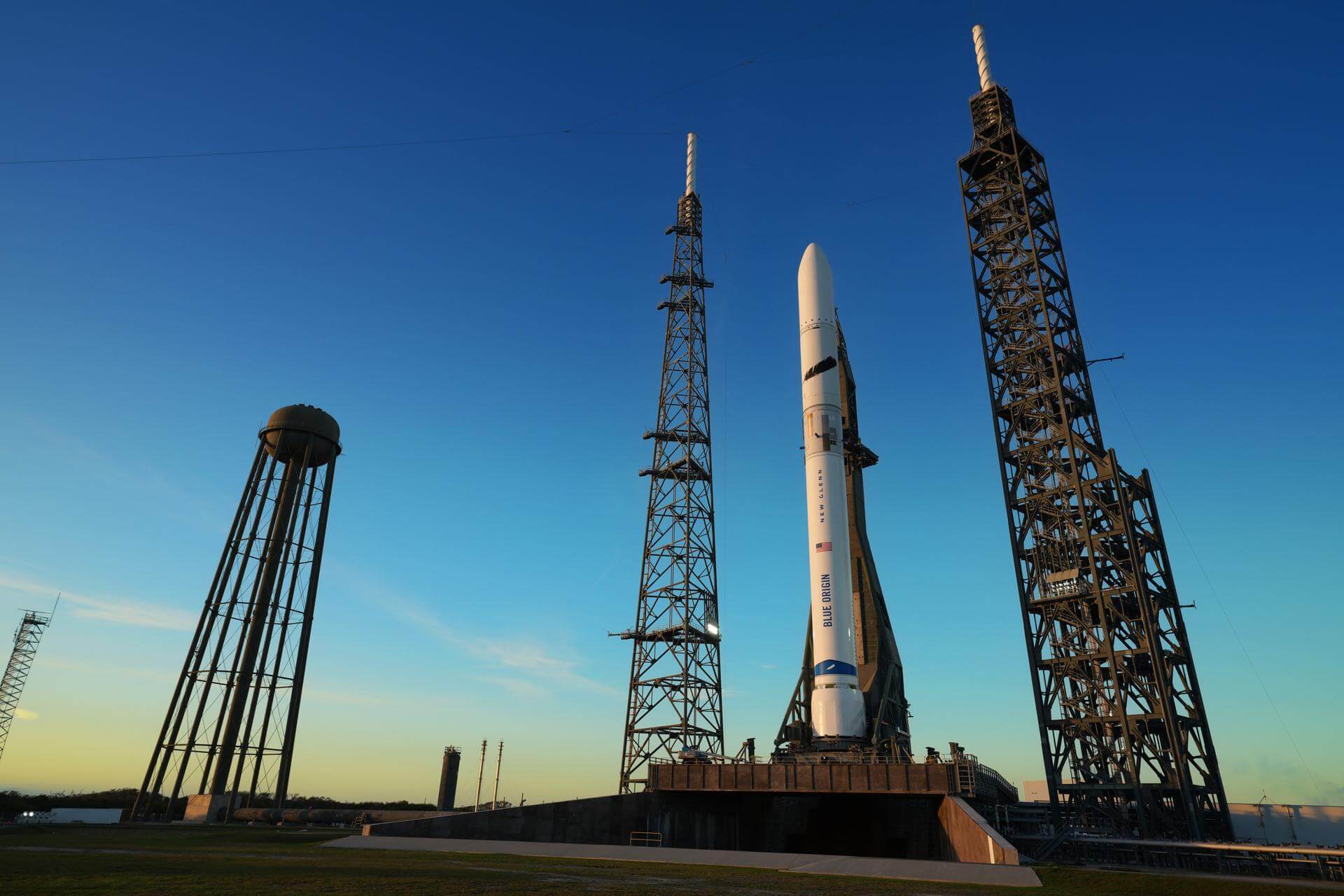
Four months after New Glenn’s launch-pad explosion in June, Blue Origin is accelerating pad reconstruction and targeting a December return to flight. The company’s focus is on Launch Complex-36 (LC-36), where the support tower, lightning tower, launch bridge, and mounting hardware all sustained severe damage.

Blue Origin has shifted from a traditional horizontal-integration approach—which relied on a large transporter-erector to supply propellants to the vehicle on the pad—to vertical integration, mirroring SpaceX’s Starship approach. Under the new plan, the support tower is being upgraded to supply super-cold cryogenic propellant directly to the rocket. To speed the work, the team destacked the tower’s modules, repaired and upgraded them on the ground in parallel, then reassembled them in place, adding new floors, guard rails, and ground support equipment for worker access and cryo transfer.
As of mid-October, the first and second modules have returned to the tower. According to CEO Dave Limp, the launch bridge—a large slab of metal and concrete that supports the rocket and provides ground interfaces—has been restored and is ready for use, with most of the structure salvaged. The main water piping has been reinstalled, and the two rainbirds (water-deluge nozzles that protect ground infrastructure from the force of Blue Origin’s seven BE-4 engines) are in place.

Pad reconstruction has reached a visible turning point, though much of the new equipment for vertical integration—such as umbilical connections and rotating worker-access platforms—has not yet arrived on-site. In an interview with Fox News, Blue Origin founder Jeff Bezos said the company is targeting December for the return-to-flight mission, which will carry a Blue Ring spacecraft. He noted, jokingly, that the date could end up being December 31st.

Constellation Park: 1.3 Million Square Feet of Manufacturing
Blue Origin is expanding its Texas footprint with Constellation Park, a new 1.3-million-square-foot multi-facility manufacturing complex in Hutto, Texas. The campus will serve as a production hub for TeraWave, the company’s satellite communications network delivering up to 6 terabits per second of symmetrical data anywhere on Earth, and Quartz, a global ground communications network of large-aperture antennas.

The facility will also manufacture key Blue Origin subsystems, including solar arrays, avionics, telecommunications hardware, and other satellite components. The expansion will add over 2,000 manufacturing and related jobs over the next 10 years, strengthening Texas’s aerospace industry. Blue Origin’s roots in Texas date back to 2006 with the establishment of Launch Site One; the company currently employs more than 550 people in the state.
CEO Dave Limp said: “Texas has long understood what it takes to lead in space exploration. We’re proud to grow our footprint here in Texas, tap into the world-class talent this state has to offer, and help ensure America remains the leader in space innovation.”
New Glenn Officially Added to NASA Launch Services
NASA has added Blue Origin’s New Glenn 9×4 launch service to the NASA Launch Services (NLS) II contract through an annual on-ramp provision. The NLS II contracts are multiple-award, indefinite-delivery/indefinite-quantity agreements with an ordering period through June 2030 and an overall period of performance through December 2032. Under the contract, NASA can also provide launch services to other government agencies, such as the National Oceanic and Atmospheric Administration.
The addition positions New Glenn as an available option for NASA’s Human Spaceflight Mission Directorate, Science Mission Directorate, and Research and Technology Mission Directorate missions.
Blue Moon Carries European Rover to Lunar South Pole
Belgium’s Space Applications Services has secured a payload slot aboard Blue Origin’s Blue Moon Mark 1 lunar lander for its LUVMI-M rover. The mission is on track to become Europe’s first fully commercial lunar rover mission, with a launch target of early 2029—more than a year later than the company’s previous target of Q4 2027.
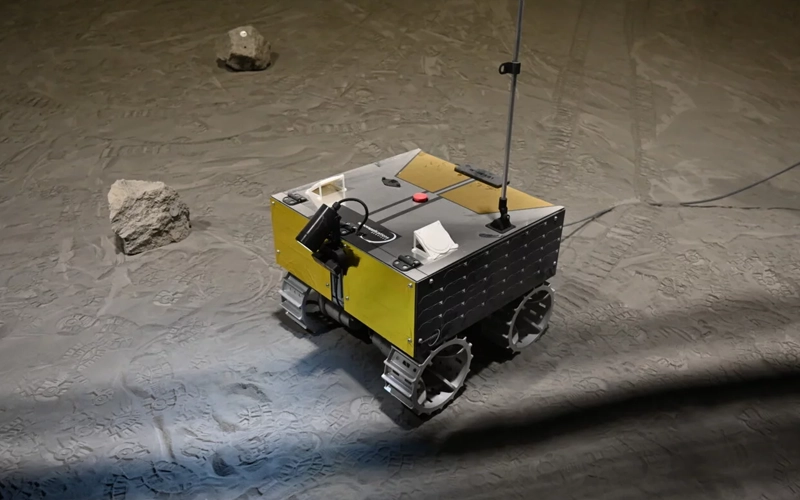
The LUVMI-M rover, weighing approximately 20 kilograms, can carry up to 20 kilograms of customer payloads. The baseline mission is designed to last between 10 and 14 Earth days, during which the rover is expected to travel up to five kilometres across the lunar surface in the lunar south polar region. Although development of the LUVMI family has benefited from public funding and support from the European Union, ESA, and the Belgian Science Policy Office, the upcoming mission itself is being financed through payload reservations and service contracts with private-sector customers.
Blue Origin Supplies P-Sampler for JAXA Martian Mission
Blue Origin’s Pneumatic Sampler (P-Sampler) is heading to Mars’s moon Phobos aboard JAXA’s Martian Moons eXploration (MMX) spacecraft. The mission is scheduled to launch on October 19 EDT (October 20 Japan Standard Time) from JAXA’s Tanegashima Space Centre in Japan. The P-Sampler is designed to use high-pressure nitrogen gas to collect Phobos regolith and will support the study of Mars’s moons and their origins.

The contribution underscores Blue Origin’s expanding role in planetary science. NASA will hold a media teleconference on October 15 to preview U.S. contributions to the mission, with Kris Zacny, vice president of Blue Origin’s Honeybee Robotics division, participating as a panellist.
VIPER Rover Offload Demonstration Succeeds
Blue Origin and NASA completed a risk-reduction test campaign involving the offloading of NASA’s VIPER rover. Using a VIPER Mobility Ground Research Unit (MGRU), the teams ran a full offload sequence—both nominal and off-nominal scenarios—across the full range of lander tilt angles. The test validated the complete concept of operations, with NASA commanding the rover remotely. Blue Origin’s flight offloader is currently being fabricated.

Citations
- “Blue Origin Advances LC-36 Rebuild for Year-End New Glenn Return to Flight” — https://www.nasaspaceflight.com/2026/10/blue-origin-lc-36-rebuild-new-glenn/
- “NASA Adds Blue Origin New Glenn 9×4 to Launch Services Contract” — https://www.nasa.gov/news-release/nasa-adds-blue-origin-new-glenn-9×4-to-launch-services-contract/
- “European Lunar Rover Secures Spot Aboard Blue Origin Blue Moon Mission” — https://europeanspaceflight.com/european-lunar-rover-secures-spot-aboard-blue-origin-blue-moon-mission/
- “Blue Origin Announces Constellation Park: New Texas Manufacturing Campus and 2,000 Advanced Jobs” — https://www.blueorigin.com/news/blue-origin-announces-new-texas-manufacturing-campus
- “Blue Origin” — https://x.com/blueorigin
- “Dave Limp” — https://x.com/davill
- “Space Events This Week” — https://www.spaceflightnow.com
Blue Ring-1
Provider: Blue Origin
Date: December 31, 2026
Time: 12:00 AM UTC
Vehicle: New Glenn
The first mission of Blue Ring, Blue Origin’s all-in-one, high-powered hybrid solar electric and chemical propelled spacecraft, will test the spacecraft’s operations in Geostationary Transfer Orbit (GTO), as well as subsequent operations after reaching Geostationary Orbit (GEO).
It will carry one of Scout Space’s flagship next-generation space domain awareness (SDA) Owl sensors, which is designed to enhance real-time tracking, characterization, and assessment of space objects by integrating advanced optical sensing, onboard artificial intelligence-driven processing, and autonomous decision-making capabilities to deliver domain-wide intelligence in space in support of the U.S. Space Force’s space control mission set.
Blue Ring will also carry Optimum Technologies (OpTech)’s next-generation Caracal optical payload, which is designed to provide actionable insights on resident space objects and orbital activity and includes onboard image storage, object detection algorithms, and passive thermal control. The payload is designed to operate flexibly across dynamic orbits over a year-long mission profile.
Several internal Blue Origin payloads will also be hosted.
Amazon Leo (LN-01)
Provider: Blue Origin
Date: December 31, 2026
Time: 12:00 AM UTC
Vehicle: New Glenn
Amazon Leo, formerly known as Project Kuiper, is a mega constellation of satellites in Low Earth Orbit that will offer broadband internet access, this constellation will be managed by Kuiper Systems LLC, a subsidiary of Amazon. This constellation is planned to be composed of 3,276 satellites. The satellites are projected to be placed in 98 orbital planes in three orbital layers, one at 590 km, 610 km and 630 km altitude.
48 satellites will be carried on this New Glenn launch.
BlueBird Block 2
Provider: Blue Origin
Date: December 31, 2026
Time: 12:00 AM UTC
Vehicle: New Glenn
AST SpaceMobile’s Block 2 BlueBird satellites are designed to deliver up to 10 times the bandwidth capacity of the BlueBird Block 1 satellites, required to achieve 24/7 continuous cellular broadband service coverage in the United States, with beams designed to support a capacity of up to 40 MHz, enabling peak data transmission speeds up to 120 Mbps, supporting voice, full data and video applications. The Block 2 BlueBirds, featuring as large as 2400 square foot communications arrays, will be the largest satellites ever commercially deployed in Low Earth orbit once launched.
This launch will feature 8 satellites.
Blue Moon Pathfinder
Provider: Blue Origin
Date: March 31, 2027
Time: 12:00 AM UTC
Vehicle: New Glenn
First flight of Blue Origin’s Blue Moon MK1 lunar lander, MK1-SN001 “Endurance”.
Blue Origin HLS LEO Demo
Provider: Blue Origin
Date: June 30, 2027
Time: 12:00 AM UTC
Vehicle: New Glenn
The Blue Moon HLS pathfinder spacecraft in support of NASA’s Artemis III mission in Low Earth Orbit will be a modified Blue Moon Mark 1 vehicle equipped with a docking mechanism, a crew cabin and environmental control systems on board. This Blue Moon HLS will launch before the Artemis III Orion has launched into LEO aboard SLS. Once docked, Orion and Blue Moon will spend about two days docked together for tests and technology demonstrations, with the Artemis III crew scheduled to enter the lander.



Enjoying the content? Stay up to date on everything happening behind the scenes by following our Patreon!


Leave a Reply