
The Bright Blue Origin: New Glenn’s BE-4 valve fix clears return-to-flight path
New Glenn Engine Fix and Return-to-Flight Plan
Blue Origin has identified the root cause of the May 28 New Glenn explosion: an anomaly in the main oxygen valve of one of the BE-4 first-stage engines. CEO Dave Limp announced the finding on August 5, more than two months after the static fire test destroyed the rocket on the pad at Launch Complex 36 and damaged the facility’s infrastructure.

“Extensive component-level and engine hotfire tests have been conducted to understand the failure mode better and inform mitigations,” Limp said in his update. The company has designed small modifications to the valve that can be retrofitted to existing engines. The updated hardware is being manufactured and will be ready by the end of August 2026.
With the fault tree analysis ongoing in parallel, Blue Origin is targeting a return to flight by the end of 2026. New Glenn has completed three orbital flights since its January 2025 debut; the May anomaly marked a significant setback for the company’s heavy-lift vehicle and its critical role in both commercial and government missions.
NASA Stennis Partnership for Upper-Stage Testing
Blue Origin and NASA announced an expanded agreement in late July to conduct second-stage hot-fire testing for New Glenn on the B-2 test stand at NASA’s Stennis Space Center near Bay St. Louis, Mississippi. Testing is targeted to begin in the autumn of 2026.
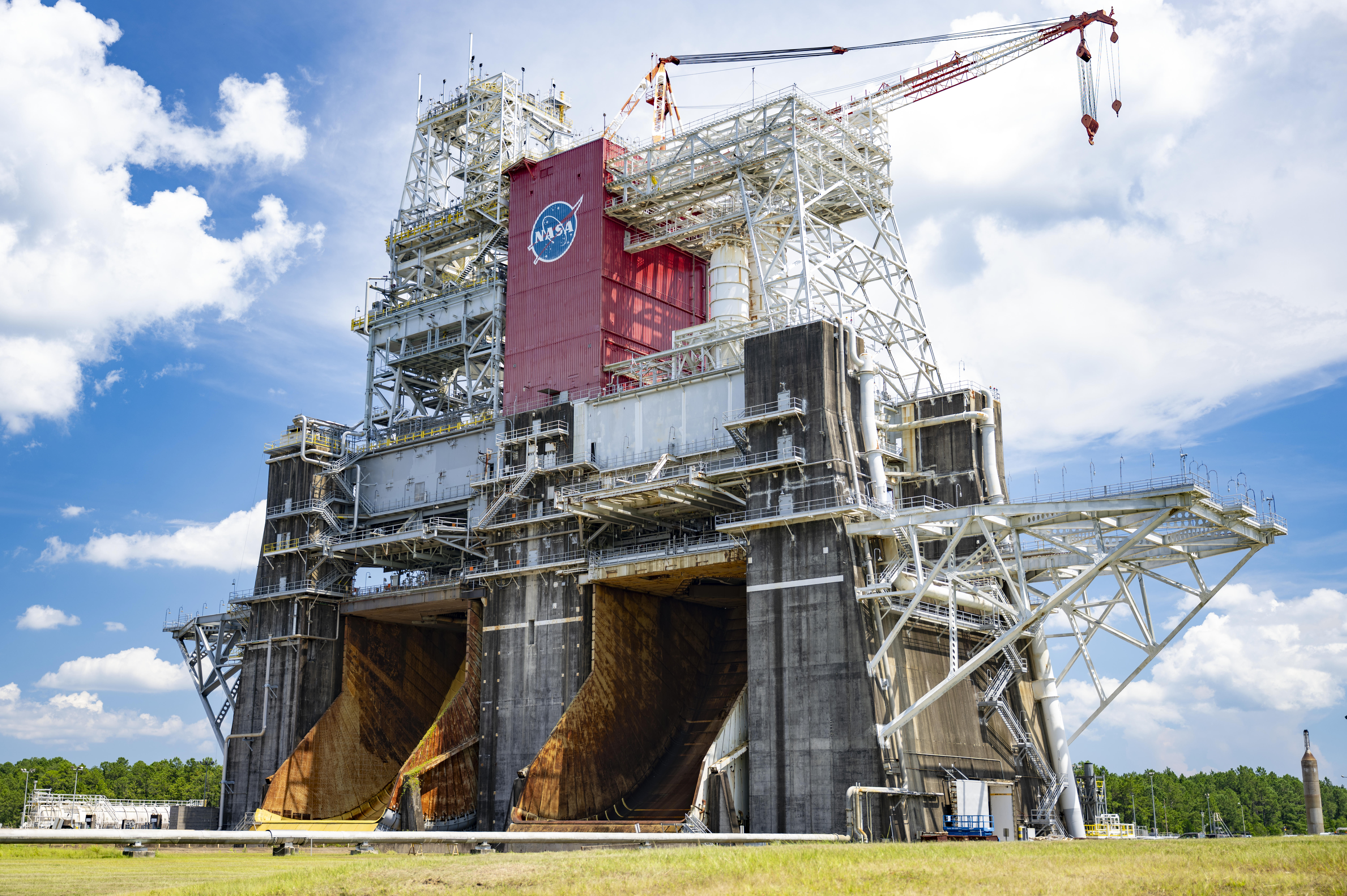
The B-2 test stand, built in the 1960s to test Saturn V rocket stages for the Apollo programme, will provide critical infrastructure for validating New Glenn’s upper stage. The partnership directly supports NASA’s Artemis programme, which aims to return American astronauts to the Moon and build a lunar base near the South Pole. Regional lawmakers, including Senators Roger Wicker and Cindy Hyde-Smith of Mississippi, highlighted the agreement as a boost for the state’s role in national space exploration and job creation.
Air Force REGAL Cargo Contract Expands
The U.S. Air Force Research Laboratory has added $11.7 million to a Blue Origin contract, expanding the agreement to approximately $13 million total. The modification, announced on July 31, builds on a roughly $1.3 million contract awarded last year.
Under the agreement, Blue Origin will define technical and mission requirements for adapting New Glenn to support “point-to-point” cargo transport—a concept that would launch military supplies from one location and deliver them to a designated destination in under an hour. The work, part of the Rocket Experimentation for Global Agile Logistics (REGAL) programme, remains focused on studies and systems analysis rather than operational demonstrations. Blue Origin competes with Anduril Industries, Sierra Space, and Rocket Lab for Air Force funding in the initiative. Completion is expected by October 2027.
Lunar Infrastructure and Astronaut Engagement
Blue Origin’s subsidiary Honeybee Robotics recently passed Critical Design Review for a lunar rover destined for Firefly Space’s Blue Ghost lander, targeting a 2028 mission to the Moon’s Gruithuisen Domes. The milestone marks a major step toward flight-build readiness; the mobility and navigation test vehicle continues operating in the company’s lunar analog facility.

Separately, Blue Origin highlighted the communications architecture of Lunar Express, a Blue Ring spacecraft designed to provide cislunar infrastructure and delivery services. The hybrid system combines radio frequency and optical communications, delivering up to 1 Gbps from the lunar surface to Earth, supporting real-time crew communications and high-resolution imagery relay. The system is compatible with NASA’s ground stations and commercial networks worldwide.
In early August, the company hosted Artemis III astronauts Randy Bresnik and Frank Rubio at Rocket Park, underscoring Blue Origin’s role in supporting future crewed lunar missions through its Blue Moon MK2 Earth Orbit Rendezvous vehicle.
Launch Complex 36 Reconstruction
Reconstruction of Launch Complex 36 is progressing in parallel with New Glenn’s return-to-flight preparation. In late July, Blue Origin removed the top six modules of the vehicle access tower to begin integrating fluids and controls systems as part of a revised Concept of Operations. The company is adding cryo systems, pneumatics, mechanisms, and access floors to enable parallel work that maintains the return-to-flight timeline.

On July 30, six new door panels were installed at the Integration Facility’s north side. Each stands 88 feet tall and weighs approximately 40,000 pounds, with a total opening width of approximately 196 feet. The south-side doors are scheduled to follow. A two-million-pound launch table was returned to the facility for inspection and adjustments in mid-July, then destined for reinstallation at the pad.
Citations
- “Blue Origin identifies engine issue behind New Glenn explosion” — https://spaceflightnow.com/2026/08/06/blue-origin-identifies-engine-issue-behind-new-glenn-explosion/
- “NASA to Support Blue Origin New Glenn Rocket Testing, Advance Artemis” — https://www.nasa.gov/news-release/nasa-to-support-blue-origin-new-glenn-rocket-testing-advance-artemis/
- “U.S. Air Force expands Blue Origin rocket cargo contract” — https://spacenews.com/u-s-air-force-expands-blue-origin-rocket-cargo-contract/
- Blue Origin (@blueorigin) X feed — https://x.com/blueorigin
- Dave Limp (@davill) X feed — https://x.com/davill
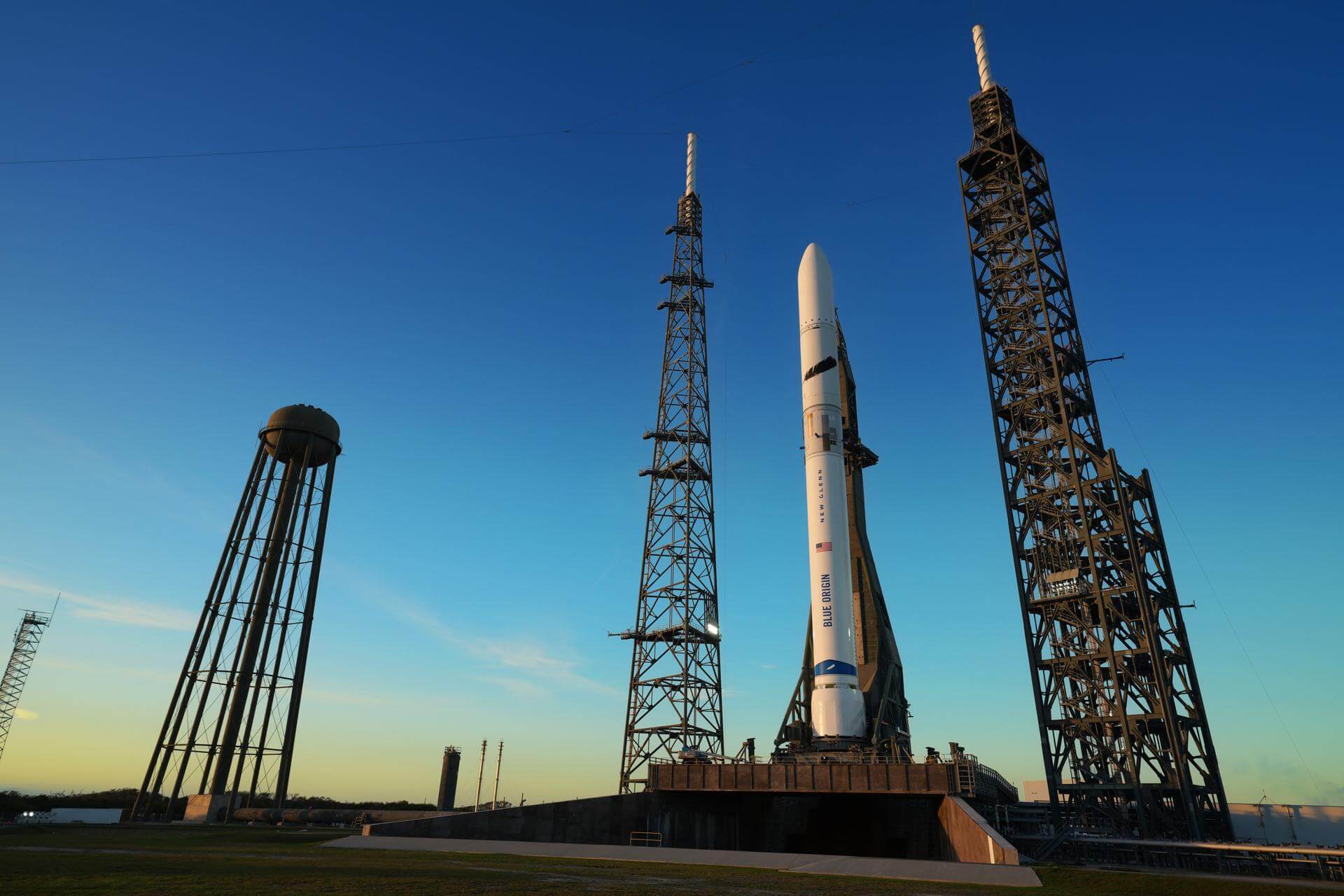
Amazon Leo (LN-01)
Provider: Blue Origin
Date: December 31, 2026
Time: 12:00 AM UTC
Vehicle: New Glenn
Amazon Leo, formerly known as Project Kuiper, is a mega constellation of satellites in Low Earth Orbit that will offer broadband internet access, this constellation will be managed by Kuiper Systems LLC, a subsidiary of Amazon. This constellation is planned to be composed of 3,276 satellites. The satellites are projected to be placed in 98 orbital planes in three orbital layers, one at 590 km, 610 km and 630 km altitude.
48 satellites will be carried on this New Glenn launch.
BlueBird Block 2
Provider: Blue Origin
Date: December 31, 2026
Time: 12:00 AM UTC
Vehicle: New Glenn
AST SpaceMobile’s Block 2 BlueBird satellites are designed to deliver up to 10 times the bandwidth capacity of the BlueBird Block 1 satellites, required to achieve 24/7 continuous cellular broadband service coverage in the United States, with beams designed to support a capacity of up to 40 MHz, enabling peak data transmission speeds up to 120 Mbps, supporting voice, full data and video applications. The Block 2 BlueBirds, featuring as large as 2400 square foot communications arrays, will be the largest satellites ever commercially deployed in Low Earth orbit once launched.
This launch will feature 8 satellites.
Blue Moon Pathfinder
Provider: Blue Origin
Date: March 31, 2027
Time: 12:00 AM UTC
Vehicle: New Glenn
First flight of Blue Origin’s Blue Moon MK1 lunar lander, MK1-SN001 “Endurance”.
Blue Moon Pathfinder Mission 2 & VIPER
Provider: Blue Origin
Date: December 31, 2027
Time: 12:00 AM UTC
Vehicle: New Glenn
2nd of the National Team’s Blue Moon MK1 lunar lander test missions to validate the necessary technologies for its HLS lunar module. Some of the life support hardware will travel on this mission in preparation for the first crew Blue Moon flight.
This mission will also carry NASA’s VIPER (Volatiles Investigating Polar Exploration Rover) lunar rover. VIPER is designed to explore the relatively nearby but extreme environment of the Moon in search of ice and other potential resources. This mobile robot will land at the South Pole of the Moon on a 100-day mission, in order to teach us about the origin and distribution of water on the Moon and help determine how we can harvest the Moon’s resources for future human space exploration.
VIPER is designed to roam the Moon using its three instruments and a 1 meter long drill to detect and analyze various lunar soil environments at a range of depths and temperatures. The rover can venture into permanently shadowed craters, some of the coldest spots in the solar system, where ice reserves have endured for billions of years.
The rover was originally slated to launch on Astrobotic’s Griffin Mission One lunar lander (with the Falcon Heavy rocket), but the VIPER mission was cancelled in July 2024 due to budget cuts. After consulting with the industry to find alternative ways to deliver the rover to the lunar surface, NASA ultimately chose to launch it with Blue Origin’s 2nd Blue Moon MK1 lander mission.


Enjoying the content? Stay up to date on everything happening behind the scenes by following our Patreon!


Leave a Reply