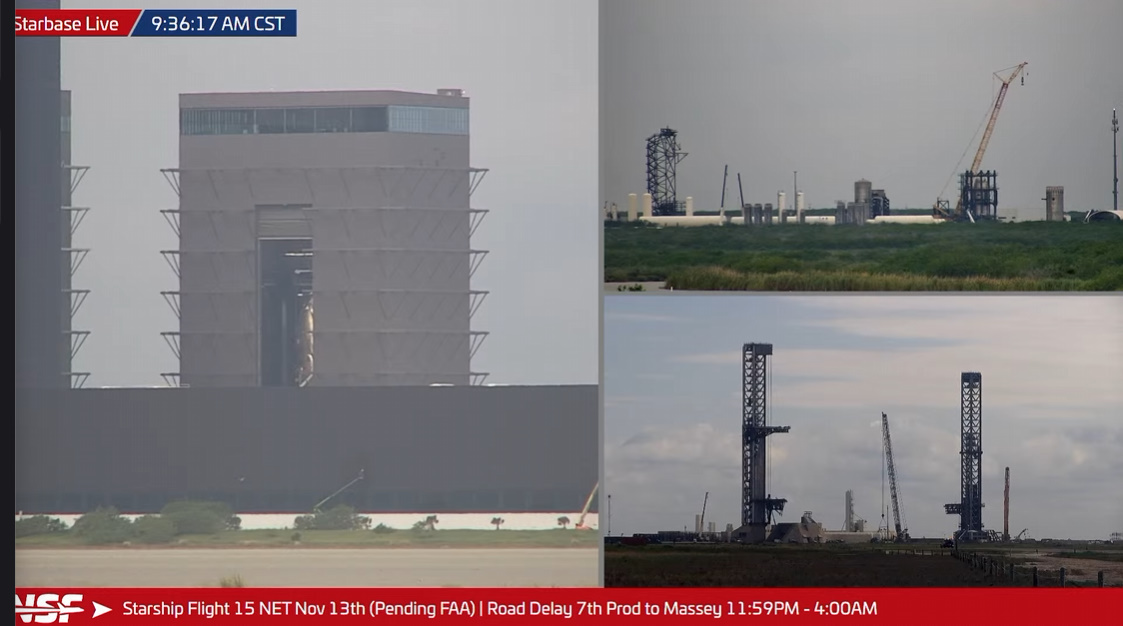
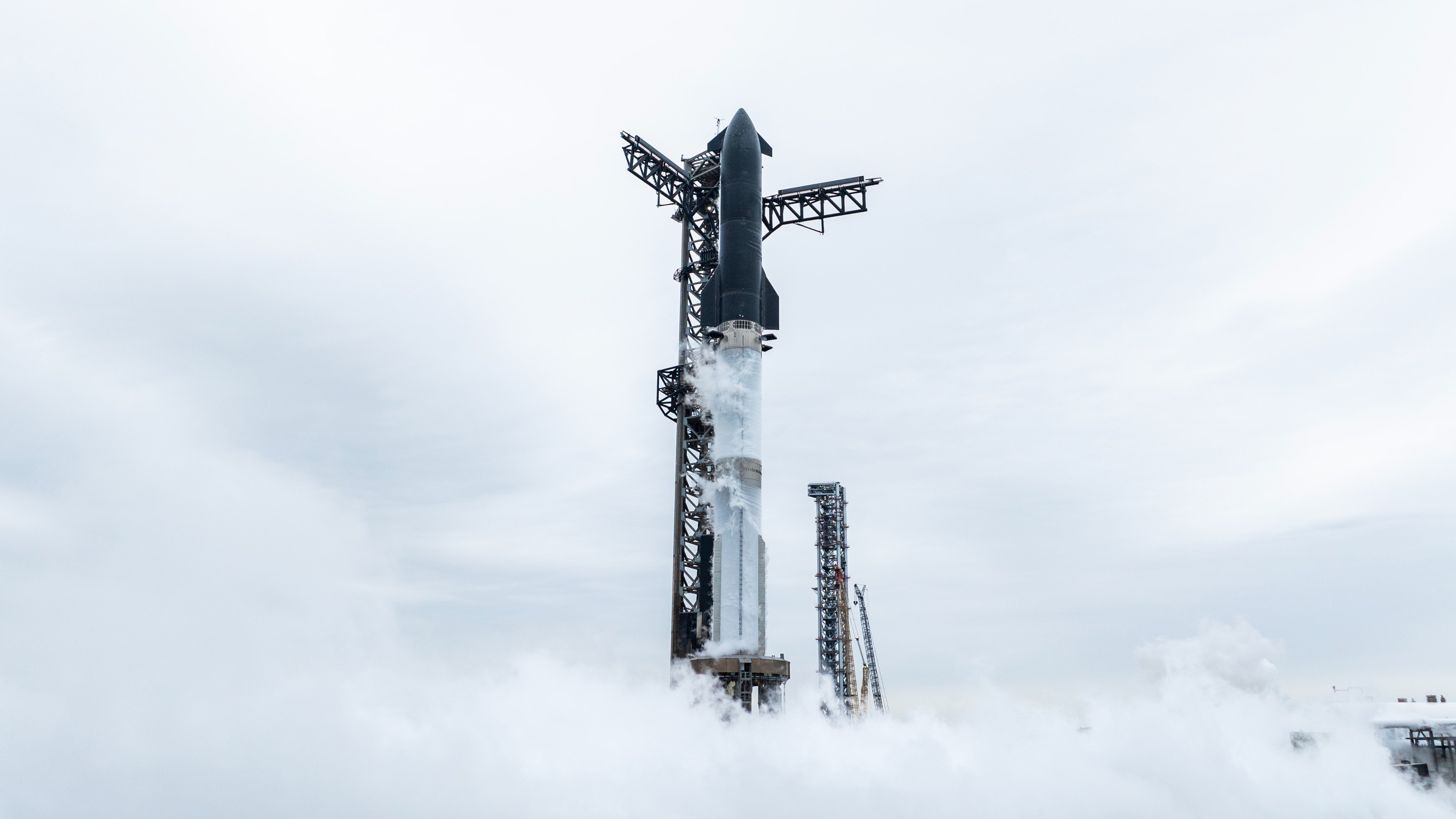
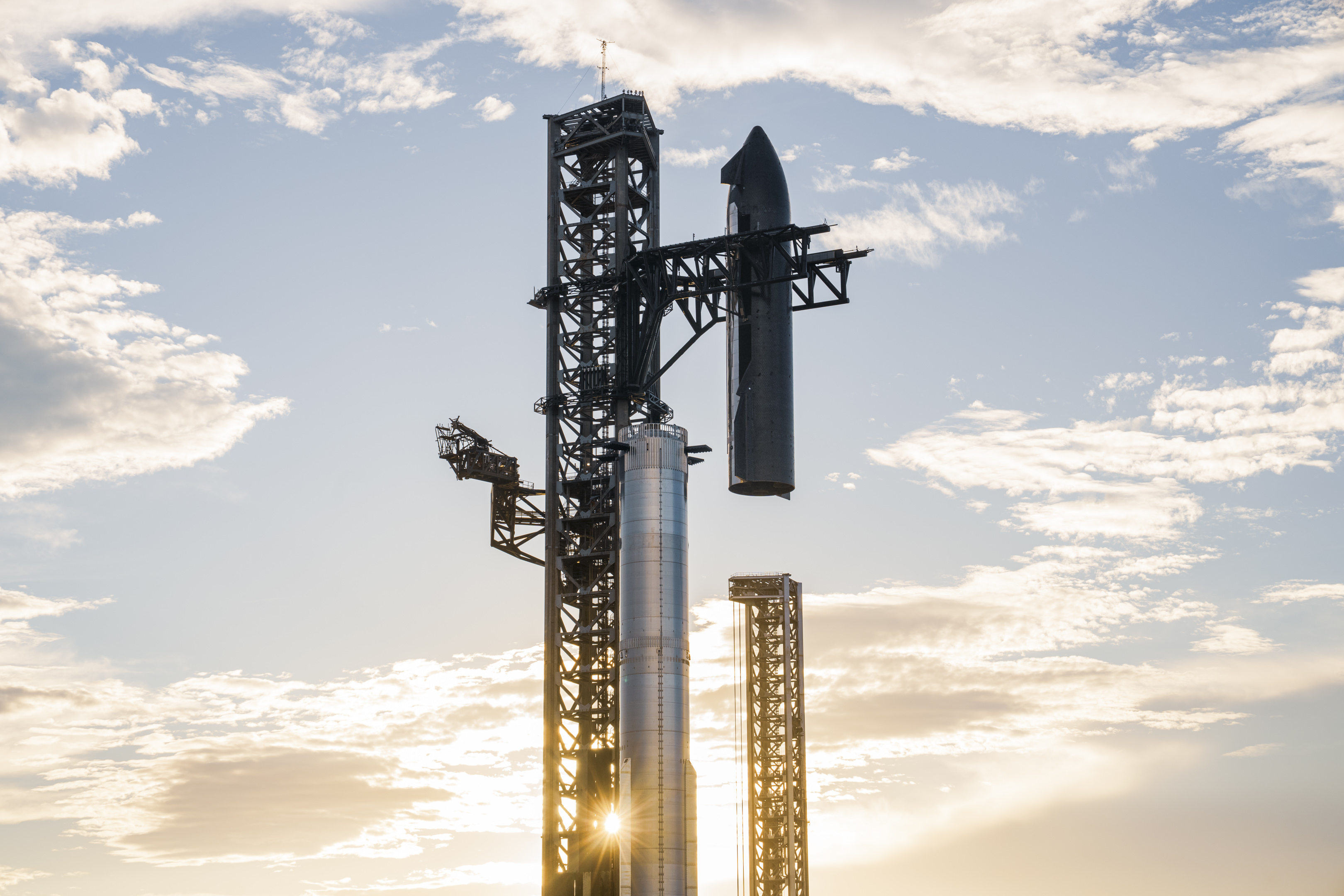
Booster 22 and Ship 42 are in final checkouts for a no-earlier-than November 13 launch that would attempt to catch both stages at Starbase Pad 2. The date has slipped by only one day, with the ship-catch licence from the FAA still the deciding factor.
Both stages completed their static-fire campaigns in close succession, with Booster 22 firing up on Pad 2 on October 25 and Ship 42 at Massey’s on October 26 and 27, before returning to the production site for final inspections and checkouts. SpaceX has rolled Booster 22 back to Mega Bay 1 and Ship 42 to Mega Bay 2, putting Starship Flight 15 firmly into its final pre-launch processing flow.
For Ship 42, the next steps are installation of Flight Termination System (FTS) charges and loading of a batch of Starlink satellites.
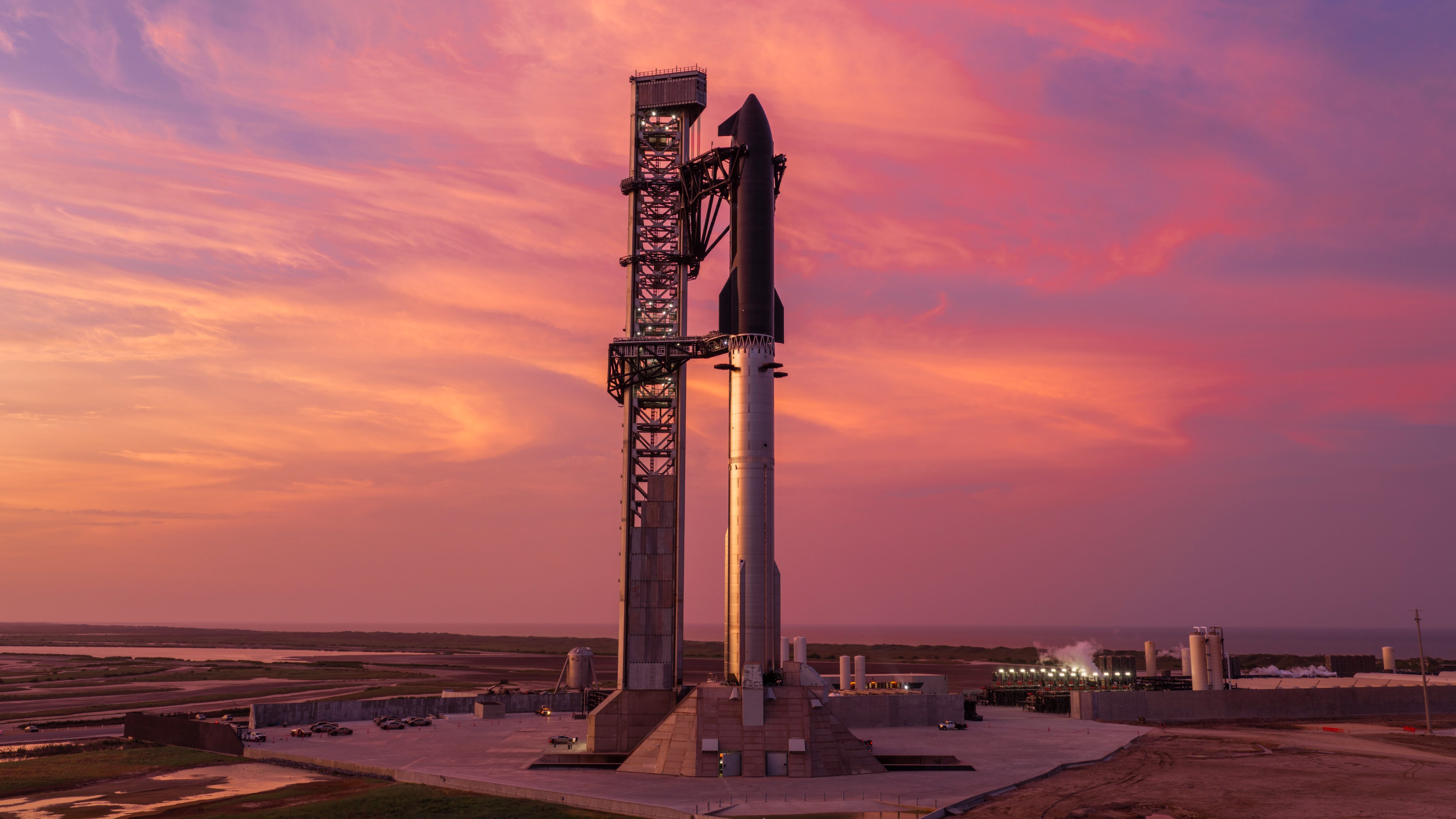
Elon Musk has confirmed SpaceX will try to catch both the Super Heavy booster and the Ship on Flight 15. No Ship has yet been caught, and it would also be the first Block 3 booster catch and the first catch at Pad 2.
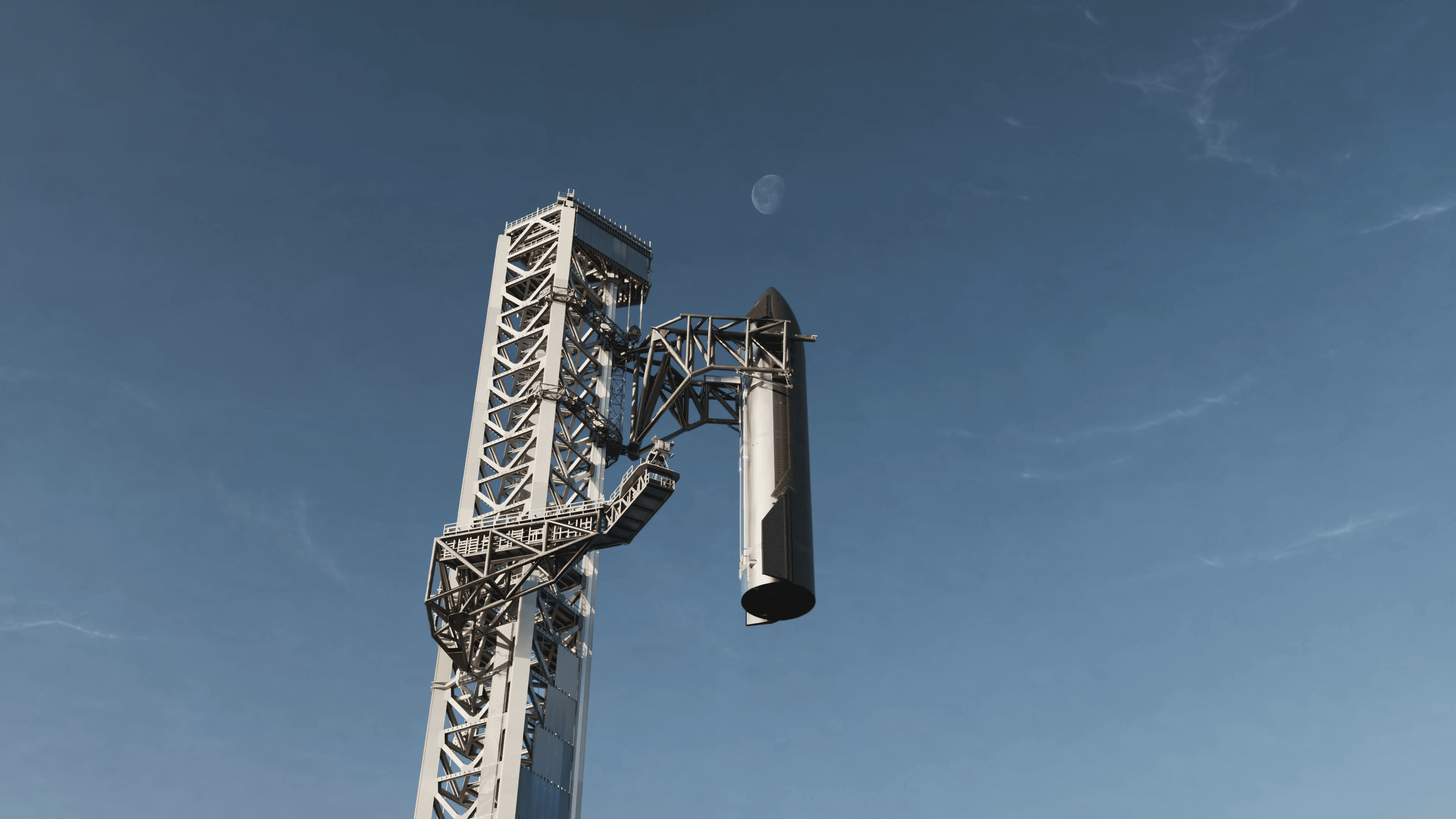
SpaceX now needs FAA approval of a licence modification for Flight 15, including permission to bring Ship 42 back to the tower at Starbase, which will involve an overflight of populated areas during the return. Until that is in hand, the dual-catch profile cannot fly as planned.
SpaceX published an official update on November 7 detailing the return-to-launch-site profile. “On Flight 15, Starship will attempt its first ever return to launch site.” “On previous flights, Starship ended its mission with a splashdown in the ocean.”
The company noted that to return Starship to Starbase, the spacecraft must fly a safe trajectory that will take it over inhabited areas in northern Mexico and southern Texas to reach its launch site for catch. SpaceX compared the profile to Space Shuttle missions, which from 1981 to 2011 every returning mission reentered over land, and Dragon spacecraft landings around Florida from 2020 to 2025.
NSF understands the working plan is a mission of roughly 24 hours, giving Ship 42’s orbit time to realign with the targeted re-entry corridor back to Starbase and Pad 2. If Ship 42 flies the full day-long profile, it would complete about 15 to 16 orbits. That would make it by far the longest Starship mission yet, as Flight 14 lasted just over three hours.
That stretch would deliver critical data on propellant boil-off rates and how well Starship performs for a prolonged period in space. Controllers would keep built-in early-return points if they are not confident the vehicle can safely deorbit at the end of the profile.
Ship 40 in Mega Bay 2 After Ocean Landing
Ship 40, the vehicle that survived the ocean landing and was returned to Starbase, is on a transport stand in Mega Bay 2. The ship completed its mission with a splashdown in the ocean rather than a tower catch, as no Ship has yet been caught.
USSF-432 Launches on Falcon 9 B1095-8
SpaceX launched another batch of satellites for a clandestine U.S. Space Force program on a Falcon 9 rocket from California on November 6. Liftoff from pad 4E at Vandenberg Space Force Base occurred at 4:48 p.m. PST (7:48 p.m. EST / 0048 UTC). The rocket took a south-easterly trajectory on departure from the central California coast.
The flight was originally scheduled for November 1 but was delayed repeatedly, first due to delays of the Starlink 15-18 launch, and then for reasons that were not disclosed. Falcon 9 B1095-8 launched USSF-432.
Starlink Router 4 Ships in Canada and U.S.
Router 4 is now shipping with Starlink V4 Kits in the United States and Canada on Residential 200 Mbps and Residential Max plans. The new router is available for order.
Starlink Mobile said its 5G base stations will leverage Qualcomm chips to accelerate deployment. The company stated that its 5G base stations will leverage Qualcomm chips to accelerate deployment, starting in 2027. The initiative aims to build the first fully-integrated U.S. nationwide satellite and terrestrial network.
Elon Musk noted on X that “It is so tempting to make a 500 ton thrust Raptor 4 in place of the 250 ton Raptor 3 for the outer ring of the Starship booster”; no development timeline was provided.
Provider: SpaceX Date: November 13, 2026 Time: 10:45 PM UTC Vehicle: Starship
15th test flight of the two-stage Starship launch vehicle and 4th flight of Starship V3. Second Starship flight to deploy satellites (a group of Starlink satellites known as Starlink Group 31-2) into stable Low Earth Orbit and first ever to attempt returning the Starship 2nd stage back to the launch site.
The ship is expected to fly at an altitude approximately 275 km above Earth and complete approximately 14 orbits around the planet for more than 22 hours, with the ship expected to attempt returning back to Starbase, Texas on its launch pad by pad arms catching.
The booster’s primary test objective on Flight 15 will be executing a successful launch, ascent, stage separation, boostback burn, and landing by pad arms catching. This will also be the 1st Starship V3 booster to attempt returning to its launch site.
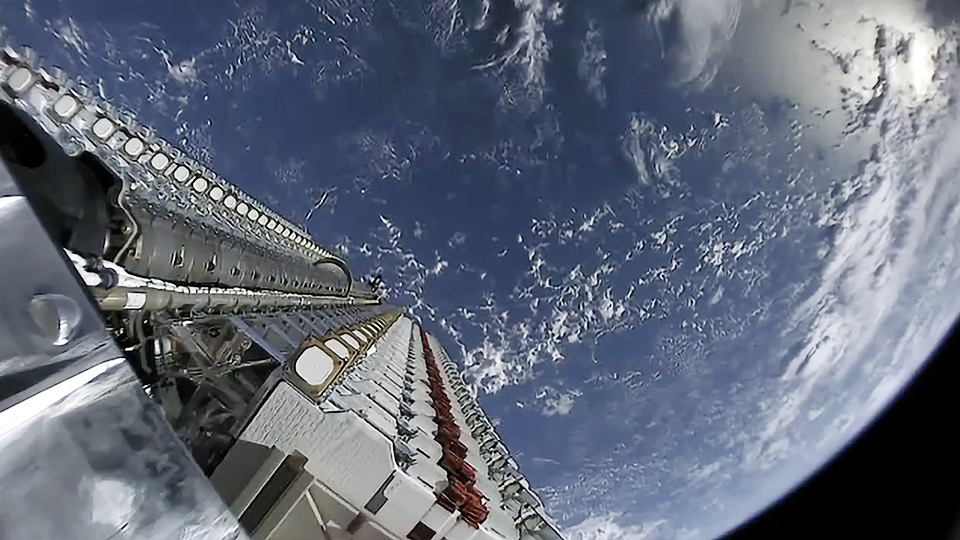
Starship will deliver 26 Starlink V3 satellites to orbit for the second time, which aim to greatly expand the network’s capacity and user speeds. Each Starlink V3 satellite will add 1 Tbps of capacity to the constellation. 3 of the satellites have been modified with a suite of cameras to scan Starship’s heatshield and transmit imagery down to operators.
USSF-75
Provider: SpaceX Date: December 31, 2026 Time: 12:00 AM UTC Vehicle: Falcon Heavy
Classified payload for the United States Space Force
Griffin Mission One
Provider: SpaceX Date: January 31, 2027 Time: 12:00 AM UTC Vehicle: Falcon Heavy
Demonstration flight of the Astrobotic Griffin lander and its engines, initially contracted for the NASA VIPER (Volatiles Investigating Polar Exploration Rover) mission. The vacated payload spot will now host the FLIP (FLEX Lunar Innovation Platform) lunar rover from Astrolab.
SpaceX HLS LEO Demo
Provider: SpaceX Date: June 30, 2027 Time: 12:00 AM UTC Vehicle: Starship
The Starship HLS pathfinder spacecraft in support of NASA’s Artemis III mission in Low Earth Orbit will be a Version 3 vehicle equipped with a docking mechanism, but with no crew cabin or environmental control systems on board. This Starship HLS will launch after the Artemis III Orion has launched into LEO aboard SLS, and has completed its demonstrations with Blue Origin’s Blue Moon lander. Once docked, Orion and Starship will spend about a day connected for checkouts and testing.
NROL-86
Provider: SpaceX Date: June 30, 2027 Time: 12:00 AM UTC Vehicle: Falcon Heavy
Classified payload for the US National Reconnaissance Office
Starlink Group 31-2 (Starship Flight 15) ×
Mission Details
TypeCommunications
OrbitLow Earth Orbit
TargetEarth
15th test flight of the two-stage Starship launch vehicle and 4th flight of Starship V3. Second Starship flight to deploy satellites (a group of Starlink satellites known as Starlink Group 31-2) into stable Low Earth Orbit and first ever to attempt returning the Starship 2nd stage back to the launch site.
The ship is expected to fly at an altitude approximately 275 km above Earth and complete approximately 14 orbits around the planet for more than 22 hours, with the ship expected to attempt returning back to Starbase, Texas on its launch pad by pad arms catching.
The booster’s primary test objective on Flight 15 will be executing a successful launch, ascent, stage separation, boostback burn, and landing by pad arms catching. This will also be the 1st Starship V3 booster to attempt returning to its launch site.
Starship will deliver 26 Starlink V3 satellites to orbit for the second time, which aim to greatly expand the network’s capacity and user speeds. Each Starlink V3 satellite will add 1 Tbps of capacity to the constellation. 3 of the satellites have been modified with a suite of cameras to scan Starship’s heatshield and transmit imagery down to operators.
The SpaceX Starship is a fully reusable super heavy-lift launch vehicle under development by SpaceX since 2012, as a self-funded private spaceflight project. The second stage of the Starship — is designed as a long-duration cargo and passenger-carrying spacecraft. It is expected to be initially used without any booster stage at all, as part of an extensive development program to prove out launch-and-landing and iterate on a variety of design details, particularly with respect to the vehicle’s atmospheric reentry.
The second launch and landing pad of the full version of the combined SpaceX Starship and Superheavy booster. To be first used for launch in 2025 with version 3 of Starship and the Superheavy…
The Super Heavy Booster 22 will attempt to return the launch site at Starbase.
Spacecraft: Ship 42
Fourth V3 Starship to fly with various enhancements, to be used on the 15th Starship test flight, the 2nd Starship flight to deploy satellites into stable Low Earth Orbit. It is the first ever Starship 2nd stage to attempt returning to its launch pad.
Specifications
SerialS42
TypeReuseable Upper Stage
StatusActive
DestinationLow Earth Orbit
Height52.1 m
Diameter9 m
Maiden Flight2026-05-22
History
The third-generation Starship upper stage will be introduced on flight 12.
Capability
More than 100 tons to Earth orbit
Details
Third-generation second stage of the two-stage Starship super heavy-lift launch vehicle.
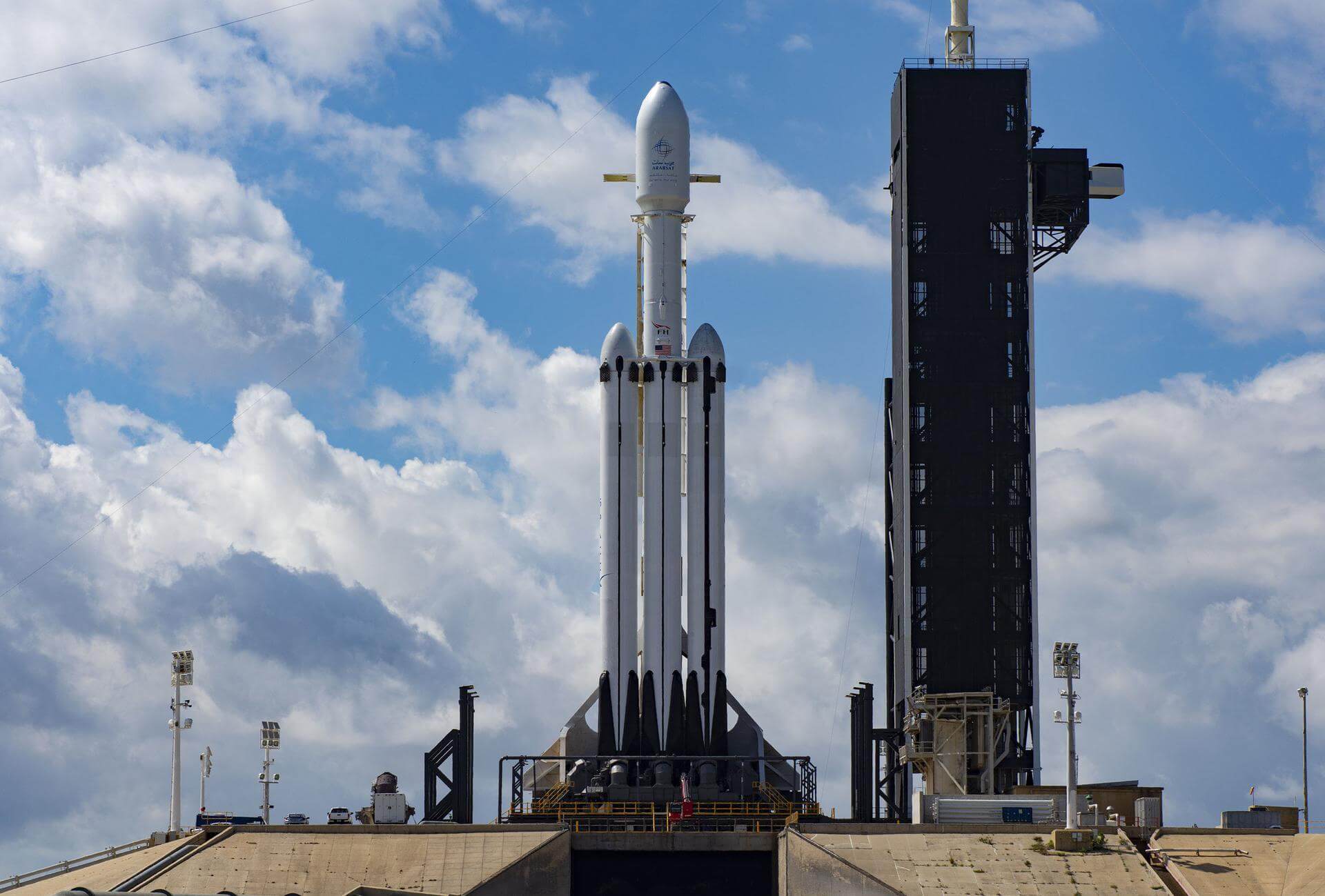
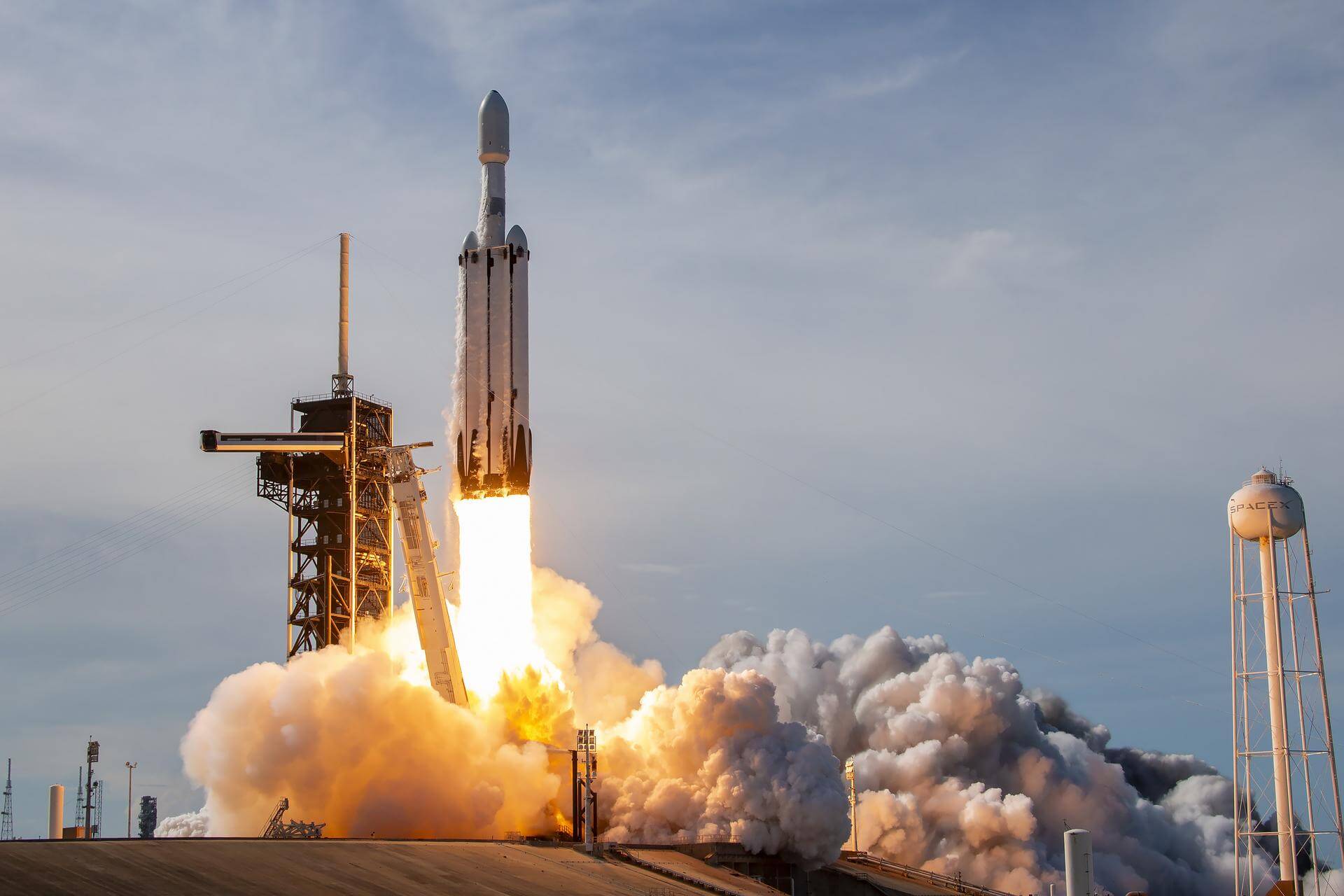
The Falcon Heavy is a variant of the Falcon 9 full thrust launch vehicle and consists of a standard Falcon 9 rocket core, with two additional boosters derived from the Falcon 9 first stage.
Demonstration flight of the Astrobotic Griffin lander and its engines, initially contracted for the NASA VIPER (Volatiles Investigating Polar Exploration Rover) mission. The vacated payload spot will now host the FLIP (FLEX Lunar Innovation Platform) lunar rover from Astrolab.
Agencies Involved
• Voyager Technologies (Private)
Launch Provider: SpaceX
Commercial • United States of America • Founded 2002
The Falcon Heavy is a variant of the Falcon 9 full thrust launch vehicle and consists of a standard Falcon 9 rocket core, with two additional boosters derived from the Falcon 9 first stage.
The center core will attempt to land on an ASDS after launch.
Strap-On Booster (TBD)
LandingPlanned
Landing MethodRTLS
Landing SiteUnknown
the sidebooster will attempt to land at the launch site after launch.
Strap-On Booster (TBD)
LandingPlanned
Landing MethodRTLS
Landing SiteUnknown
the sidebooster will attempt to land at the launch site after launch.
SpaceX HLS LEO Demo ×
Mission Details
TypeHuman Exploration
OrbitLow Earth Orbit
TargetEarth
The Starship HLS pathfinder spacecraft in support of NASA’s Artemis III mission in Low Earth Orbit will be a Version 3 vehicle equipped with a docking mechanism, but with no crew cabin or environmental control systems on board. This Starship HLS will launch after the Artemis III Orion has launched into LEO aboard SLS, and has completed its demonstrations with Blue Origin’s Blue Moon lander. Once docked, Orion and Starship will spend about a day connected for checkouts and testing.
Agencies Involved
• SpaceX (Commercial)
Launch Provider: SpaceX
Commercial • United States of America • Founded 2002
The Falcon Heavy is a variant of the Falcon 9 full thrust launch vehicle and consists of a standard Falcon 9 rocket core, with two additional boosters derived from the Falcon 9 first stage.
Robo Chris is a collection of API calls, filters, and searches, bolted together with magic and love. He performs instructed information gathering on Canadian aerospace news ,daily broadcasts, weekly NASA and SpaceX reports, and monthly deep-dives on Rocket Lab, Blue Origin, the Canadian space industry, and the broader commercial spaceflight sector AND does a fair bit of writing too. Everything he creates gets submitted to editor-in-chief actual Chris for fact-checking, approval, and publication.







Leave a Reply