
Third Stage and Northstar Expand New Glenn Reach
New Glenn’s Reach Extends with GS3 Third Stage and Northstar Engine
Blue Origin unveiled two major propulsion systems in early November: the GS3 third stage for New Glenn and Northstar, a new booster engine designed from the ground up to reduce mass, accelerate production, and increase thrust.

GS3 enables New Glenn to reach high-energy destinations including geostationary orbit (GEO) and trans-lunar injection (TLI). On the 7×2 configuration, GS3 delivers up to 8 metric tonnes to GEO and 10 metric tonnes to TLI. The 9×4 variant achieves 14 metric tonnes to GEO and 20 metric tonnes to TLI. The stage is already under contract for a cis-lunar mission with a government customer scheduled to launch in 2028.
Northstar produces 715,000 pounds of thrust—up from the BE-4’s 640,000 pounds—while reducing mass by 30% and parts count by 50%. More than 65% of the engine is additively manufactured using Blue Origin’s in-house 3D printing capability, enabling assembly in less than a day. CEO Dave Limp noted that Northstar was “built from the ground up by a scrappy team focused on weight, cost, manufacturability, and performance.”

GS3 expands New Glenn’s mission flexibility, while Northstar shortens production timelines. GS3 integrates within an interstage, preserving the full fairing volume for spacecraft and using the same payload adapters as the two-stage vehicle.
Multiple Pads, New Landing Vessels, Manufacturing Expansion Target Multiple Flights Per Week
To support an aggressive increase in New Glenn flight rate, Blue Origin announced a comprehensive infrastructure buildout across Florida’s Space Coast in mid-October.
Ian Richardson, Senior Vice President of Operations, stated the company is “building the capacity to support more missions, more reliably, and more efficiently” and that the infrastructure “is designed to support multiple flights per week by the end of the decade.” The Federal Aviation Administration sought public input on Blue Origin’s request to increase launch cadence at Launch Complex 36A from 12 permitted flights to 50.
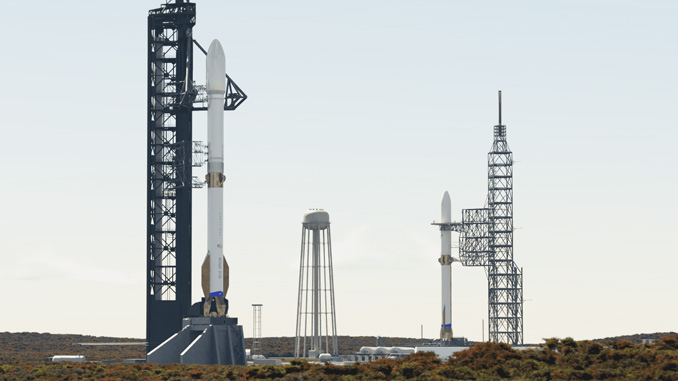
New pads modelled after LC-36 will augment the rebuild and expansion already underway at Cape Canaveral. LC-36A is being rebuilt after the May 2026 hotfire anomaly; LC-36B is under construction for the 9×4 variant. Blue Origin will also commission two new landing vessels and a new vertical integration facility for booster servicing.
Manufacturing capacity is also ramping. A $330 million expansion at Rocket Park, Blue Origin’s 1.37-million-square-foot manufacturing campus near Kennedy Space Center, is targeted for completion in summer 2027. When finished, the facility will support production of up to 150 New Glenn upper stages annually for the 9×4 variant.
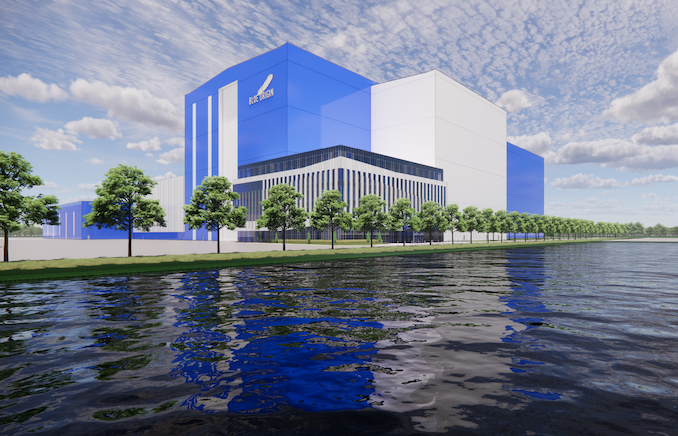
Blue Origin has invested more than $3 billion in facilities and infrastructure across Florida. The company now employs more than 5,000 people in the state and works with about 500 Florida suppliers, with operations spanning more than 20 sites across Brevard and Orange Counties.
Artemis III Multi-Vehicle Campaign Confirmed
NASA Administrator Jared Isaacman outlined the multi-launch architecture for Artemis III in early November, confirming that Blue Origin’s Blue Moon lander will launch first aboard New Glenn to enable orbital checkout before the crewed vehicle departs Earth.
“We’re not going to launch without Blue Origin in it,” Isaacman said. “That’s why they’re going to launch first. Like they need to be up there, do some checkouts, and then we commit SLS.”

The campaign is planned to sequence three launches from three different providers: New Glenn carrying Blue Moon, followed by the Space Launch System (SLS) with Orion, and then SpaceX’s Starship. Blue Moon is expected to loiter in orbit for roughly 30 days, allowing time for system verification before crewed arrival.
Isaacman framed the multi-launch profile as a signal of future space architecture. Isaacman cited autonomous assembly and fission-powered spacecraft as examples of future multi-launch campaigns. “If we realize this nuclear NASA dream and you’re going to have these fleets of fission-powered spacecraft, there’s going to be a lot of launches to build those things.”
Honeybee Robotics P-Sampler Aboard JAXA’s Martian Mission
Blue Origin’s Pneumatic Sampler (P-Sampler), built by Honeybee Robotics—a Blue Origin company—launched aboard JAXA’s Martian Moons eXploration (MMX) spacecraft on October 19 from Yoshinobu Launch Complex at Tanegashima Space Center in Japan.
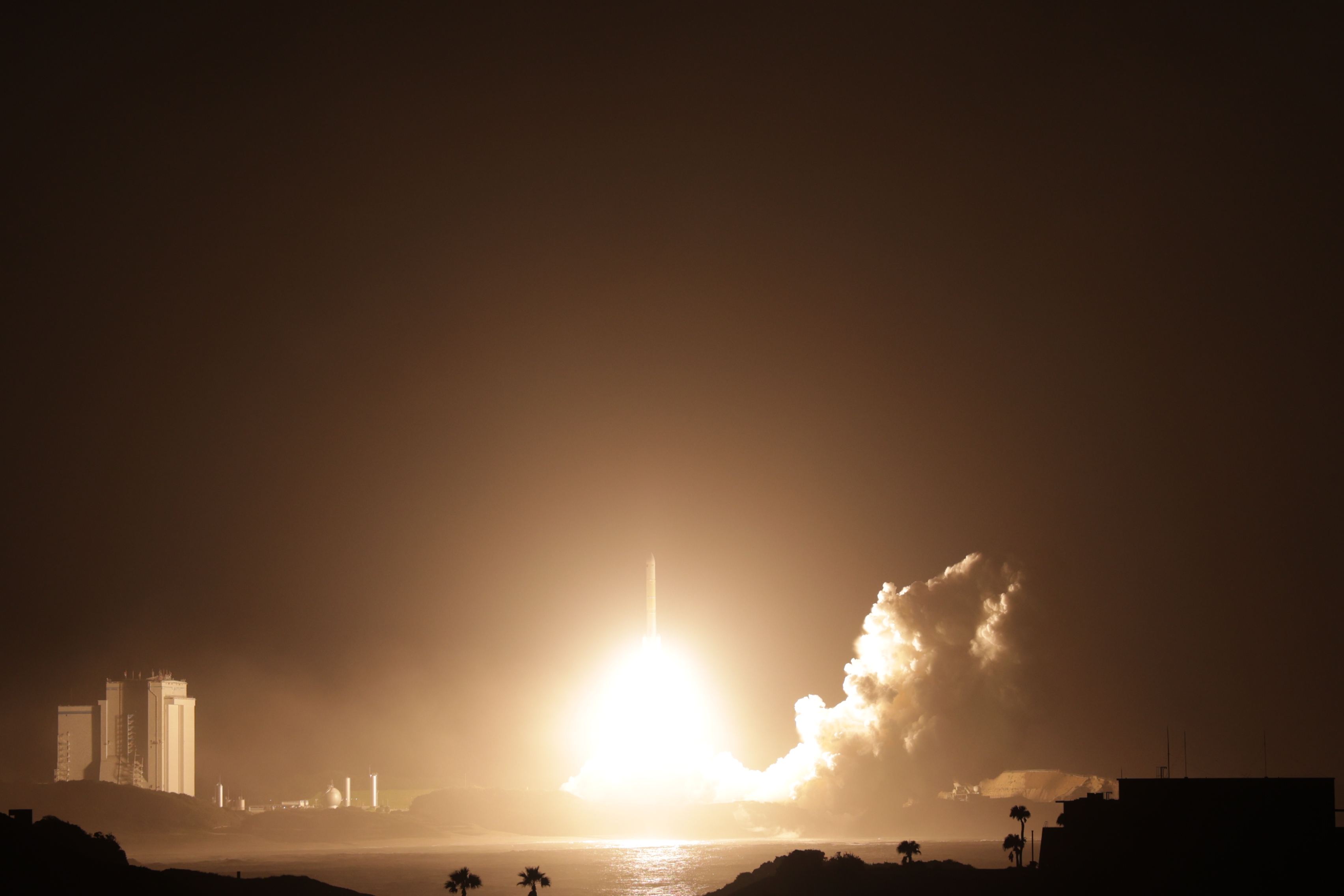
The P-Sampler is designed to collect surface material from the Martian moon Phobos and will play a key role in JAXA’s effort to return the first-ever samples from a Martian moon to Earth.
ATLAS Space Manufacturing Apprenticeship Programme Launches
Blue Origin launched ATLAS (Advanced Training & Learning Academy for Space) in late October, the first registered apprenticeship programme designed specifically for space manufacturing. The programme, developed in partnership with Apprenti, the nation’s leading apprenticeship intermediary, addresses a critical workforce shortage in the space industry.
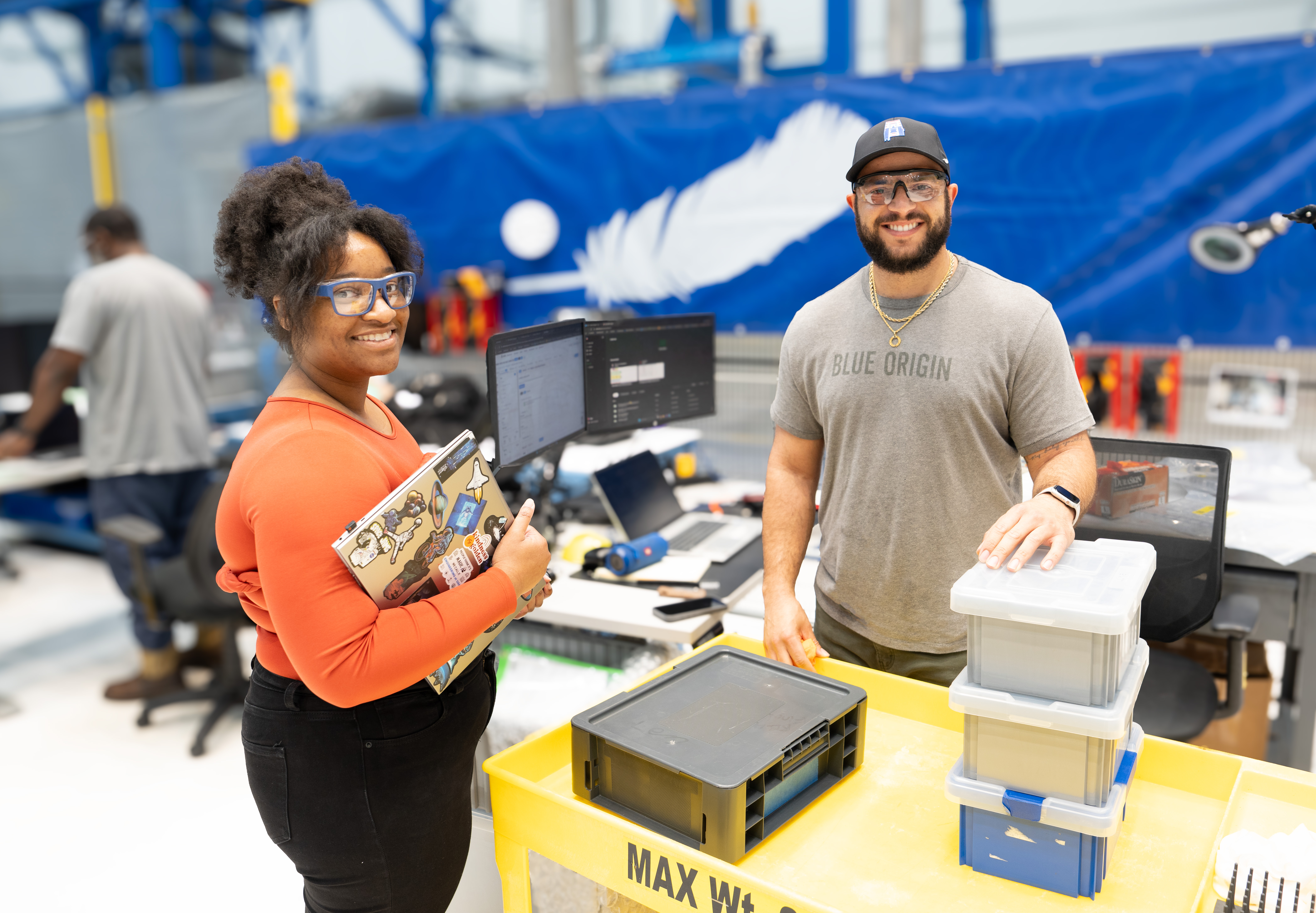
The programme was set to launch in Alabama in October with 10 machinist apprentices. Participants earn competitive full-time salaries and benefits while mastering the precision skills needed to build flight-ready space hardware. The curriculum combines classroom instruction at Drake State Community & Technical College with hands-on training at Blue Origin facilities, covering precision measurement, advanced CNC programming, quality systems, and space-specific materials knowledge.
Blue Origin noted that traditional manufacturing training cannot prepare workers for space requirements like cryogenic environments, exotic alloys, and micron-level tolerances. “You cannot simply hire a skilled welder and expect them to build rocket propellant tanks from exotic alloys or take a CNC machinist and have them produce flight hardware with the precision required for vacuum and cryogenic environments,” said Nick Curry, Blue Origin’s Early Career Director.
ATLAS will expand to Florida in early 2027, followed by Washington and other Blue Origin manufacturing sites. The company targets producing more than 200 journey-level technicians annually by 2030.
Return to Flight Momentum Continues
Blue Origin confirmed continued progress on its return-to-flight plan for New Glenn in early November. The modified BE-4 main oxygen valve implicated in the May 2026 hotfire anomaly completed qualification testing and has been incorporated into engines slated for upcoming flights, with rollout across the remaining fleet underway.
Blue Origin said it expects to “complete the anomaly investigation later this month.” The company plans to return to flight from Launch Complex 36A with booster “Never Tell Me The Odds” early in 2027.

The rebuild at LC-36 is moving to a new operational concept: horizontal mating in the integration facility followed by crane-assisted vertical breakover at the pad, with payload integration occurring after the vehicle is vertical. This configuration increases flight cadence.
Citations
- Blue Origin unveils New Glenn GS3 third stage and Northstar booster engine — nasaspaceflight.com
- Blue Origin to add new Florida launch pads, seeks aggressive increase in New Glenn flight rate — spaceflightnow.com
- Isaacman outlines Artemis III multi-launch checkout sequence and Blue Origin priority — nasaspaceflight.com
- Introducing Northstar: A New Booster Engine with More Thrust and Less Mass — blueorigin.com
- New Glenn Expands Its Reach with GS3: Heavy-Lift Performance Direct to GEO and Beyond — blueorigin.com
- GS1-3 Hotfire Updates — blueorigin.com
- Building the Infrastructure for More Frequent Launches in Florida — blueorigin.com
- Blue Origin Launches Earth’s First Space Manufacturing Apprenticeship Program — blueorigin.com
- Blue Origin’s P-Sampler Launches Aboard JAXA’s Martian Moons eXploration Mission — blueorigin.com
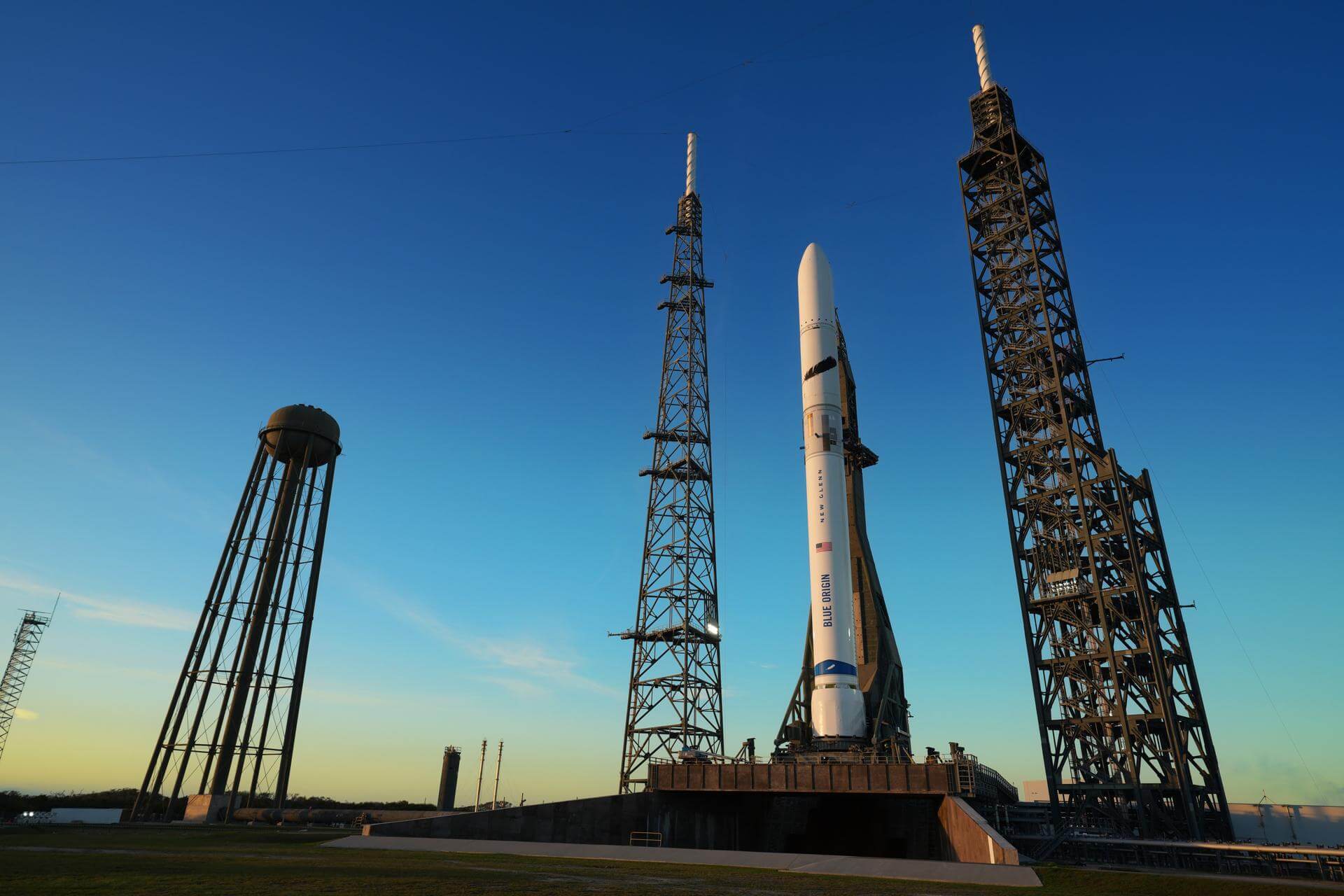
Amazon Leo (LN-01)
Provider: Blue Origin
Date: December 31, 2026
Time: 12:00 AM UTC
Vehicle: New Glenn
Amazon Leo, formerly known as Project Kuiper, is a mega constellation of satellites in Low Earth Orbit that will offer broadband internet access, this constellation will be managed by Kuiper Systems LLC, a subsidiary of Amazon. This constellation is planned to be composed of 3,276 satellites. The satellites are projected to be placed in 98 orbital planes in three orbital layers, one at 590 km, 610 km and 630 km altitude.
48 satellites will be carried on this New Glenn launch.
BlueBird Block 2
Provider: Blue Origin
Date: December 31, 2026
Time: 12:00 AM UTC
Vehicle: New Glenn
AST SpaceMobile’s Block 2 BlueBird satellites are designed to deliver up to 10 times the bandwidth capacity of the BlueBird Block 1 satellites, required to achieve 24/7 continuous cellular broadband service coverage in the United States, with beams designed to support a capacity of up to 40 MHz, enabling peak data transmission speeds up to 120 Mbps, supporting voice, full data and video applications. The Block 2 BlueBirds, featuring as large as 2400 square foot communications arrays, will be the largest satellites ever commercially deployed in Low Earth orbit once launched.
This launch will feature 8 satellites.
Blue Ring-1
Provider: Blue Origin
Date: January 31, 2027
Time: 12:00 AM UTC
Vehicle: New Glenn
The first mission of Blue Ring, Blue Origin’s all-in-one, high-powered hybrid solar electric and chemical propelled spacecraft, will test the spacecraft’s operations in Geostationary Transfer Orbit (GTO), as well as subsequent operations after reaching Geostationary Orbit (GEO).
It will carry one of Scout Space’s flagship next-generation space domain awareness (SDA) Owl sensors, which is designed to enhance real-time tracking, characterization, and assessment of space objects by integrating advanced optical sensing, onboard artificial intelligence-driven processing, and autonomous decision-making capabilities to deliver domain-wide intelligence in space in support of the U.S. Space Force’s space control mission set.
Blue Ring will also carry Optimum Technologies (OpTech)’s next-generation Caracal optical payload, which is designed to provide actionable insights on resident space objects and orbital activity and includes onboard image storage, object detection algorithms, and passive thermal control. The payload is designed to operate flexibly across dynamic orbits over a year-long mission profile.
Several internal Blue Origin payloads will also be hosted.
Blue Moon Pathfinder
Provider: Blue Origin
Date: March 31, 2027
Time: 12:00 AM UTC
Vehicle: New Glenn
First flight of Blue Origin’s Blue Moon MK1 lunar lander, MK1-SN001 “Endurance”.
Blue Origin HLS LEO Demo
Provider: Blue Origin
Date: June 30, 2027
Time: 12:00 AM UTC
Vehicle: New Glenn
The Blue Moon HLS pathfinder spacecraft in support of NASA’s Artemis III mission in Low Earth Orbit will be a modified Blue Moon Mark 1 vehicle equipped with a docking mechanism, a crew cabin and environmental control systems on board. This Blue Moon HLS will launch before the Artemis III Orion has launched into LEO aboard SLS. Once docked, Orion and Blue Moon will spend about two days docked together for tests and technology demonstrations, with the Artemis III crew scheduled to enter the lander.


Enjoying the content? Stay up to date on everything happening behind the scenes by following our Patreon!


Leave a Reply