
Rocket Lab Roundup: Rocket Lab Launches 95th Electron; Files Mars Contract Protest
Three Launches in Three Weeks Cement Electron’s Cadence
Rocket Lab flew three Electron missions between August 21 and September 11, reinforcing its position as the world’s most frequent small-lift launch provider. The trio of missions — for Japanese Earth-imaging firms iQPS and Synspective, plus a confidential commercial customer — underscores the company’s ability to deliver schedule certainty in a tight market.

On August 21, the Lightning God Defends mission deployed the ninth QPS-SAR satellite for the Institute for Q-shu Pioneers of Space, Inc. (iQPS) to a 575-kilometre orbit — Rocket Lab’s 93rd launch overall and 14th of 2026. iQPS has 100% mission success with Electron and nine more dedicated launches booked through 2030.
Two weeks later, on September 3, Owl Around The World lifted the 12th StriX satellite for Synspective to a 575-kilometre low Earth orbit, marking the 94th Electron flight and 15th launch of the year. Synspective, which has used Rocket Lab as its exclusive launch provider since 2020, has 16 additional missions scheduled before 2030.
On September 11, Rocket Lab achieved its 95th overall launch with Happily Ever Faster, deploying a single Earth observation satellite to 500-kilometre orbit for a confidential customer — the company’s 16th launch of 2026. The consecutive success rate and narrow turnaround times reflect Rocket Lab’s operational maturity at Launch Complex 1 in Mahia, New Zealand.
Synspective Constellation Continues This Week
Rocket Lab is not pausing. The company announced a September 19 launch window for Owl By The Dozen, which will deliver Synspective’s 12th StriX satellite to orbit. The launch window opens at 3:15 p.m. New Zealand Standard Time (03:15 UTC / 11:15 p.m. EDT on September 18), continuing what the company calls its unmatched cadence for dedicated small-satellite missions.

Germanium-Free Solar Cells Enter Production
On September 8, Rocket Lab released Inverted Metamorphic (IMM) Apex, a next-generation solar cell that achieves 31.5% beginning-of-life conversion efficiency while reducing cell mass by 40% compared to conventional designs. The innovation sidesteps the germanium substrates that have constrained the space power industry for three decades, mitigating supply-chain risk and cost pressure.

IMM Apex is mechanically and electrically compatible with legacy solar-cell interfaces, allowing customers to integrate the technology without system redesign. The cell draws on more than a decade of in-orbit validation — IMM cells powered NASA’s Ingenuity Mars Helicopter during its historic mission and currently supply power to over 1,100 satellites in orbit. Brad Clevenger, President of Rocket Lab USA, called the release “a cutting-edge solar solution” that addresses “real-world challenges like rising material costs and supply chain constraints.”
U.S. Space Force Names Rocket Lab to $981-Million NITE-STAR Contract
Rocket Lab was selected as an awardee to the U.S. Space Force’s NITE-STAR (NSTTC Innovative Technology & Engineering – Space Test and Range) indefinite-delivery, indefinite-quantity (IDIQ) contract in August, opening eligibility to compete for task orders within the programme’s $981-million ceiling. The programme, managed by the Space Force’s Space Systems Command, aims to build a distributed test and training architecture to prepare space operators for contested scenarios.

As an awardee, Rocket Lab can now pursue work in space-based systems development, ground infrastructure, digital environments, and operational sustainment. The selection builds on Rocket Lab’s track record supporting the Department of War, National Reconnaissance Office, and NASA. Brad Clevenger, Vice President of Space Systems at Rocket Lab, said the award “highlights Rocket Lab’s commitment to advancing space innovation and supporting the U.S. Space Force’s mission to ensure space readiness.”
Rocket Lab Challenges NASA’s Mars Telecommunications Award
On September 11, Rocket Lab filed a formal protest with the U.S. Government Accountability Office (GAO) against NASA’s award of the Mars Telecommunications Network contract to Blue Origin. The $700-million spacecraft development, selection, launch, and operations contract was intended to relay data between Mars rovers and Earth, upgrading aging NASA infrastructure at the red planet.
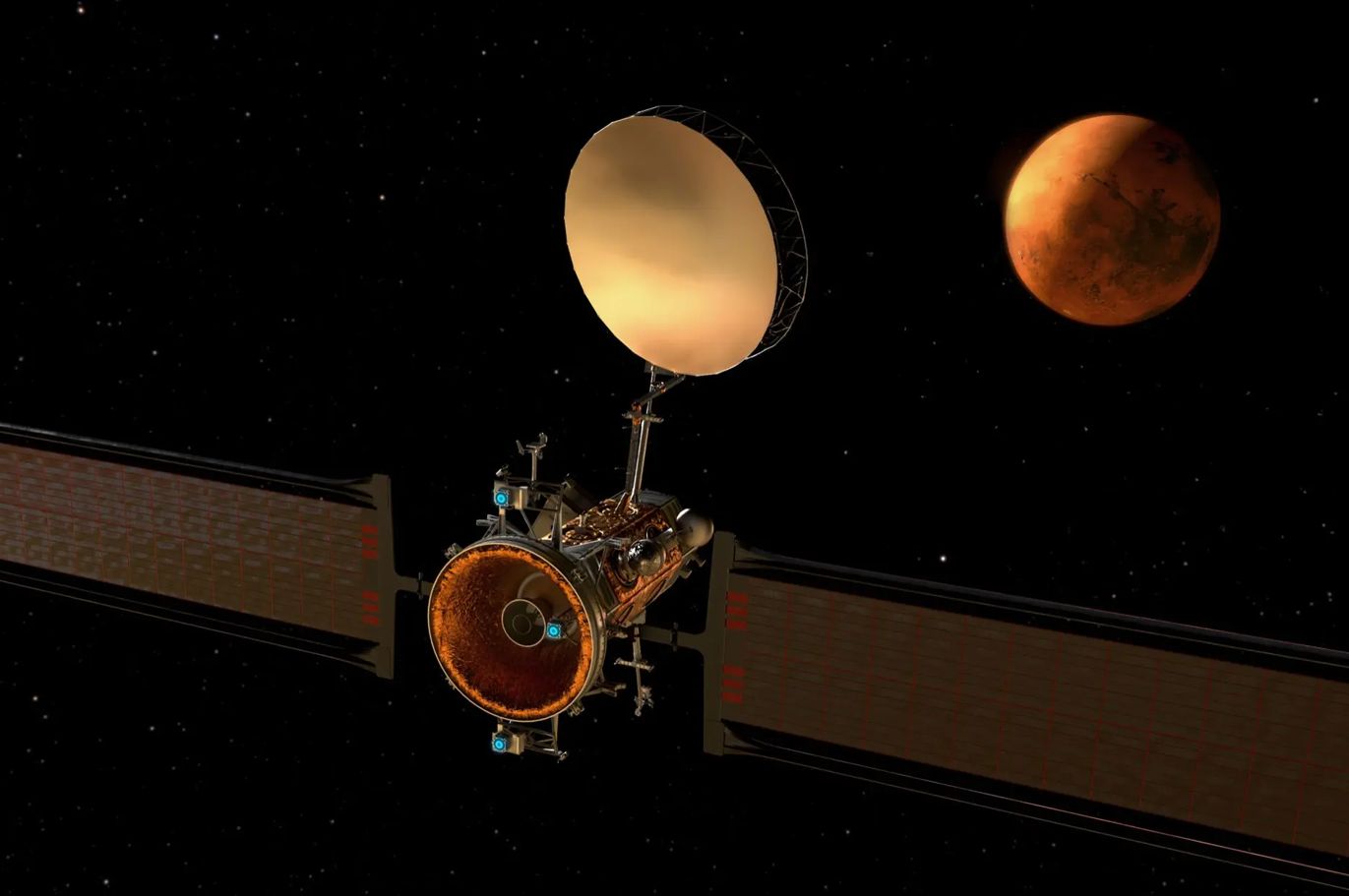
Rocket Lab’s protest centres on eligibility criteria embedded in the “One Big Beautiful Bill,” a 2025 congressional supplemental funding package. The legislation specified that candidates must have received Mars Sample Return design funding in fiscal year 2024 or 2025 and proposed an independently launched Mars telecommunications orbiter as part of an end-to-end sample-return mission. Rocket Lab asserts NASA’s selection of Blue Origin “appears to be inconsistent with the eligibility criteria mandated by Congress” and that the agency’s technical review was “inconsistent, making incorrect assertions and conclusions.”
Blue Origin responded by cautioning that delays could jeopardise the 2028 launch target, given Mars’s limited launch windows. The company expressed confidence in its proposal and NASA’s evaluation process, which it said upheld “Congress’s clear intent to support competition.”
Citations
- “MISSION SUCCESS: Rocket Lab Launches 95th Electron Mission” — https://rocketlabcorp.com/updates/mission-success/
- “MISSION SUCCESS: Rocket Lab Launches 94th Electron Mission” — https://rocketlabcorp.com/updates/mission-success-rocket-lab-launches-94th-electron-mission/
- “MISSION SUCCESS: Rocket Lab Launches 93rd Electron Mission” — https://rocketlabcorp.com/updates/mission-success-rocket-lab-launches-93rd-electron-mission/
- “Rocket Lab Introduces High-Efficiency Solar Cell to Reduce Reliance on Supply-Constrained Critical Minerals” — https://rocketlabcorp.com/updates/rocket-lab-introduces-high-efficiency-solar-cell-to-reduce-reliance-on-supply-constrained-critical-minerals/
- “Rocket Lab Onboarded to U.S. Space Force’s $981M NITE-STAR Program to Advance Space Test and Training Infrastructure” — https://rocketlabcorp.com/updates/new-blog-posrocket-lab-onboarded-to-u-s-space-forces-981m-nite-star-program-to-advance-space-test-and-training-infrastructure-program/
- “Rocket Lab is seeing red about NASA’s decision on a Mars spacecraft” — https://arstechnica.com/space/2026/09/rocket-lab-is-seeing-red-about-nasas-decision-on-a-mars-spacecraft/
- “Rocket Lab — Official Rocket Lab account (Past Week)” — https://x.com/RocketLab

Owl By The Dozen (StriX Launch 12)
Provider: Rocket Lab
Date: September 19, 2026
Time: 3:15 AM UTC
Vehicle: Electron
Synthetic aperture radar satellite for Japanese Earth imaging company Synspective.
LOXSAT 1
Provider: Rocket Lab
Date: September 30, 2026
Time: 12:00 AM UTC
Vehicle: Electron
LOXSAT 1 is a demonstration satellite of a complete cryogenic oxygen fluid management system in orbit, developed by Eta Space and sponsored by NASA’s Tipping Point program.
The system will be integrated on a Rocket Lab Photon-LEO satellite bus and collect critical cryogenic fluid management data in orbit for 9 months, demonstrating capabilities of in-space cryogenic storage and transferal. Eta Space plans to use technology developed for this mission to develop a truly commercial depot intended to serve multiple customers in the future.
6x HawkEye 360
Provider: Rocket Lab
Date: September 30, 2026
Time: 12:00 AM UTC
Vehicle: Electron
HawkEye 360 is a a space-based civil global intelligence satellite network using radio frequency (RF) technology to help monitor transportation across air, land and sea and assist with emergencies, and to provide civil SIGINT (Signal Intelligence) mission.
The constellation of small satellites (named Hawk ) will collect information on specific radio signals worldwide to provide high-precision radio frequency mapping and analytics from Low Earth orbit (LEO).
BlackSky Gen-3 6
Provider: Rocket Lab
Date: September 30, 2026
Time: 12:00 AM UTC
Vehicle: Electron
BlackSky Gen-3 Earth-imaging satellites
StriX Launch 13
Provider: Rocket Lab
Date: December 31, 2026
Time: 12:00 AM UTC
Vehicle: Electron
Synthetic aperture radar satellite for Japanese Earth imaging company Synspective.



Enjoying the content? Stay up to date on everything happening behind the scenes by following our Patreon!


Leave a Reply