
The Bright Blue Origin: Blue Origin’s Pivotal Spring: Equity Revamp, Planetary Shields, and a New CEO Vision
Blue In The News
Blue Origin is navigating a season of strategic recalibration, highlighted by a major shift in how it rewards its workforce. On March 9, CEO Dave Limp announced a new stock option plan—a direct response to years of employee frustration over the original 2016 equity scheme, whose options expired worthless last month. The new plan, set to begin issuing options this spring, promises “opportunities for liquidity events” that would allow employees to convert vested options into real value. Details remain scarce ahead of the April 17 company-wide meeting, but the move signals Blue Origin’s awareness that retaining top aerospace talent increasingly hinges on financial upside, not just mission-driven idealism.
The timing is critical. With SpaceX poised for an IPO that could mint thousands of millionaires and rivals like Rocket Lab and Relativity Space offering competitive packages, Blue Origin can no longer rely solely on its founder’s deep pockets. Jeff Bezos continues to inject billions annually, but the company’s estimated $1 billion in yearly revenue pales next to SpaceX’s projected $22–24 billion in 2026. The new equity plan may also hint at Bezos’s openness to outside investment—a notion once unthinkable but now floated by industry analysts as essential for Blue Origin to keep pace.
On the hardware front, Blue Origin is expanding its portfolio beyond launch vehicles. The company has unveiled NEO Hunter, a planetary defense concept developed with NASA’s Jet Propulsion Laboratory and Caltech. Built on the versatile Blue Ring platform, NEO Hunter would combine ion-beam deflection with a high-mass kinetic impactor—nearly nine times heavier than NASA’s DART spacecraft—as a dual-mode system to nudge hazardous asteroids off collision courses with Earth. Structural testing is underway at NASA’s Marshall Space Flight Center, while the first flight-ready Blue Ring unit undergoes evaluation at Blue Origin’s facilities. Importantly, this is still a concept; no launch date has been set.

Bright Blue Updates
Blue Origin’s launch cadence remains tightly focused on proving the reliability of its New Glenn rocket. As of mid-March 2026, the vehicle has flown twice—NG-1 in late 2025 and NG-2 on November 13, 2025. Work is now in full swing on the third New Glenn mission, which will carry AST SpaceMobile’s Block 2 BlueBird satellite. According to CEO Dave Limp’s March 17 tweet, the next BE-4 engine set is ready for installation on the third booster, and the upper stage—designated GS2-5—recently completed a hot-fire test producing 175,000 pounds of thrust.
Notably, Limp confirmed on February 19 that Flight 3 will reuse Booster 2, marking Blue Origin’s first attempt at booster recovery and reuse. The payload was encapsulated in the fairing at the “Lunar Plant 1” high bay and is now at Launch Complex 36 (LC-36) on Florida’s Space Coast for final integration. While no official launch date has been announced, industry observers anticipate a mid-2026 liftoff, pending payload readiness and range availability.
Meanwhile, Blue Ring—the company’s multi-mission orbital transfer vehicle—is transitioning from concept to reality. Blue Origin’s March 11 tweet confirmed that the platform will serve as the foundation for both NEO Hunter and the proposed Mars Telecommunications Orbiter. Designed to deliver up to 3,500 kg of hosted or deployable payloads across cislunar space and to Mars, Blue Ring offers significant delta-v for orbital maneuvering. Former ULA CEO Tory Bruno, now president of Blue Origin’s national security group, emphasized during a February 19 webinar that Blue Ring’s “enormous amount of delta-v” and AI-enhanced autonomy make it ideal for dynamic space operations—a growing priority for U.S. defense agencies concerned about orbital threats.
The Internet Of Amazon
While not directly part of Blue Origin’s core operations, Jeff Bezos’s broader space ambitions include the TeraWave broadband constellation—a separate 5,280-satellite network in low Earth orbit (LEO) paired with 128 medium Earth orbit (MEO) relay satellites. Announced via an FCC filing in January 2026, TeraWave targets enterprise and government customers with symmetrical 6-terabit-per-second point-to-point links using Q/V-band radio frequencies and optical ground terminals. Blue Origin stresses that TeraWave will not compete with Amazon’s own Amazon Leo constellation, which focuses on consumer and regional broadband.
TeraWave remains in early development, with no launch date set. Blue Origin claims it will fly the constellation on New Glenn rockets, though analysts question whether sufficient launch capacity exists given New Glenn’s current flight rate and existing manifest commitments—including 27 missions for Amazon Leo itself.

Blue Side Projects
Former United Launch Alliance CEO Tory Bruno’s move to Blue Origin continues to yield insights into the company’s national security ambitions. In a February 19 webinar, Bruno described his decision to join Blue Origin as driven by “urgent” concerns about U.S. readiness in dynamic space operations—the ability of satellites to maneuver autonomously in response to threats. He confirmed that Blue Ring will support a Defense Innovation Unit-funded mission launching later this year, though specific details remain classified.
Bruno’s presence underscores Blue Origin’s evolution from a launch-focused startup to what he calls a “full-service” space enterprise, spanning launchers (New Glenn), lunar landers (Blue Moon), orbital tugs (Blue Ring), and now national security spacecraft. His endorsement carries weight: under his leadership, ULA successfully fielded the Vulcan Centaur rocket, and his confidence in Blue Origin suggests serious momentum behind programs that have long operated in SpaceX’s shadow.

Citations
- “After falling far behind the rest of industry, Blue Origin creates new stock option plan” – https://arstechnica.com/space/2026/03/after-years-of-missteps-blue-origin-to-finally-offer-meaningful-stock-options/
- “Blue Origin Unveils NEO Hunter: A Hybrid Planetary Defense Concept” – https://www.nasaspaceflight.com/2026/03/blue-origin-neo-hunter-planetary-defense/
- “Blue Origin’s surprise TeraWave constellation jolts LEO broadband race” – https://spacenews.com/blue-origins-surprise-terawave-constellation-jolts-leo-broadband-race/
- “Bruno says he joined Blue Origin to work on ‘urgent’ national security projects” – https://spacenews.com/bruno-says-he-joined-blue-origin-to-work-on-urgent-national-security-projects/
Upcoming Launches
BlueBird Block 2 #2
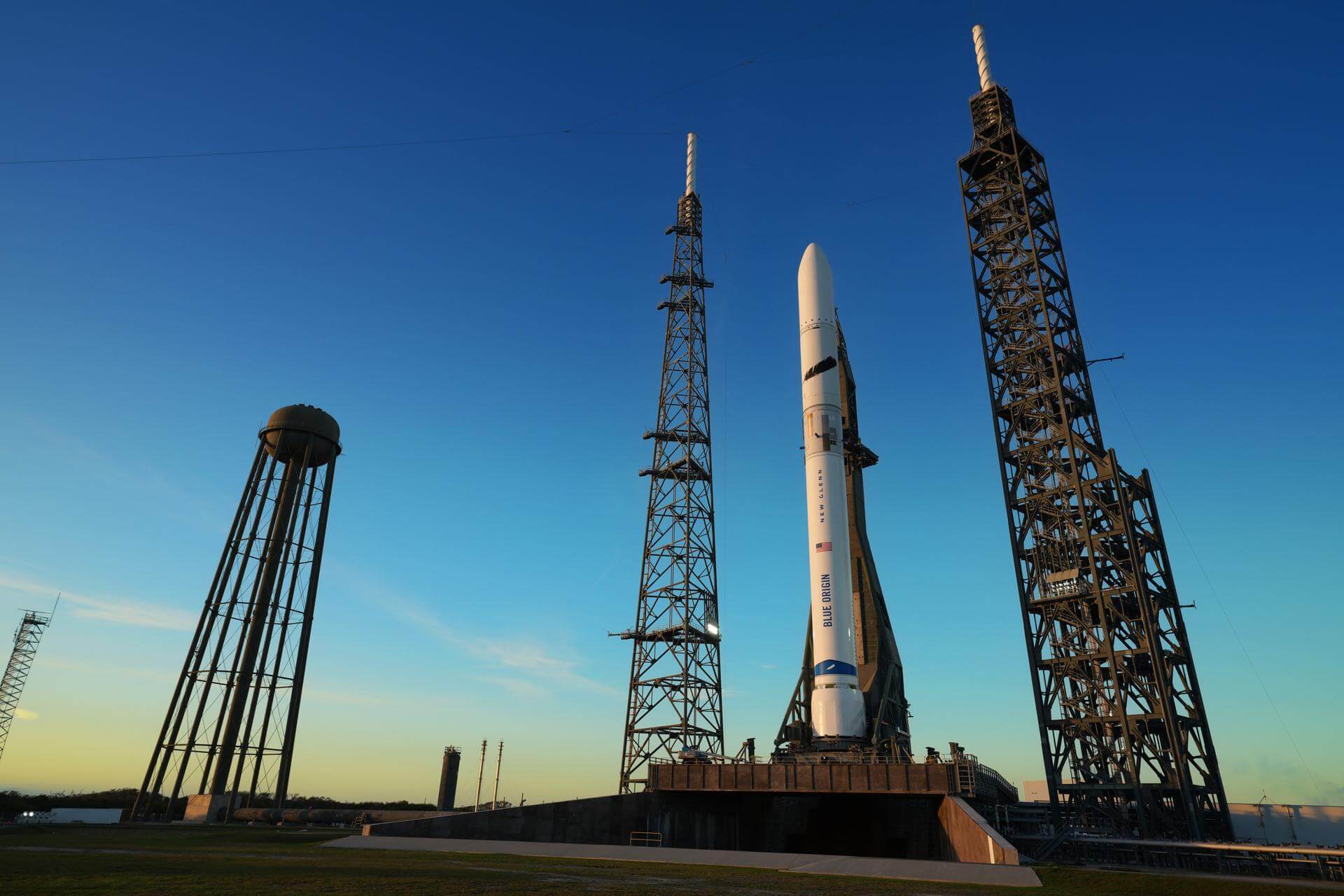
Launch Provider: Blue Origin – Commercial
Launch Date: March 31, 2026
Launch Time: 12:00 AM UTC
Vehicle: New Glenn
Brief: AST SpaceMobile’s Block 2 BlueBird satellites are designed to deliver up to 10 times the bandwidth capacity of the BlueBird Block 1 satellites, required to achieve 24/7 continuous cellular broadband service coverage in the United States, with beams designed to support a capacity of up to 40 MHz, enabling peak data transmission speeds up to 120 Mbps, supporting voice, full data and video applications. The Block 2 BlueBirds, featuring as large as 2400 square foot communications arrays, will be the largest satellites ever commercially deployed in Low Earth orbit once launched.
This launch will feature 1 satellite, BlueBird 7/BlueBird Block 2 FM2.
📽️ No Livestream scheduled yet
Amazon Leo (New Glenn #1)
Launch Provider: Blue Origin – Commercial
Launch Date: December 31, 2026
Launch Time: 12:00 AM UTC
Vehicle: New Glenn
Brief: Amazon Leo, formerly known as Project Kuiper, is a mega constellation of satellites in Low Earth Orbit that will offer broadband internet access, this constellation will be managed by Kuiper Systems LLC, a subsidiary of Amazon. This constellation is planned to be composed of 3,276 satellites. The satellites are projected to be placed in 98 orbital planes in three orbital layers, one at 590 km, 610 km and 630 km altitude.
61 satellites will be carried on each New Glenn launch.
📽️ No Livestream scheduled yet
BlueBird Block 2 #4
Launch Provider: Blue Origin – Commercial
Launch Date: December 31, 2026
Launch Time: 12:00 AM UTC
Vehicle: New Glenn
Brief: AST SpaceMobile’s Block 2 BlueBird satellites are designed to deliver up to 10 times the bandwidth capacity of the BlueBird Block 1 satellites, required to achieve 24/7 continuous cellular broadband service coverage in the United States, with beams designed to support a capacity of up to 40 MHz, enabling peak data transmission speeds up to 120 Mbps, supporting voice, full data and video applications. The Block 2 BlueBirds, featuring as large as 2400 square foot communications arrays, will be the largest satellites ever commercially deployed in Low Earth orbit once launched.
This launch will feature 8 satellites.
📽️ No Livestream scheduled yet
Blue Moon Pathfinder
Launch Provider: Blue Origin – Commercial
Launch Date: December 31, 2026
Launch Time: 12:00 AM UTC
Vehicle: New Glenn
Brief: First flight of Blue Origin’s Blue Moon MK1 lunar lander, MK1-SN001 “Endurance”.
📽️ No Livestream scheduled yet
Blue Moon Pathfinder Mission 2 & VIPER
Launch Provider: Blue Origin – Commercial
Launch Date: December 31, 2027
Launch Time: 12:00 AM UTC
Vehicle: New Glenn
Brief: 2nd of the National Team’s Blue Moon MK1 lunar lander test missions to validate the necessary technologies for its HLS lunar module. Some of the life support hardware will travel on this mission in preparation for the first crew Blue Moon flight.
This mission will also carry NASA’s VIPER (Volatiles Investigating Polar Exploration Rover) lunar rover. VIPER is designed to explore the relatively nearby but extreme environment of the Moon in search of ice and other potential resources. This mobile robot will land at the South Pole of the Moon on a 100-day mission, in order to teach us about the origin and distribution of water on the Moon and help determine how we can harvest the Moon’s resources for future human space exploration.
VIPER is designed to roam the Moon using its three instruments and a 1 meter long drill to detect and analyze various lunar soil environments at a range of depths and temperatures. The rover can venture into permanently shadowed craters, some of the coldest spots in the solar system, where ice reserves have endured for billions of years.
The rover was originally slated to launch on Astrobotic’s Griffin Mission One lunar lander (with the Falcon Heavy rocket), but the VIPER mission was cancelled in July 2024 due to budget cuts. After consulting with the industry to find alternative ways to deliver the rover to the lunar surface, NASA ultimately chose to launch it with Blue Origin’s 2nd Blue Moon MK1 lander mission.
📽️ No Livestream scheduled yet
