
Rocket Lab Roundup: Rocket Lab Soars: Record-Breaking Year and Massive Contracts Define December 2025
Rocket Lab’s Stellar Year and Landmark Deals
Rocket Lab has had a monumental close to 2025, setting new benchmarks and securing game-changing contracts that solidify its position in the global space industry. The company announced a staggering $816 million prime contract from the U.S. Space Development Agency (SDA) to design and manufacture 18 satellites for the Tracking Layer Tranche 3 (TRKT3) program under the Proliferated Warfighter Space Architecture (PWSA). Announced on December 19, 2025, this deal is Rocket Lab’s largest single contract to date, focusing on missile warning, tracking, and defense sensors for global threat detection. With additional subsystem opportunities, the total capture value could approach $1 billion, showcasing Rocket Lab’s growing clout in national security space.
This contract builds on a previous $515 million award for the Transport Layer-Beta Tranche 2 program, bringing Rocket Lab’s total SDA contract value to over $1.3 billion. The company’s vertically integrated approach—producing everything from solar arrays to payloads in-house—has been key to its ability to deliver speed, cost efficiency, and quality, disrupting traditional defense primes. As Peter Beck, Rocket Lab’s founder and CEO, noted, this approach is enabling a “fundamental shift” in how national security space programs are executed.
Closer to home for Canadian readers, while no direct partnerships with Canadian entities were announced this month, Rocket Lab’s work on scalable space systems could open future opportunities for collaboration with Canadian space tech firms or agencies like the Canadian Space Agency, especially given our country’s focus on satellite innovation and northern surveillance. For now, Rocket Lab’s trajectory continues to inspire as it redefines what’s possible in space access and technology.

Electron’s Record-Setting Launches in December 2025
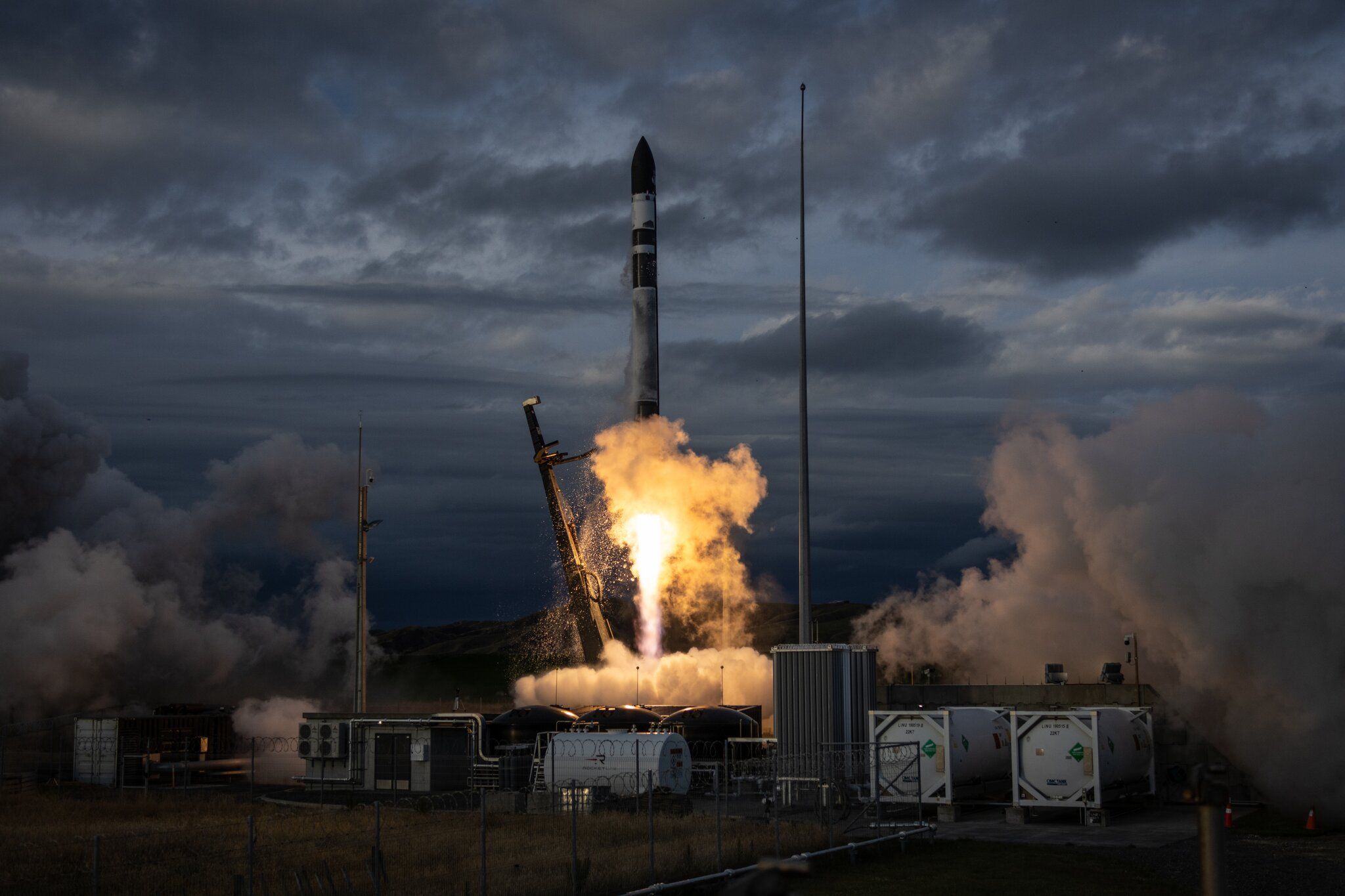
Rocket Lab wrapped up 2025 with a flurry of successful Electron launches, achieving a record-breaking 21 missions for the year with 100% mission success. On December 18, the company executed the STP-S30 mission, named ‘Don’t Be Such A Square,’ for the U.S. Space Force and NASA. Launching from Rocket Lab Launch Complex 2 at Wallops Island, Virginia, at 12:03 a.m. EST (05:03 UTC), Electron deployed four innovative DiskSat spacecraft to a 550km low Earth orbit. These disk-shaped satellites, developed by The Aerospace Corporation, aim to test maneuverability and electric propulsion for future small satellite missions. Impressively, Rocket Lab accelerated this launch by five months, showcasing its industry-leading responsiveness.

Just days later, on December 21 at 7:36 p.m. NZDT (06:36 UTC), Rocket Lab completed its final launch of the year with ‘The Wisdom God Guides’ mission from Launch Complex 1 in Mahia, New Zealand. This flight deployed the QPS-SAR-15 satellite for the Institute for Q-shu Pioneers of Space, Inc. (iQPS), a Japan-based Earth imaging company, adding to their synthetic aperture radar constellation. This was Rocket Lab’s first dedicated launch for JAXA and marked the seventh satellite deployed for iQPS since 2023, with five more planned for 2026. This 21st launch cemented Electron as the world’s most frequently launched small-lift orbital rocket in 2025.
Neutron on the Horizon for 2026
As Rocket Lab looks ahead to 2026, anticipation builds for the debut of its Neutron launch vehicle, designed to unlock medium-lift capabilities for constellation deployment, national security, and exploration missions. While specific updates on Neutron’s development progress were limited this month, the company reiterated its focus on preparing for the rocket’s inaugural flight in 2026. Following Electron’s record-setting year, Neutron represents the next step in Rocket Lab’s mission to expand access to space, and we’ll be watching closely for test updates or milestones in the coming months. For Canadian space enthusiasts, Neutron’s capabilities could eventually support launches of larger Canadian-built satellites or payloads, enhancing our presence in orbit.
Interplanetary Progress with ESCAPADE
Beyond launches and contracts, Rocket Lab provided exciting updates on its ESCAPADE mission for NASA, aimed at studying Mars’ atmospheric escape. On January 6, 2026, the Gold spacecraft completed its second and longest trajectory correction maneuver (TCM-2), lasting 97.7 seconds, sending it past the Earth-Sun L2 Lagrange point into a deep-space cruise phase alongside its twin, Blue. Both spacecraft are on track for a Trans-Mars Injection burn in November 2026, with arrival at Mars expected in September 2027. This mission highlights Rocket Lab’s growing role in interplanetary exploration, paving the way for future scientific insights that could captivate space fans across Canada and beyond.

Citations
- “Rocket Lab Awarded $816M Prime Contract to Build Missile-Defense Satellite Constellation for U.S. Space Force” – https://rocketlabcorp.com/updates/rocket-lab-awarded-816m-prime-contract-to-build-missile-defense-satellite-constellation-for-u-s-space-force/
- “Rocket Lab Successfully Launches for iQPS, Ends 2025 with 21 Launches and 100% Mission Success” – https://rocketlabcorp.com/updates/rocket-lab-successfully-launches-for-iqps-ends-2025-with-21-launches-and-100-mission-succes/
- “Rocket Lab Executes Successful Launch of STP-S30 Mission for the Department of War” – https://rocketlabcorp.com/updates/rocket-lab-executes-successful-launch-of-stp-s30-mission-for-the-department-of-war/
- “Rocket Lab Schedules Launch for U.S. Space Force’s STP-S30 Mission, Brings Launch Forward By Several Months” – https://rocketlabcorp.com/updates/rocket-lab-schedules-launch-for-u-s-space-forces-stp-s30-mission-brings-launch-forward-by-several-months/
- “So you’re in space and on the way to Mars, what next?” – https://rocketlabcorp.com/updates/so-youre-in-space-and-on-the-way-to-mars-what-next/
- “Rocket Lab wraps up record launch year” – https://spacenews.com/rocket-lab-wraps-up-record-launch-year/
- “Rocket Lab launches 4 novel DiskSat satellites for U.S. Space Force, NASA” – https://spaceflightnow.com/2025/12/18/rocket-lab-launches-4-novel-disksat-satellites-for-u-s-space-force-nasa/
- “After record-breaking 2025, Rocket Lab prepares for Neutron’s debut in 2026” – https://www.nasaspaceflight.com/2025/12/rocket-lab-2025-overview/
Upcoming Rocket Lab Launches
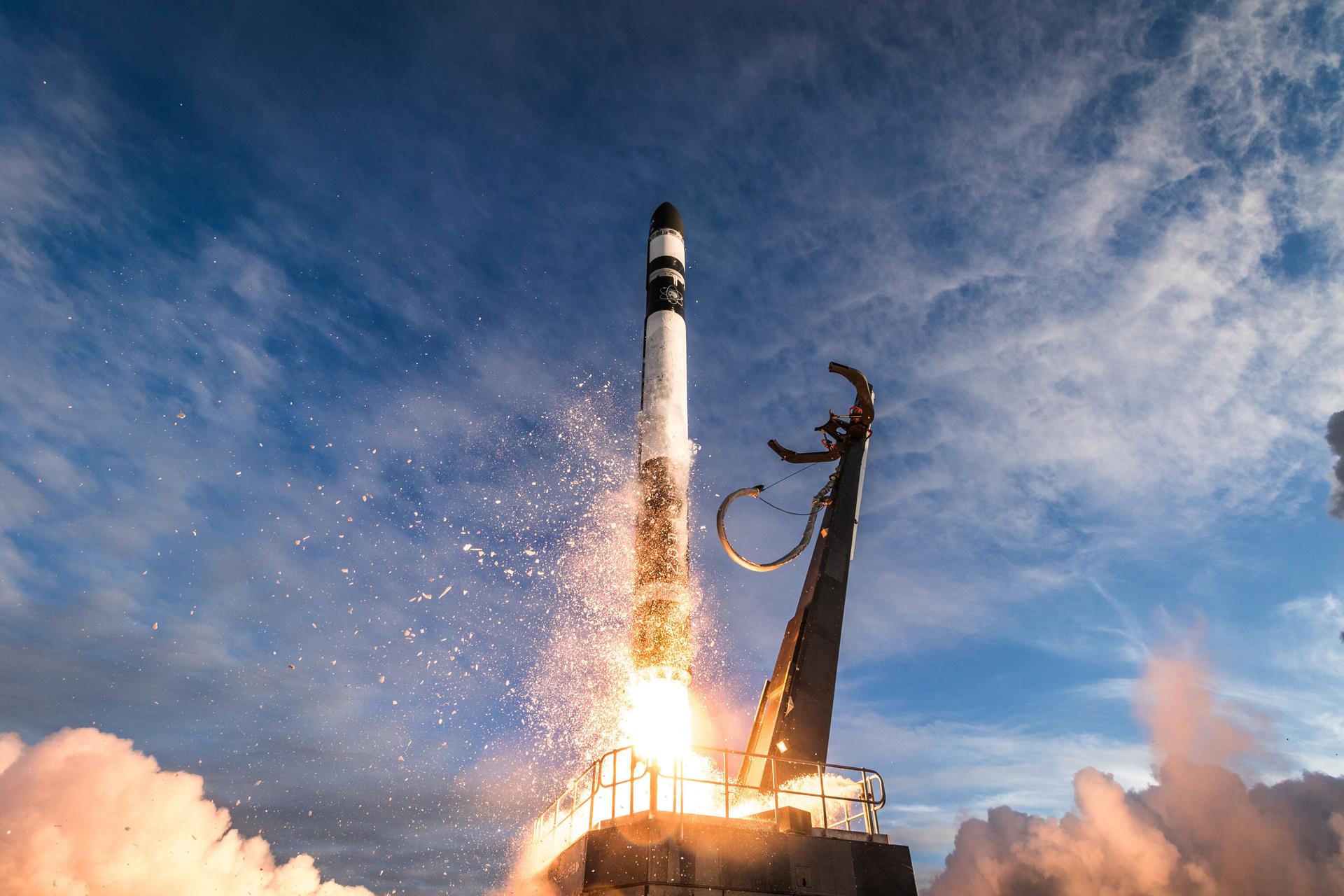
Bridging The Swarm (NeonSat-1A)
Launch Provider: Rocket Lab – Commercial
Launch Date: January 31, 2026
Launch Time: 12:00 AM UTC
Vehicle: Electron
Brief: The NeonSat-1A, carrying a high-resolution optical camera, is designed to test the constellation capabilities of the South Korean government’s Earth observation micro-satellite constellation NeonSat (New-space Earth Observation Satellite), in particular technology improvements identified from operations of NeonSat-1 after its launch in April 2024. These technologies will in turn be incorporated into the next 10 NeonSat under construction, as well as providing more site re-visiting capabilities along with NeonSat-1.
The NeonSat constellation is the first satellite system developed by the government using a mass-production approach for precise monitoring of the Korean Peninsula, lead by the Satellite Technology Research Center (SaTReC) at the Korea Advanced Institute of Science and Technology (KAIST), Korea’s leading university dedicated to science and technology. Designed to capture near-real time natural disaster monitoring for the Korean peninsula, KAIST’s NEONSAT constellation is a collaboration across multiple Korean academic, industry, and research institutions, including SaTReC, which is leading the program’s system design and engineering.
The NEONSAT program is funded by the Korean government’s Ministry of Science and ICT (MSIT).
LOXSAT 1
Launch Provider: Rocket Lab – Commercial
Launch Date: March 31, 2026
Launch Time: 12:00 AM UTC
Vehicle: Electron
Brief: LOXSAT 1 is a demonstration satellite of a complete cryogenic oxygen fluid management system in orbit, developed by Eta Space and sponsored by NASA’s Tipping Point program.
The system will be integrated on a Rocket Lab Photon-LEO satellite bus and collect critical cryogenic fluid management data in orbit for 9 months, demonstrating capabilities of in-space cryogenic storage and transferal. Eta Space plans to use technology developed for this mission to develop a truly commercial depot intended to serve multiple customers in the future.
Kakushin Rising (JAXA Rideshare)
Launch Provider: Rocket Lab – Commercial
Launch Date: March 31, 2026
Launch Time: 12:00 AM UTC
Vehicle: Electron
Brief: JAXA-manifested rideshare of eight separate spacecraft that includes educational small sats, an ocean monitoring satellite, a demonstration satellite for ultra-small multispectral cameras, and a deployable antenna that can be packed tightly using origami folding techniques and unfurled to 25 times its size.
The satellites were originally planned to launch with RAISE-4 on a Japanese Epsilon-S rocket, but the Epsilon-S was heavily delayed due to test firing failures.
The 8 satellites are:
* MAGNARO-II
* KOSEN-2R
* WASEDA-SAT-ZERO-II
* FSI-SAT2
* OrigamiSat-2
* Mono-Nikko
* ARICA-2
* PRELUDE
