
The SpaceX Report: Record-Breaking Boosters, Starship Breakthroughs, and Starlink’s Quiet Canadian Impact
Starship Takes Root at Cape Canaveral
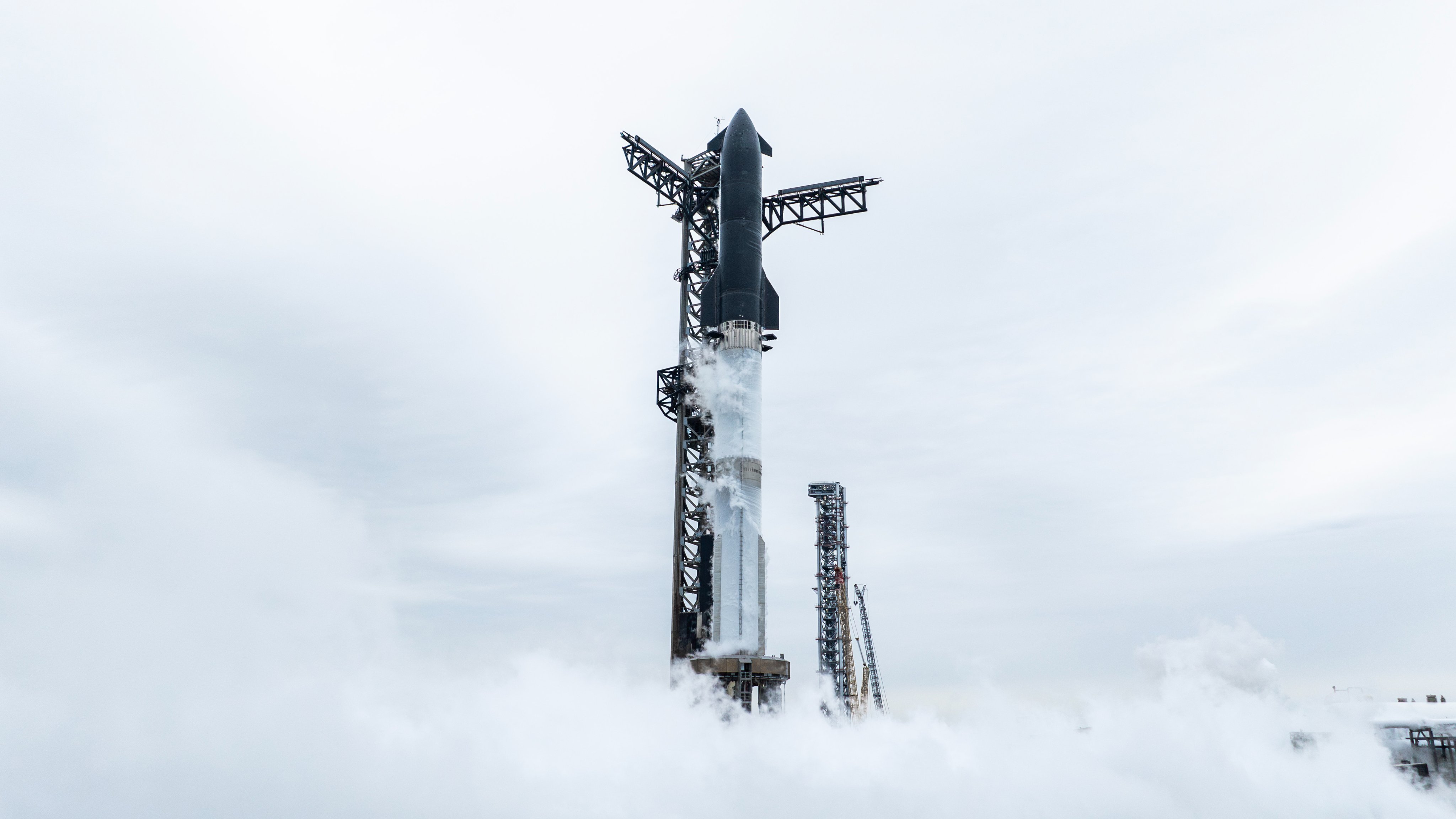
SpaceX has cleared a major bureaucratic hurdle this week: it received final environmental approval and authorization from the Department of the Air Force to transform the former Delta IV launch site—Space Launch Complex 37 (SLC-37)—into a full-fledged Starship launch complex at Cape Canaveral Space Force Station. This marks the second official Starship launch location in Florida, joining the under-construction pad at Kennedy Space Center’s LC-39A.
According to the finalized Environmental Impact Statement (EIS), the new complex could eventually support up to 76 Starship launches per year, along with an equal number of static fire tests for both boosters and ships. The plan includes dual launch mounts, two launch towers with “chopstick” catching arms, and extensive propellant infrastructure capable of storing 16,500 tons of liquid oxygen, 6,500 tons of liquid nitrogen, and 5,000 tons of liquid methane—enough for roughly 2.5 launches.
Demolition of the old SLC-37B pad is complete, and SpaceX confirmed on December 1 that construction has already begun. While the EIS estimates a 12-month build timeline, industry observers note that Pad 2 at Starbase is still under construction after 20 months, suggesting timelines may stretch. Still, with tower segments already fabricated at Roberts Road near Cape Canaveral, vertical assembly could begin as early as Q1 2026.
Notably, the site plan also includes an on-site methane liquifier and air separation unit, reducing reliance on trucked-in propellants—a strategic move for rapid reusability and launch cadence. Elon Musk emphasized that these Florida pads will support both national security missions and NASA’s Artemis program, reinforcing Starship’s role as the backbone of U.S. deep-space ambitions.

Starbase Infrastructure: Building for Scale
While attention shifts to Florida, SpaceX continues to expand its Starbase facility in Boca Chica, Texas. Though no major launches occurred this week from the site, construction remains active on Pad 2—the second orbital launch mount designed to handle the full Starship stack with catch capabilities.
Recent updates from internal timelines suggest Pad 2’s foundation work, including Continuous Flight Auger (CFA) piles and flame trench reinforcement, is nearing completion. The speed-core tower base—a hollow steel structure filled with concrete—is expected to follow, mirroring the design now being implemented at SLC-37. This standardization across sites hints at SpaceX’s push toward modular, repeatable infrastructure.
Production-wise, the Gigabay continues to churn out Starship vehicles, though exact output rates remain undisclosed. One key development: Raptor 3 engine testing is now routine, with Musk declaring it “the most advanced rocket engine ever made.” A December 3 test video showed a Raptor 3 performing a simulated ascent burn, part of validation for Starship’s three inner engines that endure the highest thermal and structural loads during liftoff.
Despite the lack of a launch this week, Starbase remains the proving ground for next-generation systems. With Florida pads years from matching Starbase’s operational tempo, Texas will likely host the next few integrated flights—assuming regulatory approvals align.
Falcon 9 Sets New Reusability Record
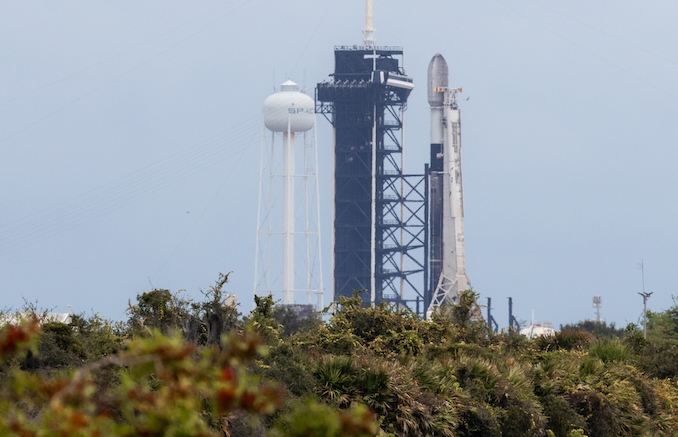
SpaceX’s workhorse Falcon 9 had an exceptionally busy week, with five Starlink missions launched between December 1 and 7—three from Vandenberg Space Force Base in California and two from Florida.
The standout achievement came on Sunday, December 7, with the Starlink 6-92 mission from Kennedy Space Center’s LC-39A. Aboard the flight was booster B1067, completing its 32nd launch and landing—a new record for orbital-class rocket reuse. That same day, another Falcon 9 launched 28 Starlink satellites from Vandenberg (Starlink 11-15), continuing deployment into the mid-inclination Group 11 shell.
Earlier in the week, missions like Starlink 6-95 (December 2) and Starlink 11-25 (December 4) added 29 and 28 satellites respectively, all v2 Mini variants. Notably, the December 1 Vandenberg launch (Starlink 15-10) targeted the 70-degree inclination shell—critical for coverage in high-latitude regions like northern Canada, Alaska, and Scandinavia.
With over 150 Falcon 9 launches already completed in 2025, SpaceX is on track for ~170 total launches this year—further cementing its dominance in global orbital access.
Starlink’s Subsidy Reality and Global Growth
While Starlink blankets more of the planet in high-speed internet, its path to rural broadband funding in the U.S. hit a reality check. According to a December 4 report, SpaceX (alongside Amazon) will receive only 4% of the $20 billion allocated by U.S. states under the federal BEAD program—though that slice covers roughly 21% of eligible rural locations.
This modest share reflects regulatory caution and competition from terrestrial providers, but it doesn’t dampen Starlink’s global momentum. Elon Musk announced South Korea as the latest market on December 4, and publicly appealed for support in India and Namibia—markets where regulatory approval is still pending.
Meanwhile, Starlink’s utility for high-latitude coverage remains strategically relevant for Canada. The Group 15 shell—deployed December 1—specifically enhances service across the Canadian North, where traditional infrastructure is sparse or nonexistent. Though SpaceX doesn’t break out Canadian subscriber numbers, anecdotal evidence suggests growing adoption in remote communities, research stations, and maritime operations.
Back on the human spaceflight front, Roscosmos quietly replaced a cosmonaut on the upcoming Crew Dragon mission to the ISS, though neither NASA nor the Russian agency disclosed the reason. No other Crew or Cargo Dragon missions were scheduled this week.

Citations
- “SpaceX gets approval to build Starship launch complex at Cape Canaveral” – https://spacenews.com/spacex-gets-approval-to-build-starship-launch-complex-at-cape-canaveral/
- “SpaceX gets Environmental Approval for Starship at SLC-37” – https://www.nasaspaceflight.com/2025/12/spacex-environmental-approval-starship-slc-37/
- “Final proposals leave SpaceX and Amazon with 4% of $20 billion rural broadband subsidies” – https://spacenews.com/final-proposals-leave-spacex-and-amazon-with-4-of-20-billion-rural-broadband-subsidies/
- “Live coverage: SpaceX to launch 3,000th Starlink satellite in 2025 on record-setting 32nd flight of Falcon 9 booster” – https://spaceflightnow.com/2025/12/07/live-coverage-spacex-to-launch-3000th-starlink-satellite-in-2025-on-record-setting-32nd-flight-of-falcon-9-booster/
- “Roscosmos replaces cosmonaut on next Crew Dragon mission to ISS” – https://spacenews.com/roscosmos-replaces-cosmonaut-on-next-crew-dragon-mission-to-iss/
- Elon Musk Tweet, December 6, 2025 – https://x.com/elonmusk/status/1997401910635278368
- SpaceX Tweet, December 1, 2025 – https://x.com/SpaceX/status/1995641577591767181
Upcoming Starship Launch
Flight 12
Launch Provider: SpaceX – Commercial
Launch Date: January 31, 2026
Launch Time: 1/31/2026, 12:00 AM UTC
Vehicle: Starship
Brief: 12th test flight of the two-stage Starship launch vehicle. Maiden Flight of Starship V3
