
Canada From Orbit: Canada’s Space Momentum Builds: From Lunar Triumphs to Sovereign Launch Ambitions
Canadian Space Agency Celebrates Artemis II, Prepares for Crew-13
May 2026 finds the Canadian Space Agency (CSA) riding a wave of national pride following the successful completion of the Artemis II mission. On April 10, CSA astronaut Jeremy Hansen returned to Earth after becoming the first Canadian to travel to the Moon and back—a historic milestone that capped a 9-day journey covering more than 1.1 million kilometres. The crew aboard NASA’s Orion spacecraft broke the Apollo 13 distance record on April 6, reaching 406,773 km from Earth before executing a flawless lunar flyby. Canadians watched closely as Hansen participated in live downlinks, including a memorable call with Prime Minister Mark Carney on April 8.
With Artemis II in the books, attention turns to the next Canadian mission to orbit. Astronaut Joshua Kutryk is scheduled to launch no earlier than September 2026 as part of NASA’s SpaceX Crew-13 mission to the International Space Station (ISS). This flight will mark the first time a Canadian astronaut flies under NASA’s Commercial Crew Program. While aboard the ISS, Kutryk will conduct human health research with potential applications for Canadians on Earth.
Back in low Earth orbit, Canadarm2 continues its legacy of reliable operations. On April 13, the CSA-built robotic arm successfully installed Northrop Grumman’s Cygnus XL cargo spacecraft to the Unity module of the ISS. The mission, CRS-24, delivered over 11,000 pounds of supplies and scientific equipment and will remain docked until October.
The CSA also remains active on the policy and partnership front. At the 41st Space Symposium in Colorado Springs (April 13–16), CSA President Lisa Campbell signed a new Memorandum of Understanding with the Korea AeroSpace Administration (KASA) and reaffirmed Canada’s commitment to international collaboration. The agency also highlighted its support for Canadian industry, notably Kepler Communications’ expanded role in the European Space Agency’s HydRON optical communications network.

Nord Space News
As of May 6, 2026, there are no significant public updates from Nord Space in the provided sources. The company’s activities this month appear limited compared to other Canadian launch stakeholders. Should Nord Space announce developments related to its planned launch infrastructure or partnerships, they would likely align with the broader national push toward sovereign launch capability—a theme gaining momentum following the introduction of Bill C-28, the Canadian Space Launch Act.
Maritime Launch Services Advances Spaceport Nova Scotia
Maritime Launch Services (MLS) is making tangible progress on Spaceport Nova Scotia, buoyed by recent federal support and evolving regulatory clarity. On May 5, MLS Vice President of Spaceport Operations Melissa Quinn emphasized the strategic importance of sovereign launch infrastructure during the Canadian Space Launch Conference in Ottawa, stating that Canada “must build sovereign access to space” to ensure national security and economic resilience.
Groundwork is now visible at the Canso site, with local contractors installing roads and preparing areas for security, payload processing, and launch control facilities. This on-the-ground activity follows the federal government’s April announcement of a $200 million investment over 10 years to support the spaceport’s development.
MLS continues to advocate for Bill C-28, which would modernize Canada’s regulatory framework to permit orbital launches from Canadian soil. The company maintains that this legislation is essential to unlocking Spaceport Nova Scotia’s potential as a gateway to orbit for Canadian and international payloads. While no launch date has been announced, MLS is positioning itself to support Canada’s long-term launch ambitions once regulatory and infrastructure milestones are met.

Canadian News From Orbit
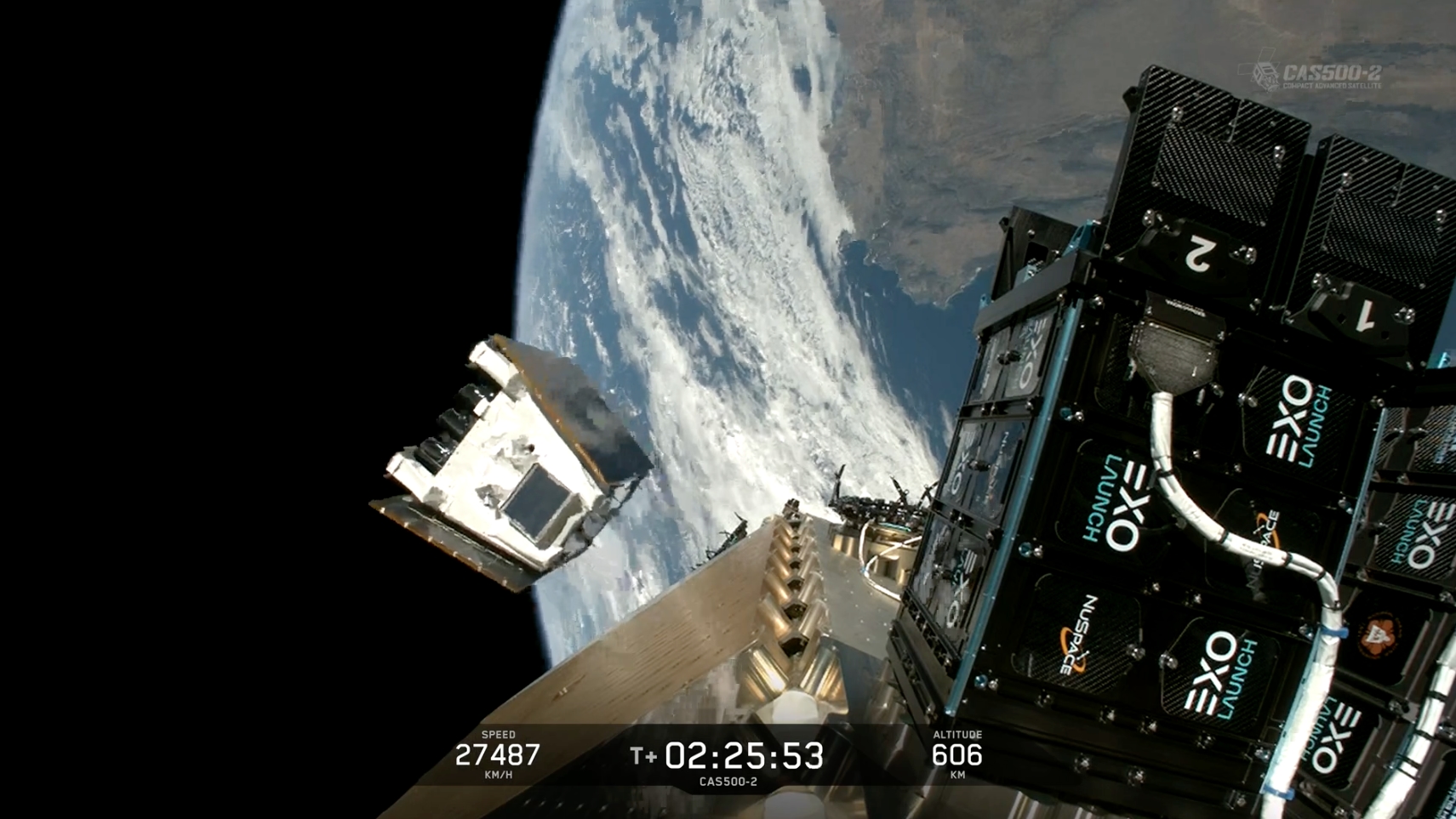
Canada’s presence in orbit grew significantly in early May with the successful deployment of seven Canadian satellites on a SpaceX rideshare mission. Launched on May 4 aboard a Falcon 9 carrying the CAS500-2 primary payload, the secondary manifest included six Earth observation satellites for Vancouver-based EarthDaily Analytics (EDC-02 through EDC-07). These spacecraft expand EarthDaily’s constellation to seven and bring it closer to full commercial operations, planned for late summer 2026. The company’s “AI-ready” data strategy—focused on consistent, calibrated measurements rather than high-resolution snapshots—is gaining traction with government and commercial clients concerned with data sovereignty.
Also aboard was FrontierSat (CTS-SAT-1), the first satellite built by the University of Calgary. Developed by the student-led CalgaryToSpace team, this 3U CubeSat carries a Mini Plasma Imager to study the auroral phenomenon known as STEVE. After overcoming last-minute customs hurdles by driving the satellite across the border into Montana, the team confirmed successful deployment and plans to operate FrontierSat for at least three years from the Rothney Astrophysical Observatory.
In the commercial sector, Telesat confirmed its fully funded path toward launching its Lightspeed Low Earth Orbit (LEO) constellation by the end of Q1 2028. The company reported $171 million invested in the programme during Q1 2026, bringing total spending to approximately $2.7 billion. Telesat also highlighted strong interest from allied governments in its newly added Military Ka-band (Mil-Ka) capacity, and expects to finalize a major contract under the Enhanced Satellite Communications Project – Polar (ESCAPE) in the coming months.
Meanwhile, Reaction Dynamics continues advancing Canada’s domestic launch technology. Senior Additive Manufacturing Engineer Oscar Sanchez Mata detailed how the Montreal-based company uses 3D printing to produce complex hybrid rocket engine components, including nozzles and combustion chambers, in single-piece builds that reduce cost and manufacturing time. These innovations support RDX’s upcoming Aurora suborbital demonstration and contribute to Canada’s broader sovereign launch ecosystem.
Citations
- “Rocket Report: Artemis III rocket getting ready; SpaceX is now an AI company” – https://arstechnica.com/space/2026/04/rocket-report-some-canadians-dont-want-a-spaceport-falcon-hits-600-landings/
- “ESA begins next phase of ‘fibre in the sky’ optical communications project with Canada” – https://www.esa.int/Applications/Connectivity_and_Secure_Communications/ESA_begins_next_phase_of_fibre_in_the_sky_optical_communications_project_with_Canada
- “Canadarm2 Installs Cygnus XL Cargo Craft to Unity Module” – https://www.nasa.gov/blogs/spacestation/2026/04/13/canadarm2-installs-cygnus-xl-cargo-craft-to-unity-module/
- “SpaceX deploys seven Canadian satellites on CAS500-2 mission, marking University of Calgary’s first” – https://spaceq.ca/spacex-deploys-seven-canadian-satellites-on-cas500-2-mission-marking-university-of-calgarys-first/
- “Telesat confirms fully funded 2028 Lightspeed timeline following Q1 design reviews” – https://spaceq.ca/telesat-confirms-fully-funded-2028-lightspeed-timeline-following-q1-design-reviews/
No upcoming launches scheduled at this time.
