
The SpaceX Report: Constellations, Controversies, and Countdowns: SpaceX’s Busy Week in Brief
Starship V3 Launch Slips—Again
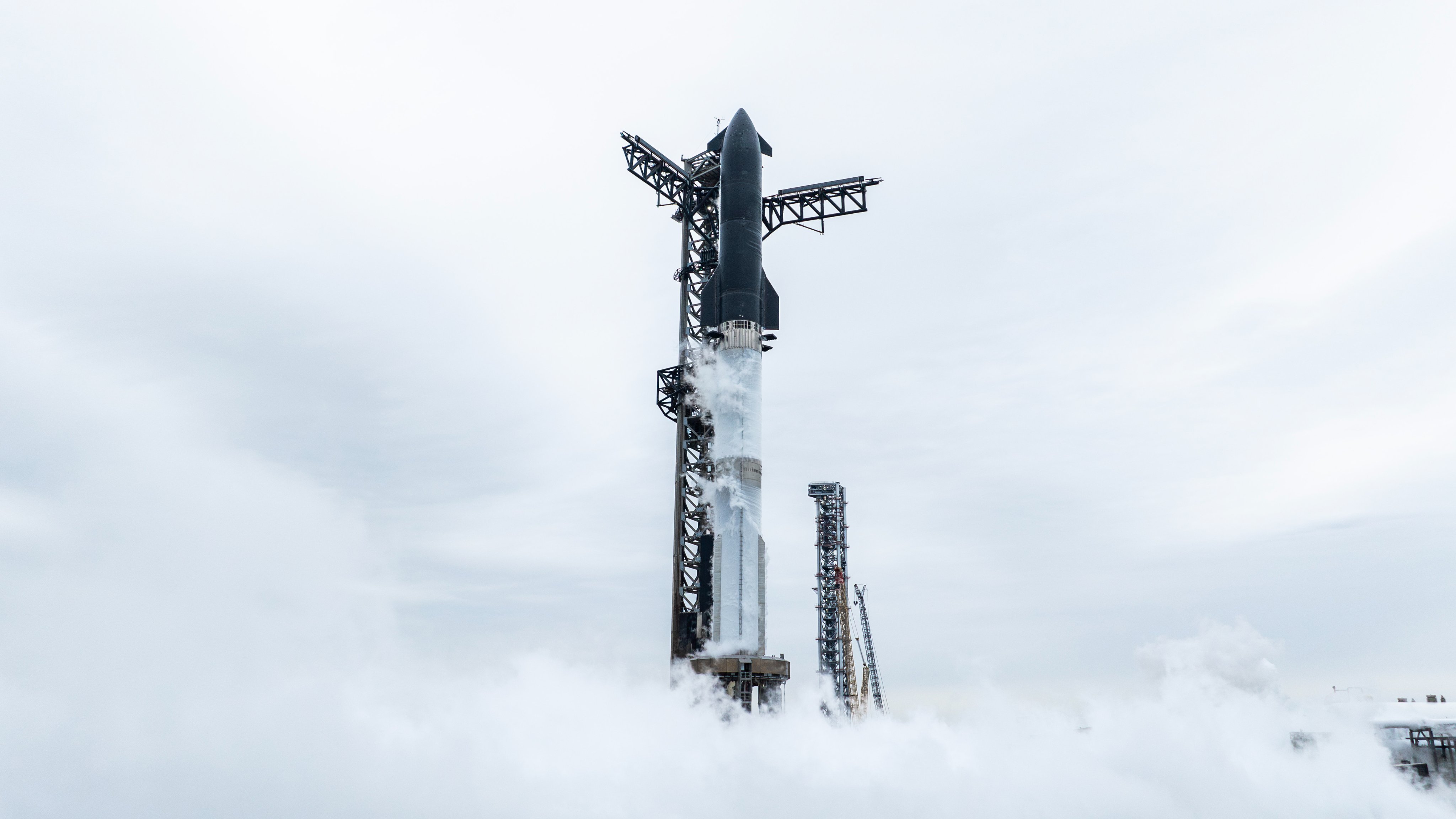
SpaceX’s much-anticipated debut of the Starship V3 configuration has been pushed back once more. On March 7, Elon Musk stated via social media that the first flight of the upgraded vehicle would occur “in about 4 weeks”—pointing to an April 4, 2026 launch date. This marks a four-week delay from his previous estimate of a March 9 liftoff.
The vehicle in question, Ship 39, recently completed cryoproof testing at Starbase, Texas, validating its structural integrity under cryogenic conditions. However, no official launch date has been confirmed by SpaceX, and no maritime or airspace notices have been issued—typical precursors to an imminent launch.
This latest slip comes as NASA intensifies pressure on SpaceX to accelerate development of the Human Landing System (HLS) variant of Starship for Artemis missions. Despite the delay, NASA Administrator Jared Isaacman indicated in late February that both SpaceX and Blue Origin have submitted acceleration plans deemed acceptable by the agency. Under the revised Artemis architecture, Artemis 3 will now be a low Earth orbit docking demonstration in mid-2027, with the first lunar landing attempt shifted to Artemis 4 in early 2028.
As Musk noted, Starship V3 is intended to be SpaceX’s “production rocket,” featuring design improvements aimed at boosting performance and reusability over the V2 version, which last flew in October 2025. The delay follows a November 21, 2025 incident in which the first V3 Super Heavy booster was damaged during testing.

Inside the Starfactory: Steel to Starship
While launch dates shift, SpaceX’s industrial engine at Starbase continues to hum. The Starfactory—a permanent, high-volume manufacturing facility completed in early 2022—has fully replaced the temporary tents once used for Starship assembly. Now, it’s the central hub for producing Block 3 (V3) Starship hardware, with parallel production lines for both the Ship upper stage and Super Heavy booster.
Inside, automated robotic cutters and welders shape stainless steel coils into precision components, while specialized systems install the Thermal Protection System (TPS) tiles and ablative backup layers. A key innovation is the “N:3” stacking method, where the nosecone and three adjacent barrel sections are pre-assembled before being moved to Megabay 2 for full integration. This streamlines production and reduces time on the final assembly floor.
Similarly, Super Heavy boosters are assembled in Megabay 1, with recent builds—including Booster 19—incorporating an extra liquid oxygen tank to support landing burns. After stacking, both vehicles undergo rigorous cryogenic proof testing at the Masseys test site before engine installation and static fire trials.
Though much of the interior remains hidden from public view, the Starfactory’s scale and efficiency are visible in its output: a steady cadence of increasingly refined Starship prototypes, each bringing SpaceX closer to its orbital refueling and lunar ambitions.

Falcon 9 Delivers EchoStar-25 in Middle-of-the-Night Launch
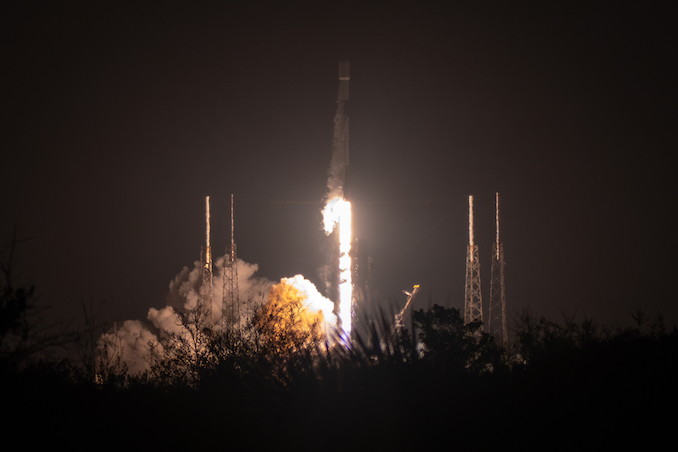
On March 9, 2026, at 12:19 a.m. EDT, a Falcon 9 rocket successfully launched the EchoStar-25 direct broadcast satellite from Cape Canaveral’s Space Launch Complex 40. The mission, flown on booster B1085—making its 14th flight—delivered the satellite to geosynchronous transfer orbit before it maneuvers to its final slot at 110° West.
Just over 8.5 minutes after liftoff, B1085 nailed its 146th drone ship landing on A Shortfall of Gravitas in the Atlantic, marking SpaceX’s 583rd successful booster recovery. The satellite, built by Lanteris Space (formerly Maxar Space Systems), will provide television services to Dish Network customers across North America.
In a notable twist, EchoStar recently agreed to sell $17 billion worth of spectrum licenses to SpaceX—split evenly between cash and stock—to support the development of Starlink Mobile (formerly Starlink Direct to Cell). EchoStar CEO Charles Ergen called SpaceX “the most viable company” to lead in direct-to-mobile space services, signaling a strategic pivot from competitor to collaborator.
Regulatory Row and Lunar Control Concerns
SpaceX found itself in the regulatory spotlight this week as FCC Chairman Brendan Carr publicly criticized Amazon for challenging SpaceX’s application to deploy up to 1 million satellites for orbital data centers. Carr, posting on X on March 11, argued Amazon should focus on meeting its own regulatory deadlines—specifically, deploying half of its 3,236-satellite Kuiper constellation by July 30, 2026, a target it has admitted it will miss.
Meanwhile, a NASA Office of Inspector General report released March 10 revealed ongoing disagreements between the agency and SpaceX over manual flight controls for the lunar version of Starship. While Apollo astronauts routinely used manual override during Moon landings, SpaceX’s current design leans heavily on automation. NASA insists manual control is essential for crew safety, especially given Starship’s lack of flight heritage in the lunar environment. The issue remains unresolved ahead of the Critical Design Review.
For Canadian readers, while no Canadian astronauts or payloads are directly involved in these developments, the broader implications—such as orbital congestion, spectrum allocation, and the pace of lunar exploration—could shape Canada’s future role in space policy and international partnerships.

Citations
- “FCC chair blasts Amazon after it criticizes SpaceX megaconstellation” – https://arstechnica.com/space/2026/03/fcc-chair-blasts-amazon-after-it-criticizes-spacex-megaconstellation/
- “NASA and SpaceX disagree about manual controls for lunar lander” – https://arstechnica.com/space/2026/03/nasa-and-spacex-disagree-about-manual-controls-for-lunar-lander/
- “From Steel Rolls to Starship at the Starfactory” – https://www.nasaspaceflight.com/2026/03/steel-rolls-to-starship/
- “First Starship V3 launch slips” – https://spacenews.com/first-starship-v3-launch-slips/
- “SpaceX launches direct television satellite for EchoStar” – https://spaceflightnow.com/2026/03/09/live-coverage-spacex-to-launch-direct-television-satellite-for-echostar/
Upcoming Starship Launches
Flight 12

Launch Provider: SpaceX – Commercial
Launch Date: April 30, 2026
Launch Time: 12:00 AM UTC
Vehicle: Starship
Brief: 12th test flight of the two-stage Starship launch vehicle. Maiden Flight of Starship V3
📽️ No Livestream scheduled yet
Flight 13
Launch Provider: SpaceX – Commercial
Launch Date: June 30, 2026
Launch Time: 12:00 AM UTC
Vehicle: Starship
Brief: 13th test flight of the two-stage Starship launch vehicle. Second flight of Starship V3
📽️ No Livestream scheduled yet
Superbird-9
Launch Provider: SpaceX – Commercial
Launch Date: June 30, 2027
Launch Time: 12:00 AM UTC
Vehicle: Starship
Brief: Superbird-9 is a high throughput communication satellite. It is designed to deliver broadcast and broadband missions in Ku band primarily over Japan and Eastern Asia, in response to mobility and broadband demands.
📽️ No Livestream scheduled yet
Starlab
Launch Provider: SpaceX – Commercial
Launch Date: December 31, 2029
Launch Time: 12:00 AM UTC
Vehicle: Starship
Brief: Private space station developed by a joint venture between Voyager Space and Airbus.
📽️ No Livestream scheduled yet
Upcoming Falcon Heavy Launches
ViaSat-3 F3 (ViaSat-3 Asia-Pacific)
Launch Provider: SpaceX – Commercial
Launch Date: April 30, 2026
Launch Time: 12:00 AM UTC
Vehicle: Falcon Heavy
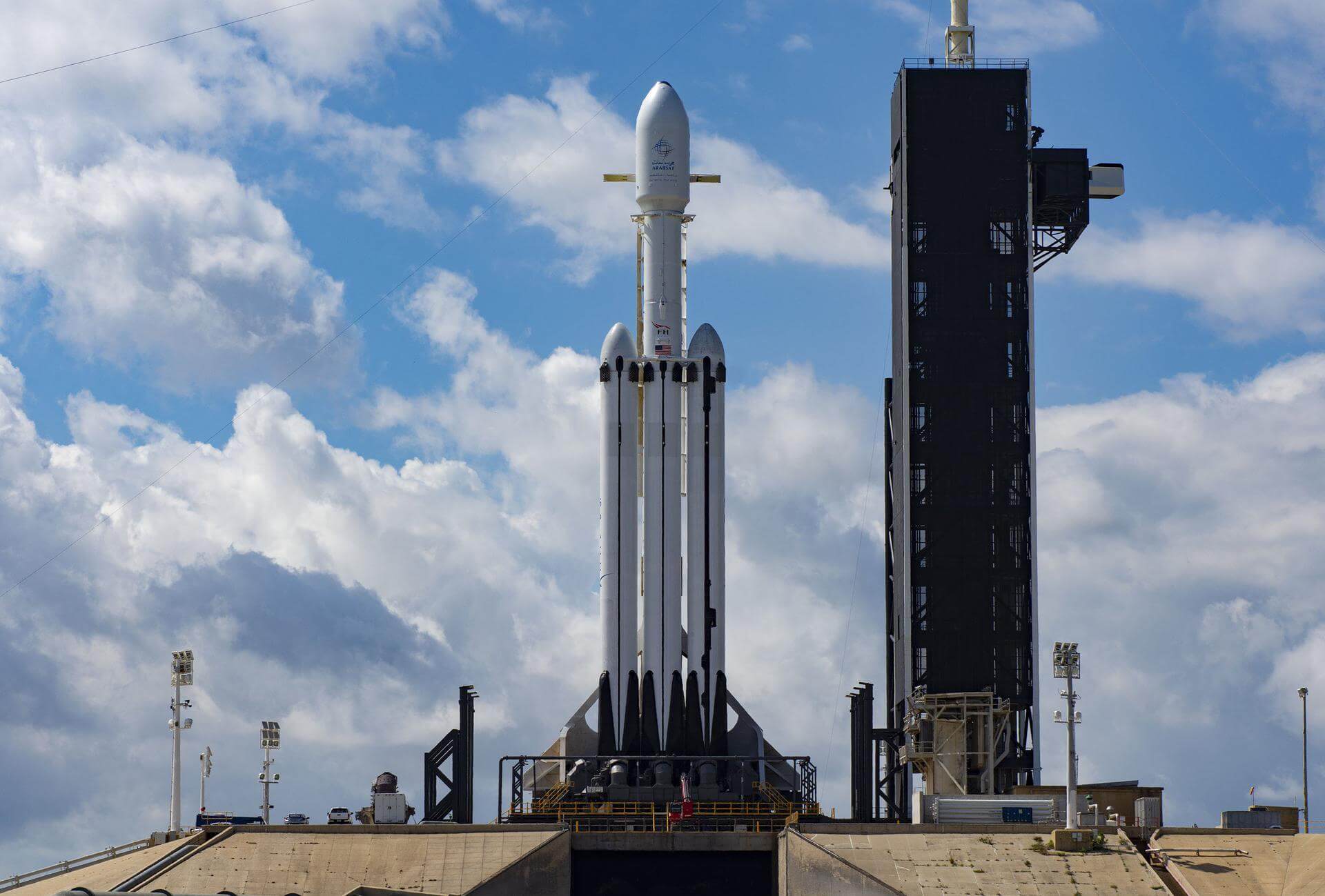
Brief: The ViaSat-3 is a series of three Ka-band satellites is expected to provide vastly superior capabilities in terms of service speed and flexibility for a satellite platform. Each ViaSat-3 class satellite is expected to deliver more than 1-Terabit per second of network capacity, and to leverage high levels of flexibility to dynamically direct capacity to where customers are located.
📽️ No Livestream scheduled yet
Griffin Mission One
Launch Provider: SpaceX – Commercial
Launch Date: July 31, 2026
Launch Time: 12:00 AM UTC
Vehicle: Falcon Heavy
Brief: Demonstration flight of the Astrobotic Griffin lander and its engines, initially contracted for the cancelled NASA VIPER (Volatiles Investigating Polar Exploration Rover) mission. The vacated payload spot will now host the FLIP (FLEX Lunar Innovation Platform) lunar rover from Astrolab.
📽️ No Livestream scheduled yet
Nancy Grace Roman Space Telescope
Launch Provider: SpaceX – Commercial
Launch Date: September 28, 2026
Launch Time: 12:00 AM UTC
Vehicle: Falcon Heavy
Brief: The Nancy Grace Roman Space Telescope is a NASA infrared space telescope with a 2.4 m (7.9 ft) wide field of view primary mirror and two scientific instruments. The Wide-Field Instrument (WFI) is a 300.8-megapixel multi-band visible and near-infrared camera, providing a sharpness of images comparable to that achieved by the Hubble Space Telescope over a 0.28 square degree field of view, 100 times larger than imaging cameras on the Hubble. The Coronagraphic Instrument (CGI) is a high-contrast, small field of view camera and spectrometer covering visible and near-infrared wavelengths using novel starlight-suppression technology. Roman objectives include a search for extra-solar planets using gravitational microlensing, and probing the expansion history of the Universe and the growth of cosmic structure, with the goal of measuring the effects of dark energy, the consistency of general relativity, and the curvature of spacetime.
📽️ No Livestream scheduled yet
USSF-70
Launch Provider: SpaceX – Commercial
Launch Date: December 31, 2026
Launch Time: 12:00 AM UTC
Vehicle: Falcon Heavy
Brief: Classified payload for the United States Space Force
📽️ No Livestream scheduled yet
USSF-75
Launch Provider: SpaceX – Commercial
Launch Date: December 31, 2026
Launch Time: 12:00 AM UTC
Vehicle: Falcon Heavy
Brief: Classified payload for the United States Space Force
📽️ No Livestream scheduled yet
