
The Daily Broadcast: From Martian Craters to Canadian Space Security: A Busy Week in the Final Frontier

ESA’s Mars Express Reveals Ancient Secrets in Arabia Terra
ESA’s long-serving Mars Express orbiter has delivered another stunning view of the Red Planet, this time zooming in on the heavily cratered expanse of Arabia Terra. The image, captured by the High Resolution Stereo Camera (HRSC), showcases a landscape battered by eons of impacts—some dating back as far as 4.1 billion years. Among the most prominent features is Trouvelot Crater, a 130-kilometre-wide depression whose crumbling rim and terraced walls tell the story of relentless erosion over billions of years.
What makes this region especially intriguing is the mix of dark, volcanic “mafic” material—rich in iron and magnesium—and lighter-toned mounds that may have formed in the presence of water. Scientists believe these light deposits could be remnants of ancient lakes or groundwater activity, offering clues to a wetter Martian past. The dark material has been sculpted by steady winds into crescent-shaped dunes known as barchan dunes, a phenomenon Mars Express has observed in other regions like the north polar area and near Tharsis.
Launched in 2003, Mars Express continues to provide high-resolution, colour, and 3D mapping of the Martian surface, fundamentally reshaping our understanding of the planet. The HRSC instrument was developed and is operated by the German Aerospace Center (DLR), with image processing led by teams at Freie Universität Berlin.

Canada’s Space Commander Warns of Growing Threats to Orbital Infrastructure
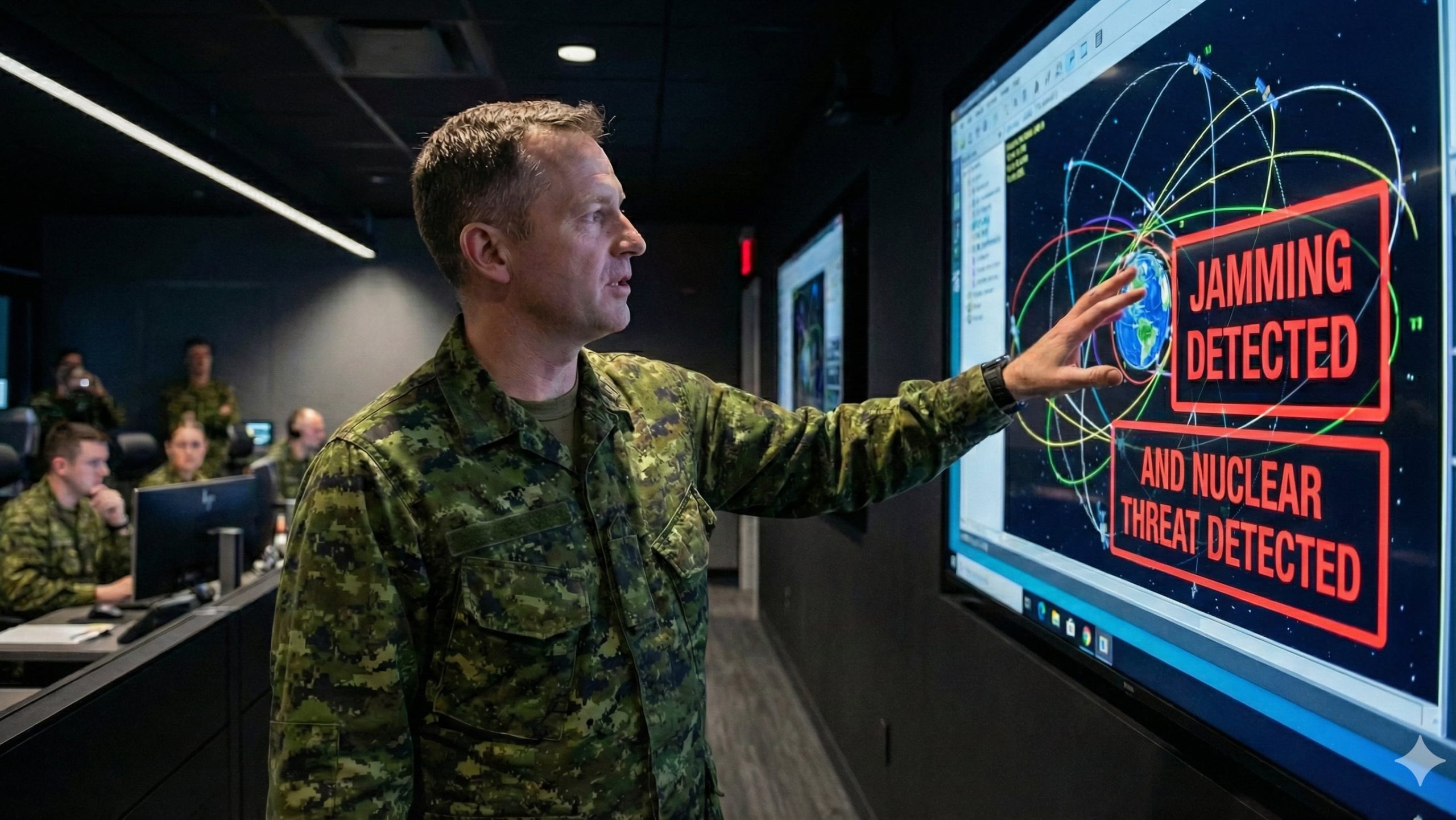
As Canadians go about their daily routines—navigating with GPS, ordering food, or tracking weather—they may not realize how vulnerable these conveniences are to disruption from space. Brigadier-General Christopher Horner, Commander of 3 Canadian Space Division, issued a sobering warning in a recent interview on CBC’s The House, highlighting the risks of electronic jamming and, more alarmingly, a potential nuclear detonation in low Earth orbit.
Such a detonation would generate an electromagnetic pulse (EMP) capable of disabling satellites across a vast area, crippling everything from financial networks to emergency response systems. Horner noted that while this scenario remains hypothetical, the threat of electronic warfare is already real: Russian jamming operations in Ukraine have already extended hundreds of kilometres into space, affecting commercial satellite constellations like Starlink and Viasat.
In response, Canada is investing $183 million in sovereign space launch capabilities to ensure it can deploy and replace critical national assets without relying on foreign launch providers during a crisis. “We have to look at the capabilities we require to harden the infrastructure we rely on and to be resilient in the face of threats,” Horner said. Emphasizing Canada’s role as a “middle power,” he stressed diplomacy and international cooperation over developing offensive space weapons.
Blue Origin Enters the Broadband Race with TeraWave Constellation
In a move that surprised many in the space industry, Blue Origin has unveiled plans for its own satellite internet constellation called TeraWave. The company recently filed details with the U.S. Federal Communications Commission (FCC) outlining a two-tier network: more than 5,000 low Earth orbit (LEO) satellites operating in high-frequency Q- and V-bands, linked via lasers to 128 medium Earth orbit (MEO) spacecraft designed to deliver point-to-point data connections at up to 6 terabits per second.
Unlike consumer-focused services like Starlink or Amazon’s Kuiper (also backed by Jeff Bezos), TeraWave is being positioned as a premium enterprise and government service, capped at around 100,000 customer sites worldwide to avoid congestion. Blue Origin claims the system will cater to mission-critical applications such as data centre interconnects, logistics, and secure government operations. The company plans to launch the constellation using its New Glenn rocket, though it has not yet announced a firm launch date.
Industry analysts remain cautious. “I am not convinced it’s real,” said Armand Musey of Summit Ridge Group, citing limited launch capacity even as Blue Origin competes with Amazon for New Glenn flights. The technology—particularly optical space-to-ground links and rain-sensitive Q/V-band frequencies—remains largely unproven at scale. Still, rivals like SES and Telesat acknowledge the potential market shift, with some suggesting TeraWave could expand the addressable market for high-capacity satellite links, even if it never fully materializes on Blue Origin’s timeline.

Citations
- “Counting craters” – https://www.esa.int/Science_Exploration/Space_Science/Mars_Express/Counting_craters
- “Canada’s space commander on protecting satellites from jamming and potential nuclear risks” – https://spaceq.ca/canadas-space-commander-on-protecting-satellites-from-jamming-and-potential-nuclear-risks/
- “Blue Origin’s surprise TeraWave constellation jolts LEO broadband race” – https://spacenews.com/blue-origins-surprise-terawave-constellation-jolts-leo-broadband-race/
Upcoming Launches
Starlink Group 10-40
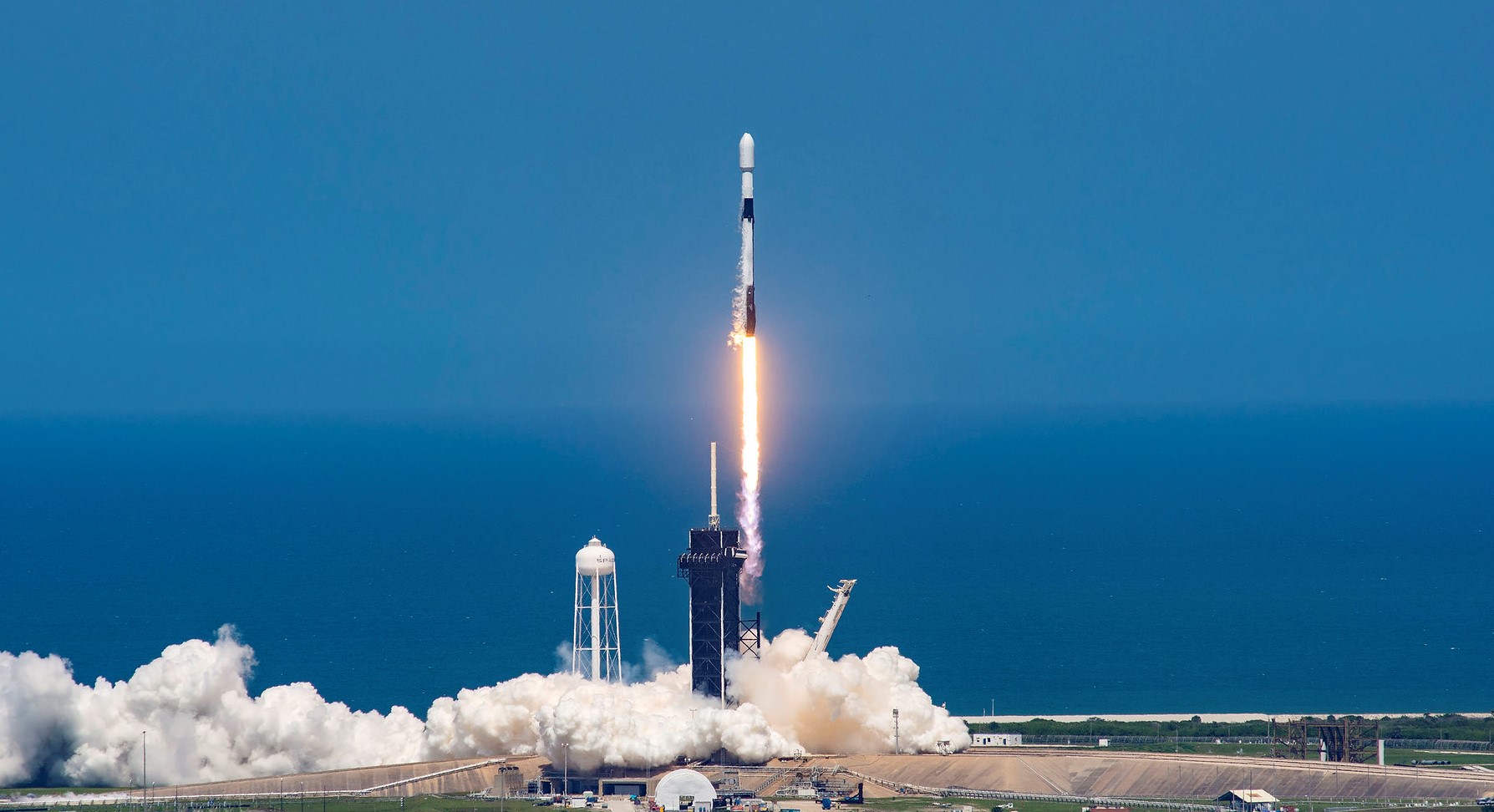
Launch Provider: SpaceX – Commercial
Launch Date: March 4, 2026
Launch Time: 10:52 AM UTC
Vehicle: Falcon 9
Brief: A batch of 29 satellites for the Starlink mega-constellation – SpaceX’s project for space-based Internet communication system.
Flight 3

Launch Provider: Space One – Commercial
Launch Date: March 5, 2026
Launch Time: 2:10 AM UTC
Vehicle: KAIROS
Brief: Third flight of the KAIROS launch vehicle.
5 satellites will be on board:
* TATARA-1R
* SC-Sat1a
* HErO
* AETS-1
* Nutsat-3 (TASA/Taiwan)
Starlink Group 17-18
Launch Provider: SpaceX – Commercial
Launch Date: March 7, 2026
Launch Time: 10:58 AM UTC
Vehicle: Falcon 9
Brief: A batch of 25 satellites for the Starlink mega-constellation – SpaceX’s project for space-based Internet communication system.
EchoStar 25
Launch Provider: SpaceX – Commercial
Launch Date: March 10, 2026
Launch Time: 3:14 AM UTC
Vehicle: Falcon 9
Brief: EchoStar 25 is a direct broadcast satellite, built on the proven Maxar 1300 series platform, which will deliver content across North America. It will be equipped with a high-power, multi-spot beam payload, allowing DISH to provide high-quality content to its customers.
Starlink Group 17-31
Launch Provider: SpaceX – Commercial
Launch Date: March 10, 2026
Launch Time: 10:58 AM UTC
Vehicle: Falcon 9
Brief: A batch of 25 satellites for the Starlink mega-constellation – SpaceX’s project for space-based Internet communication system.
