
The SpaceX Report: Block 3 Preparations Heat Up as Starlink Cadence Sets New Records
Starship’s Block 3 Debut Nears with Booster 19 Readiness
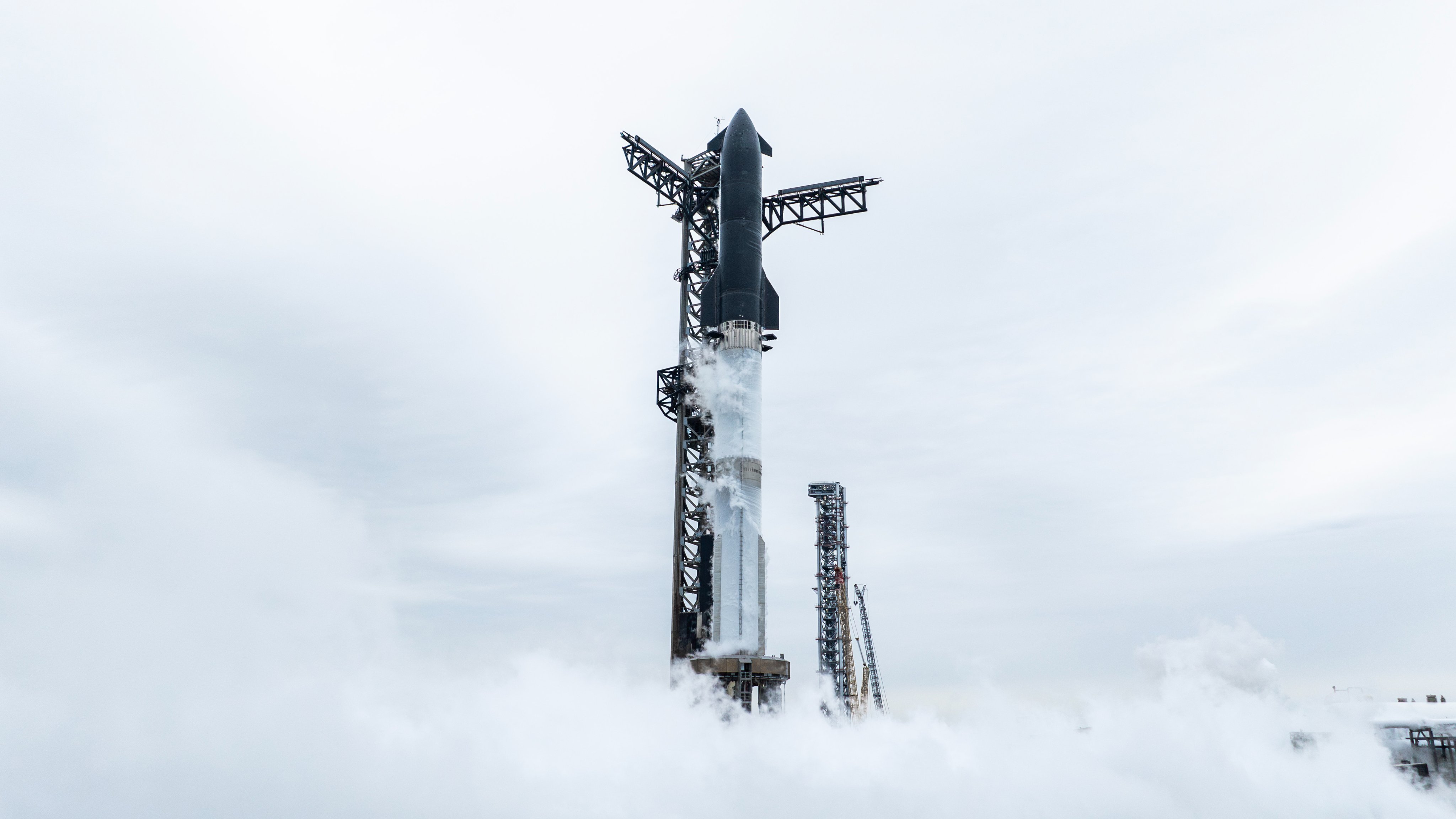
At Starbase in Texas, SpaceX is laying the groundwork for the next major leap in its Starship program: the debut of the Block 3 (or V3) configuration during Flight 12. The centerpiece of this effort is Super Heavy Booster 19, which recently completed successful cryogenic proof testing at the Massey test site and has now returned to Mega Bay 1 for installation of its 33 new Raptor 3 engines. This follows the scrapping of Booster 18 due to issues uncovered during earlier testing, making B19’s smooth performance a critical milestone.
Flight 12 will mark the first time a Block 3 Starship and Super Heavy fly together, introducing significant upgrades aimed at improving reliability and reusability. While the launch date remains unconfirmed, preparations are accelerating. Booster 19 is scheduled to roll out to Pad 2 later this month for a static fire test—the first major integrated challenge for the freshly upgraded launch complex.
One key decision still pending is whether SpaceX will conduct a full-stack wet dress rehearsal (WDR) with both booster and ship on Pad 2 before Flight 12. Given that both the vehicle and the pad are new, a WDR would offer valuable data on ground system interactions, though SpaceX has opted to skip such tests in recent campaigns. Observers note that the operational logic may favour caution this time.

Pad 2 Gets Watery Upgrade; Pad 1 Rebuild Continues
Starbase’s Pad 2 has undergone a dramatic transformation to support the immense power of Block 3 vehicles. On February 17, SpaceX successfully tested the new water-cooled top deck on the Orbital Launch Mount (OLM), demonstrating the system’s ability to manage extreme heat and acoustic forces from 33 Raptor 3 engines. The deluge system—designed to avoid the “concrete tornado” seen during early Starship flights—spewed water high into the air during the test, a clear sign of the system’s robust pressure capabilities.
Additional work is underway at Pad 2, including refinements to the ship quick disconnect arm and the installation of a new protective roof on the launch tower. A Buckner-owned LR11000 crawler crane is scheduled to install this roof between February 13 and March 16, likely to shield sensitive equipment during future ship catch attempts. Notably, Pad 2 has not yet flowed cryogenic propellants into a vehicle—a key step before full operations can begin.
Meanwhile, Pad 1 is being rebuilt to mirror Pad 2’s latest standards, including a new water-cooled launch mount, flame trench, and chopstick catch system. Continuous Flight Auger piling for the flame trench appears complete, with teams now installing sheet piles to manage groundwater—an engineering challenge reminiscent of historical issues at NASA’s Kennedy Space Center.

Falcon 9 and Falcon Heavy Operations
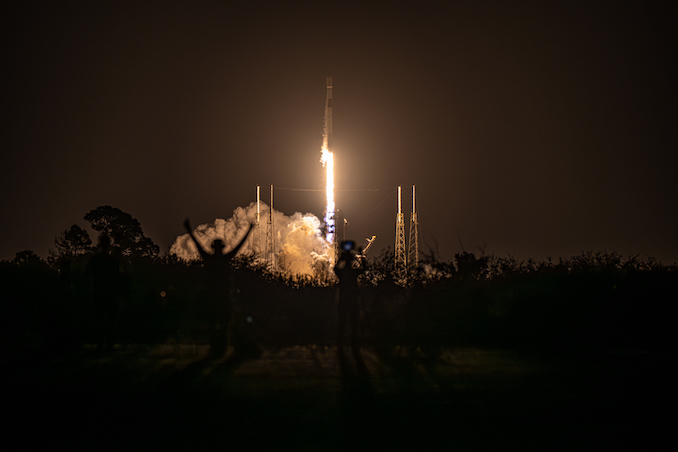
SpaceX’s Falcon 9 fleet has returned to full throttle after a brief grounding earlier in February. Over the past week alone, four Starlink missions launched successfully, including two historic milestones. On February 21, booster B1067 completed its 33rd flight—a new record for orbital-class rocket reuse—delivering 28 Starlink v2 Mini satellites from Cape Canaveral. The same booster previously flew four NASA missions and dozens of Starlink batches.
Just two days earlier, on February 19, booster B1077 made its 26th flight and achieved a rare feat: the second-ever Falcon 9 landing in Bahamian waters. The droneship Just Read the Instructions was stationed near Exuma Island, a location SpaceX says improves winter weather recovery options and allows for optimal southeast trajectories from Florida. The move follows a year-long understanding with the Bahamian government after environmental concerns arose from earlier Starship test flights.
With 23 Falcon 9 launches already completed in 2026, SpaceX is on track to meet or exceed its 2025 record of 165 Falcon family launches.
Other SpaceX News
SpaceX’s new space traffic management platform, Stargaze, is drawing industry attention for its novel approach to orbital safety. Using star tracker cameras on nearly 10,000 Starlink satellites, Stargaze collects nearly 30 million observations daily to track other objects in orbit. In a December 2025 incident, the system detected a last-minute maneuver by an unidentified spacecraft and enabled a Starlink satellite to avoid a potential collision that would have brought them within 60 meters.
As part of its rollout, SpaceX is requiring other satellite operators to share ephemeris data—information about their satellites’ positions and planned maneuvers—to participate in the system. The platform, currently in beta with over a dozen companies, will open to all operators in the spring at no charge.
On the International Space Station front, the SpaceX CRS-33 Dragon cargo spacecraft is scheduled to undock on February 26, 2026, at 17:00 UTC, ahead of its splashdown and recovery. While no Canadian astronauts are currently aboard, the mission supports ongoing research that includes Canadian scientific contributions through the Canadian Space Agency’s microgravity experiments.

Citations
- “Starbase Pad 2 prepares to receive Booster 19 ahead of Block 3 milestones” – https://www.nasaspaceflight.com/2026/02/starbase-pad-2-booster-19/
- “Launch Preview: Firefly to launch Alpha, SpaceX to launch three Starlink missions” – https://www.nasaspaceflight.com/2026/02/launch-preview-021626/
- “SpaceX unveils space traffic management system” – https://spacenews.com/spacexs-unveils-space-traffic-management-system/
- “SpaceX’s most-flown Falcon booster launches on record 33rd flight” – http://spaceflightnow.com/2026/02/21/live-coverage-spacexs-most-flown-falcon-booster-to-launch-on-record-33rd-flight/
- “SpaceX launches second Falcon 9 rocket to return to a landing in The Bahamas” – http://spaceflightnow.com/2026/02/19/live-coverage-spacex-to-launch-second-falcon-9-rocket-with-booster-landing-adjacent-to-the-bahamas/
Upcoming Starship Launches
Flight 12

Launch Provider: SpaceX – Commercial
Launch Date: March 31, 2026
Launch Time: 12:00 AM UTC
Vehicle: Starship
Brief: 12th test flight of the two-stage Starship launch vehicle. Maiden Flight of Starship V3
📽️ No Livestream scheduled yet
Flight 13
Launch Provider: SpaceX – Commercial
Launch Date: June 30, 2026
Launch Time: 12:00 AM UTC
Vehicle: Starship
Brief: 13th test flight of the two-stage Starship launch vehicle. Second flight of Starship V3
📽️ No Livestream scheduled yet
Superbird-9
Launch Provider: SpaceX – Commercial
Launch Date: June 30, 2027
Launch Time: 12:00 AM UTC
Vehicle: Starship
Brief: Superbird-9 is a high throughput communication satellite. It is designed to deliver broadcast and broadband missions in Ku band primarily over Japan and Eastern Asia, in response to mobility and broadband demands.
📽️ No Livestream scheduled yet
Starlab
Launch Provider: SpaceX – Commercial
Launch Date: December 31, 2029
Launch Time: 12:00 AM UTC
Vehicle: Starship
Brief: Private space station developed by a joint venture between Voyager Space and Airbus.
📽️ No Livestream scheduled yet
Upcoming Falcon Heavy Launches
ViaSat-3 F3 (ViaSat-3 Asia-Pacific)
Launch Provider: SpaceX – Commercial
Launch Date: June 30, 2026
Launch Time: 12:00 AM UTC
Vehicle: Falcon Heavy
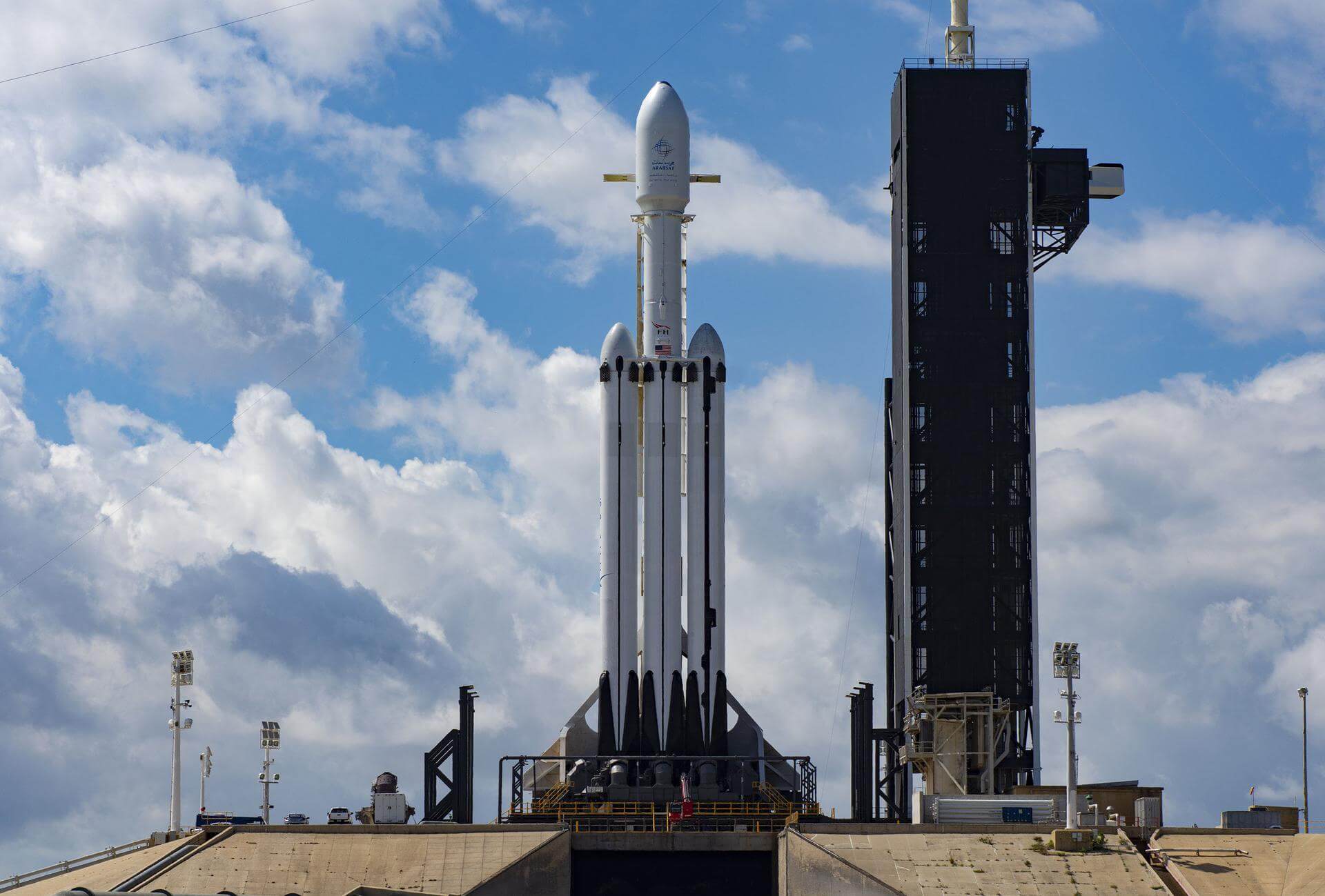
Brief: The ViaSat-3 is a series of three Ka-band satellites is expected to provide vastly superior capabilities in terms of service speed and flexibility for a satellite platform. Each ViaSat-3 class satellite is expected to deliver more than 1-Terabit per second of network capacity, and to leverage high levels of flexibility to dynamically direct capacity to where customers are located.
📽️ No Livestream scheduled yet
Griffin Mission One
Launch Provider: SpaceX – Commercial
Launch Date: July 31, 2026
Launch Time: 12:00 AM UTC
Vehicle: Falcon Heavy
Brief: Demonstration flight of the Astrobotic Griffin lander and its engines, initially contracted for the cancelled NASA VIPER (Volatiles Investigating Polar Exploration Rover) mission. The vacated payload spot will now host the FLIP (FLEX Lunar Innovation Platform) lunar rover from Astrolab.
📽️ No Livestream scheduled yet
Nancy Grace Roman Space Telescope
Launch Provider: SpaceX – Commercial
Launch Date: September 28, 2026
Launch Time: 12:00 AM UTC
Vehicle: Falcon Heavy
Brief: The Nancy Grace Roman Space Telescope is a NASA infrared space telescope with a 2.4 m (7.9 ft) wide field of view primary mirror and two scientific instruments. The Wide-Field Instrument (WFI) is a 300.8-megapixel multi-band visible and near-infrared camera, providing a sharpness of images comparable to that achieved by the Hubble Space Telescope over a 0.28 square degree field of view, 100 times larger than imaging cameras on the Hubble. The Coronagraphic Instrument (CGI) is a high-contrast, small field of view camera and spectrometer covering visible and near-infrared wavelengths using novel starlight-suppression technology. Roman objectives include a search for extra-solar planets using gravitational microlensing, and probing the expansion history of the Universe and the growth of cosmic structure, with the goal of measuring the effects of dark energy, the consistency of general relativity, and the curvature of spacetime.
📽️ No Livestream scheduled yet
USSF-70
Launch Provider: SpaceX – Commercial
Launch Date: December 31, 2026
Launch Time: 12:00 AM UTC
Vehicle: Falcon Heavy
Brief: Classified payload for the United States Space Force
📽️ No Livestream scheduled yet
USSF-75
Launch Provider: SpaceX – Commercial
Launch Date: December 31, 2026
Launch Time: 12:00 AM UTC
Vehicle: Falcon Heavy
Brief: Classified payload for the United States Space Force
📽️ No Livestream scheduled yet
