
The Daily Broadcast: From Earth to Orbit: New Missions, Mishaps, and Canadian Defence Ambitions

SMILE Mission Nears Launch After Atlantic Voyage
On February 20, 2026, the SMILE (Solar wind Magnetosphere Ionosphere Link Explorer) spacecraft is en route to Europe’s Spaceport in Kourou, French Guiana, following a carefully choreographed transatlantic journey. The joint mission between the European Space Agency (ESA) and the Chinese Academy of Sciences departed from ESA’s ESTEC facility in the Netherlands on February 11 and was loaded onto the cargo ship Colibri—the same vessel that transported the James Webb Space Telescope in 2021. After a brief stop in Saint-Nazaire, France, to pick up the Vega-C rocket’s upper stage, the ship is now crossing the Atlantic with 12 containers of hardware and four mission team members on board.
To protect the spacecraft’s sensitive instruments, its container is continuously flushed with nitrogen to eliminate moisture and contaminants. The team is also monitoring temperature, pressure, and humidity throughout the voyage. SMILE is scheduled to launch between April 8 and May 7, 2026, aboard a Vega-C rocket. Once in orbit, it will use X-ray and ultraviolet imagers, along with particle and magnetic field detectors, to study how Earth’s magnetosphere responds to solar wind—a crucial step in understanding space weather and its potential impacts on satellites and power grids. Final preparations at the spaceport will begin upon arrival, expected before the end of February.

Artemis II Wet Dress Rehearsal Succeeds—Lunar Launch Could Come in March
NASA’s Artemis II mission took a major step forward on February 19, 2026, with a successful second Wet Dress Rehearsal (WDR) at Kennedy Space Center’s Launch Complex 39B. The test, which simulates the full launch countdown and cryogenic fueling of the Space Launch System (SLS) rocket, concluded without the hydrogen leaks that plagued the first attempt earlier this month. By 2:41 p.m. EST, both the core stage and Interim Cryogenic Propulsion Stage were fully loaded with liquid hydrogen and oxygen, and the countdown rehearsal reached T-29 seconds—just as planned.
With this milestone complete, NASA is now positioned to launch Artemis II as early as March 6, 2026. The mission will carry four astronauts—NASA’s Reid Wiseman, Victor Glover, and Christina Koch, along with Canadian Space Agency astronaut Jeremy Hansen—on a 10-day journey around the Moon using a free-return trajectory. The crew will not land or enter lunar orbit, but the flight will be the first human mission beyond low Earth orbit since 1972. NASA will hold a press conference on February 20 to discuss the WDR results and may announce a formal launch date. If all goes well, Hansen will become the first Canadian to travel to deep space—a historic moment for Canada’s space programme.

Canada’s New Defence Industrial Strategy Targets Space Sovereignty
On February 20, 2026, Canada’s newly unveiled Defence Industrial Strategy (DIS) placed space front and centre as a “core strategic sovereign capability,” signaling a significant shift in how the nation approaches defence procurement and industrial policy. The strategy, backed by the Canada Strong 2025 Budget, aims to bolster domestic production capacity, reduce reliance on foreign suppliers, and ensure Canada can independently develop, deploy, and replenish critical space assets. This comes as global tensions highlight the vulnerability of space-based infrastructure to disruption or attack.
The DIS introduces key changes to the Industrial and Technological Benefits (ITB) policy, directing over $20 billion in outstanding obligations toward priority areas like space, quantum computing, and uncrewed systems. Notably, the government has earmarked $4.2 billion for Arctic surveillance and over-the-horizon radar, and aims to award 70% of defence contracts to Canadian firms. In response, MDA Space has launched a new subsidiary, 49North, focused on multi-domain C4ISR (Command, Control, Communications, Computers, Intelligence, Surveillance and Reconnaissance) systems. Meanwhile, the Department of National Defence has issued a $50 million challenge to establish secure innovation hubs for quantum and drone technologies. While the DIS doesn’t guarantee success, it represents a long-overdue recognition that sovereignty in space requires sovereign industrial capacity.

Citations
- “Smile sets sail for Europe’s Spaceport in French Guiana” – https://www.esa.int/Science_Exploration/Space_Science/Smile/Smile_sets_sail_for_Europes_Spaceport_in_French_Guiana
- “Artemis II Could Launch As Soon as March Following Successful WDR” – https://spacepolicyonline.com/news/artemis-ii-could-launch-as-soon-as-march-following-successful-wdr/
- “A strategy of consequence: Canada’s new Defence Industrial Strategy must deliver in space” – https://spaceq.ca/a-strategy-of-consequence-canadas-new-defence-industrial-strategy-must-deliver-in-space/
Upcoming Launches
Starlink Group 10-36

Launch Provider: SpaceX – Commercial
Launch Date: February 20, 2026
Launch Time: 1:41 AM UTC
Vehicle: Falcon 9
Brief: A batch of 29 satellites for the Starlink mega-constellation – SpaceX’s project for space-based Internet communication system.
First Starlink launch to feature a Falcon 9 booster landing within The Bahamas waters operationally, after the trajectory was tested during launch of Starlink Group 10-12 in February 2025.
Starlink Group 17-25
Launch Provider: SpaceX – Commercial
Launch Date: February 21, 2026
Launch Time: 8:00 AM UTC
Vehicle: Falcon 9
Brief: A batch of 25 satellites for the Starlink mega-constellation – SpaceX’s project for space-based Internet communication system.
Starlink Group 6-104
Launch Provider: SpaceX – Commercial
Launch Date: February 22, 2026
Launch Time: 2:04 AM UTC
Vehicle: Falcon 9
Brief: A batch of 28 satellites for the Starlink mega-constellation – SpaceX’s project for space-based Internet communication system.
Starlink Group 17-26
Launch Provider: SpaceX – Commercial
Launch Date: February 24, 2026
Launch Time: 2:00 PM UTC
Vehicle: Falcon 9
Brief: A batch of 25 satellites for the Starlink mega-constellation – SpaceX’s project for space-based Internet communication system.
That’s Not A Knife (DART AE)
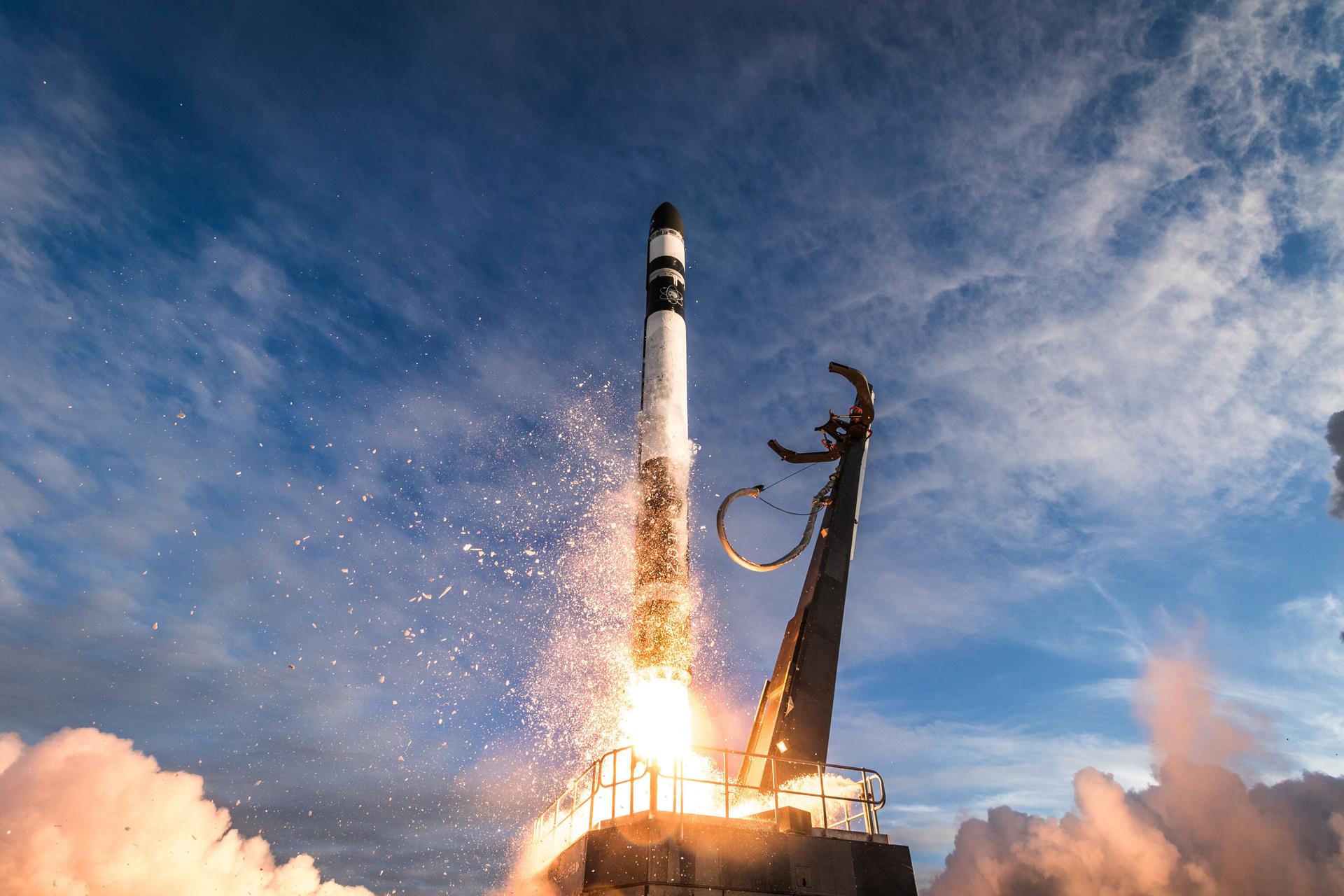
Launch Provider: Rocket Lab – Commercial
Launch Date: February 24, 2026
Launch Time: 8:00 PM UTC
Vehicle: Electron
Brief: Payload is a scramjet-powered hypersonic vehicle developed by by Australian company Hypersonix.
📽️ No Livestream scheduled yet
