
Rocket Lab Roundup: Electron Doubles Down in January as Neutron Navigates Growing Pains
Building Beyond the Rocket
While Rocket Lab’s Electron rocket stole headlines with back-to-back launches, the company’s Space Systems division quietly expanded its footprint in national security and satellite infrastructure. On February 10, Rocket Lab announced it had officially kicked off work on Tracking Layer Tranche 3 of the U.S. Space Development Agency’s Proliferated Warfighter Space Architecture, in partnership with Semper Citius. The program aims to deliver next-generation missile warning and tracking capabilities—a critical component of modern defence infrastructure that Canadian allies closely monitor given shared NORAD commitments.
Though Rocket Lab is a U.S.-listed company with strong American and New Zealand ties, its space systems work resonates in Canada through interoperability with allied defence networks. The company’s components have already enabled more than 1,700 missions, including those supporting GPS and global security architecture—an ecosystem in which Canada is an active participant.
Adding to its 2025 momentum, Rocket Lab also reported that its satellite separation systems successfully deployed over 100 spacecraft last year, smashing its previous record of 64. That 100% mission success rate for such critical hardware underscores the reliability commercial and government clients—including potential Canadian partners—can expect from Rocket Lab’s end-to-end space solutions.

Double Duty in January
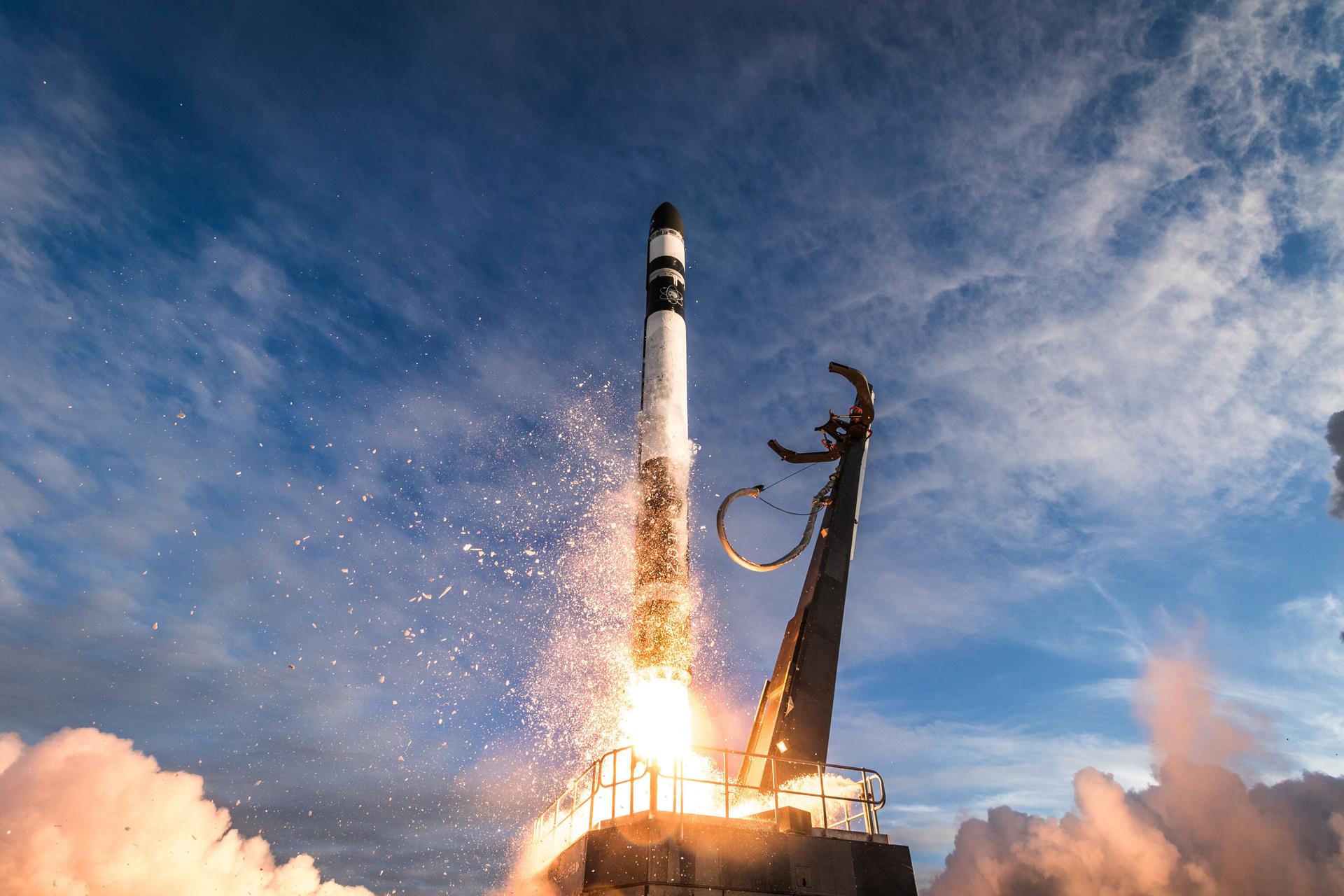
January 2026 was a busy month for Rocket Lab’s launch manifest, with two successful Electron missions from Launch Complex 1 in New Zealand—marking the company’s 80th and 81st flights overall.
On January 22, Electron lifted off on its first mission of the year: “The Cosmos Will See You Now.” This dedicated flight carried two satellites for Open Cosmos, a European space company building a constellation using spectrum previously allocated to Rivada Space Networks. The satellites were deployed into a 1,050 km low Earth orbit, a higher altitude than typical for smallsats, demonstrating Electron’s versatility. The mission kicked off Rocket Lab’s 2026 launch cadence with a 100% success rate—something CEO Peter Beck noted with satisfaction on social media.

Just eight days later, on January 30 at 2:21 p.m. NZDT (01:21 UTC), Electron returned to the pad for its 81st mission, “Bridging The Swarm.” This flight carried the NEONSAT-1A Earth-imaging satellite for the Korea Advanced Institute of Science and Technology (KAIST). The satellite will test technologies for South Korea’s future NEONSAT constellation, which is designed to monitor natural disasters and national security events on the Korean Peninsula. This mission followed up on 2024’s “Beginning of The Swarm,” which launched the first NEONSAT prototype.
“Two launches in eight days is a strong start to the year that speaks volumes about the demand for Electron and the excellence and dedication of the Rocket Lab team,” said Sir Peter Beck, underscoring the company’s push for responsive, high-cadence launch services.

Neutron’s Bumps and Breakthroughs
While Electron maintained its reliability, Rocket Lab’s next-generation Neutron rocket experienced both progress and setbacks this month. On January 21, a Stage 1 tank ruptured during hydrostatic pressure testing—a planned “test to failure” that revealed structural limits but caused no damage to facilities. Rocket Lab emphasized that such failures are common during qualification and that the next tank is already in production.
On a more positive note, the innovative “Hungry Hippo” fairing—so named for its ability to open and close like a mouth—arrived at Launch Complex 3 in Wallops Island, Virginia, on January 26. This world-first reusable fairing remains attached to the rocket throughout flight, streamlining operations and enabling rapid reuse. The fairing’s arrival marks a tangible step toward Neutron’s debut, though the recent test issue may affect the launch timeline. An update is expected during Rocket Lab’s Q4 2025 earnings call in February.

Additional Updates
While not involving Canadian entities directly, it’s worth noting that Rocket Lab’s ESCAPADE mission—twin spacecraft en route to Mars—has successfully reached the Earth–Sun L2 Lagrange point and is now in interplanetary cruise mode. The mission, developed for NASA and the University of California, Berkeley, recently won an Astro Award for its cost-effective approach to interplanetary exploration. Though Canada isn’t a partner on this specific mission, the success of such agile, affordable deep-space missions could influence future Canadian planetary science initiatives, particularly as the Canadian Space Agency explores Mars and lunar collaborations.

Citations
- “Mission Success: Rocket Lab Launches Korean Earth-Imaging Satellite, Completes 2nd Launch in 8 Days” – https://rocketlabcorp.com/updates/mission-success-rocket-lab-launches-korean-earth-imaging-satellite-completes-2nd-launch-in-8-days/
- “Rocket Lab’s Hungry Hippo Fairing Arrives at Virginia Launch Site Ahead of First Neutron Flight” – https://rocketlabcorp.com/updates/new-blog-post-27/
- “Rocket Lab Neutron Test Update” – https://rocketlabcorp.com/updates/rocket-lab-neutron-test-update/
- “Rocket Lab launches first satellites for Open Cosmos constellation” – https://spacenews.com/rocket-lab-launches-first-satellites-for-open-cosmos-constellation/
- “Rocket Lab suffers Neutron testing setback” – https://spacenews.com/rocket-lab-suffers-neutron-testing-setback/
- Tweet from Rocket Lab, February 10, 2026 – https://x.com/RocketLab/status/2021311859551613155
- Tweet from Rocket Lab, February 4, 2026 – https://x.com/RocketLab/status/2019141123701387305
- Tweet from Rocket Lab, January 19, 2026 – https://x.com/RocketLab/status/2013387646207164509
Upcoming Rocket Lab Launches
LOXSAT 1
Launch Provider: Rocket Lab – Commercial
Launch Date: March 31, 2026
Launch Time: 12:00 AM UTC
Vehicle: Electron
Brief: LOXSAT 1 is a demonstration satellite of a complete cryogenic oxygen fluid management system in orbit, developed by Eta Space and sponsored by NASA’s Tipping Point program.
The system will be integrated on a Rocket Lab Photon-LEO satellite bus and collect critical cryogenic fluid management data in orbit for 9 months, demonstrating capabilities of in-space cryogenic storage and transferal. Eta Space plans to use technology developed for this mission to develop a truly commercial depot intended to serve multiple customers in the future.
Daughter Of The Stars (LEO-PNT Pathfinder A)
Launch Provider: Rocket Lab – Commercial
Launch Date: March 31, 2026
Launch Time: 12:00 AM UTC
Vehicle: Electron
Brief: The European Space Agency (ESA)’s LEO-PNT (Low Earth Orbit Positioning, Navigation and Timing) demonstrator mission will feature a 10-satellite constellation demonstration mission that will assess how a low Earth orbit fleet of satellites can work in combination with the Galileo and EGNOS constellations in higher orbits that provide Europe’s own global navigation system.
This launch will lift 2 “Pathfinder A” satellites built by Thales Alenia Space and GMV to a 510 km altitude Low Earth Orbit.
Kakushin Rising (JAXA Rideshare)
Launch Provider: Rocket Lab – Commercial
Launch Date: March 31, 2026
Launch Time: 12:00 AM UTC
Vehicle: Electron
Brief: JAXA-manifested rideshare of eight separate spacecraft that includes educational small sats, an ocean monitoring satellite, a demonstration satellite for ultra-small multispectral cameras, and a deployable antenna that can be packed tightly using origami folding techniques and unfurled to 25 times its size.
The satellites were originally planned to launch with RAISE-4 on a Japanese Epsilon-S rocket, but the Epsilon-S was heavily delayed due to test firing failures.
The 8 satellites are:
* MAGNARO-II
* KOSEN-2R
* WASEDA-SAT-ZERO-II
* FSI-SAT2
* OrigamiSat-2
* Mono-Nikko
* ARICA-2
* PRELUDE
